Ethena’s USDe Loses Trust After 40% Supply Drop — What Comes Next?
Summary
Market snapshot: a sudden contraction in USDe supply
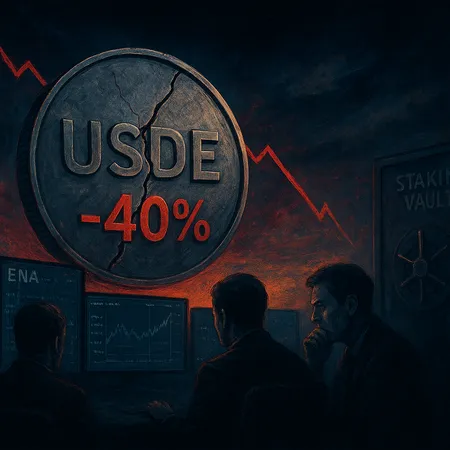
Ethena’s algorithmic stablecoin USDe saw its circulating supply fall by 40% as traders grew cautious and yields declined across the protocol. The drop reflects a rapid reassessment of risk-reward for liquidity providers and stakers, with many pulling capital to avoid compressed returns or potential peg stress. This contraction has amplified market instability — smaller liquidity pools mean wider moves when large holders shift positions.
Why funding rates and staking yields matter right now
Funding rates and staking returns are the primary incentives keeping capital committed to algorithmic stablecoins and related DeFi strategies. As funding rates declined, staking APYs fell below levels that justify the operational and smart-contract risk many users accept. That combination — lower rewards and unchanged perceived risk — encouraged cautious traders to de-risk, reducing USDe demand and creating a feedback loop that pressured supply and confidence.
Macro catalysts that could restore demand
Two main macro developments could reverse the trend: a clear path to Fed rate cuts and a credible government resolution addressing regulatory or fiscal uncertainty. Lower policy rates typically reduce yields on short-term cash alternatives, making DeFi yields relatively more attractive again. Similarly, a government statement or resolution that calms markets would likely push investors back into risk-on allocations, increasing appetite for protocol-native assets like ENA and the stablecoin USDe.
Practical signs to watch on-chain and in markets
Traders and builders should monitor a few actionable indicators: funding-rate trends on derivatives venues, redemption liquidity on USDe pools, net flows to staking contracts, and top-holder movement for ENA/USDE. A stabilization in funding rates or renewed inflows to staking contracts would be an early sign of returning confidence. Also track correlated DeFi metrics such as TVL and lending utilization that often precede broader demand shifts.
Implications for traders, protocols and platforms
Short term, expect heightened volatility and selective de-risking: liquidity providers may favor established pools, and market makers could widen spreads. Longer-term recovery depends more on macro context and protocol-level adjustments to incentives. Platforms like Bitlet.app that offer diversified crypto services may see changes in user behavior as investors hunt for safer yield alternatives or diversify across on- and off-chain instruments.
Bottom line
Ethena’s USDe faces a confidence gap after a 40% supply contraction driven by low yields and falling funding rates. Recovery is possible but conditional — watch for Fed policy shifts, any government clarity, and on-chain signals such as funding-rate normalization and renewed inflows. For market participants, prudence and active monitoring of liquidity and staking metrics remain essential as the situation evolves in the broader crypto market.