Metaplanet’s Plan to Hold 210,000 BTC by 2027: Feasible Ambition or Strategic Mirage?
Summary
The headline and the obvious mismatch
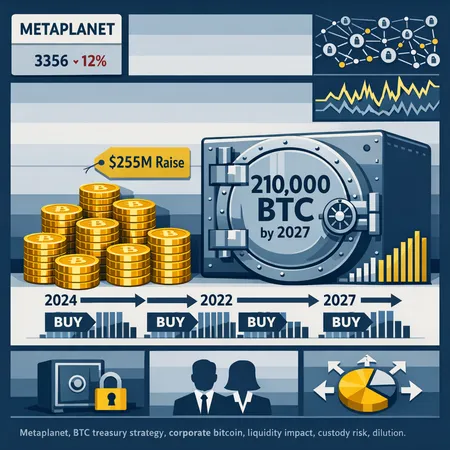
Metaplanet’s recent disclosure — a $255 million raise paired with an ambition to hold 210,000 BTC by 2027 — was always going to turn heads. The company’s announcement and subsequent reporting captured attention because the stated goal implies holding a material fraction of Bitcoin’s circulating supply, which has real market and execution consequences (AmbCrypto report on the raise).
A simple read of the headlines left investors asking: where will the capital come from, how fast will purchases happen, and what happens to float and share value if Metaplanet needs to dilute equity to fund buys? Those questions — and the math behind them — help explain why the stock fell about 12% after the announcement.
How big is 210,000 BTC in dollars? The rough math
Before we discuss market mechanics, put the target into dollar terms with a few illustrative price scenarios (price P = BTC spot price):
- 210,000 BTC × $50,000 = $10.5 billion
- 210,000 BTC × $70,000 = $14.7 billion
- 210,000 BTC × $100,000 = $21.0 billion
Metaplanet’s $255M raise is meaningful capital, but it is orders of magnitude smaller than even the lowest-dollar scenario above. To reach 210,000 BTC by 2027 the company would either need:
- access to very large, recurring financing (equity or debt),
- partnerships or custodial arrangements that substitute for outright ownership, or
- to employ derivatives or leverage (carry and financing risk), which introduce counterparty and liquidation risk.
All three paths materially change the risk profile for shareholders and for the strategy’s credibility.
Cadence modeling: monthly and daily purchase requirements
Assume a 4-year window to the end of 2027 (≈ 48 months). That gives simple cadence numbers: 210,000 BTC / 48 ≈ 4,375 BTC per month, or roughly 52,500 BTC per year.
Capital required per month for different price scenarios (approx.):
- At $50k: 4,375 × $50,000 ≈ $218.8M/month
- At $70k: 4,375 × $70,000 ≈ $306.3M/month
- At $100k: 4,375 × $100,000 ≈ $437.5M/month
If Metaplanet wanted to front-load (for example, buy 25% of the total in year one), monthly needs would spike further. Those figures show why a $255M raise is vastly insufficient as a standalone funding vehicle.
Alternative cadence levers
Metaplanet could soften market impact by:
- Using OTC desks and block trades to avoid on-exchange slippage,
- Entering bilateral swaps or notes (synthetic exposure) instead of spot purchases,
- Partnering with custodians or forming joint-venture pooling arrangements.
Each approach reduces immediate price pressure but introduces counterparty, leverage, or transparency trade-offs.
Liquidity impact and price dynamics: how buying at scale moves markets
Several levers determine the market impact of a large buyer: purchase cadence, choice of venues (OTC vs exchange), prevailing liquidity (order-book depth), and other large flows (like ETF inflows). Recent reporting shows institutional flows and long-term holder conviction have been tightening available supply, while ETFs and other vehicles continue to influence distribution (AmbCrypto on supply tightening and ETF inflows).
A simple way to think about impact is to compare required trade size to market Average Daily Volume (ADV) and to model slippage conservatively. Market-impact often scales non-linearly: executing a block several times ADV leads to outsized slippage. Example stylized relationships are used by desks: impact ≈ k × (size/ADV)^0.5 (square-root model), where k is a liquidity coefficient depending on venue and volatility.
Illustrative scenario (not a prediction):
- If a monthly buy is 4,375 BTC and average daily BTC volume is 100,000 BTC, the daily portion of an evenly distributed cadence is small — low immediate slippage.
- But if Metaplanet elects or is forced to buy 20,000+ BTC on a single day via exchanges, the trade size relative to ADV spikes and price impact and slippage can be significant.
Practical implication: sustained, well-structured OTC/algorithmic execution reduces market shock, but at scale even OTC liquidity providers charge meaningful premia. Over time, concentrated institutional accumulation reduces available free float, which can make the remaining market more sensitive to news and amplify volatility.
Why the market punished Metaplanet’s shares (the 12% drop)
A headline target without an explicit funding and execution roadmap creates multiple investor concerns:
- Funding gap and dilution risk: $255M doesn’t fund billions of dollars of purchases. Investors rationally price in the probability of share issuance or other dilutive raises.
- Execution credibility: buying at scale requires desk relationships, custodial certainty, and a legal/compliance playbook. Skepticism about those capabilities lowers valuation.
- Signaling and governance: ambitious targets can look like marketing rhetoric if not tied to concrete levers (debt facilities, forward contracts, JV agreements) — that weakens trust.
- Legal, regulatory and counterparty risk: investors discount the plan to reflect custody, AML/KYC friction, and potential for regulatory review.
Taken together, the market’s reaction likely reflected a re-evaluation of future free cash flow, higher perceived risk, and expected dilution — not merely a knee-jerk response to crypto price exposure.
Custody, regulatory and counterparty considerations
Large corporate bitcoin treasuries are not the same as retail holdings. Key areas to watch:
- Custody model and insurance scope: who holds the private keys, what insurance (if any) exists, how broad are the covered loss scenarios?
- Counterparty concentration: OTC desks, prime brokers, and derivative counterparties bring counterparty credit risk and potential systemic links.
- Regulatory visibility: authorities scrutinize large off-chain flows and treasury conversions. Corporate treasury holdings may invite different disclosure, tax, and compliance obligations.
- Liquidation and margin risk: if Metaplanet uses leverage or derivatives to accelerate accumulation, margin calls could force sales at adverse prices.
Investors should ask for named custodians, insurance details, segregation terms, and scenario planning for forced exits or insolvency of a counterparty.
What this means for investors and crypto asset managers
If you’re a value investor or an asset manager considering corporate-BTC treasury stories, focus on the following checklist:
- Funding plan clarity: look for explicit commitments (credit facilities, committed equity raises, partner capital) rather than aspirational targets.
- Dilution pathway: understand the mechanisms and potential share issuance magnitude that would fund BTC buys.
- Execution partners and process: who are the OTC desks, custodians, and prime brokers? Are there pre-negotiated block-purchase agreements?
- On-chain & exchange signals: watch exchange reserves, large withdrawals, and on-chain concentration metrics as early indicators of actual accumulation.
- Stress scenarios: evaluate downside where BTC falls sharply, counterparties fail, or regulatory actions limit usage.
Bitlet.app users and other market participants will also want to monitor on-chain metrics and trading flows to detect credible accumulation early.
Modeling scenarios (compact appendix)
Below are three compact scenarios illustrating what meeting 210,000 BTC implies. All assume a 48-month horizon.
Conservative (no dilution; only internal capital and modest recurring revenue):
- Monthly BTC needed: 4,375
- Capital/month at $70k: ~$306M
- Implied total capital: ~$14.7B — unrealistic without external financing.
Mixed financing (partial equity raises, OTC block buys, partner capital):
- Assume 50% funded by external raises and 50% by structured instruments over 48 months.
- Equity raises create dilution; debt/derivatives create leverage and margin risk. Execution feasible only with reliable counterparties and pre-negotiated terms.
Synthetic/derivative-heavy (use swaps, forwards, or tokenized exposure):
- Spot footprint smaller; synthetic exposure achieves headline crypto exposure while reducing immediate spot buying.
- Counterparty and basis risk increase; regulatory complexity and disclosure requirements rise.
None of these scenarios are free of trade-offs. Real-world execution is likely to be a blend, and every blend introduces a new layer of risk for shareholders.
Final takeaways
Metaplanet’s 210,000 BTC ambition is attention-grabbing — and strategically provocative. However, the announced $255M raise is not remotely sufficient by itself to buy that amount of bitcoin. Investors should demand clarity on funding sources, execution partners, custody insurance, and the mechanics of any synthetic exposures.
Concentrated accumulation at scale tightens float and can amplify volatility; good execution and OTC structuring mitigate price shock but increase counterparty and transparency risks. The 12% stock decline reflects market skepticism about funding, dilution, and the credibility of a near-term buy program — a healthy reminder that crypto treasury strategies live at the intersection of finance, operations, and regulation.
For investors and asset managers, the right questions are practical: show me the custodial contract, the financing timetable, the counterparties, and the plan for downside scenarios. If those answers are absent, discount the bullish headline and price in execution risk.
Sources
- AmbCrypto — Metaplanet $255M raise and 210k BTC goal: https://ambcrypto.com/metaplanets-255m-raise-fuels-plan-to-hold-210k-btc-by-2027/
- AmbCrypto — Bitcoin supply tightening and ETF inflows context: https://ambcrypto.com/bitcoin-near-76k-lths-hold-tight-btc-etfs-add-almost-1b-what-changed/