March 2026: How ETF Inflows and Large-Scale Accumulation Are Tightening Bitcoin Supply
Summary
March 2026: the institutional bid revisited
March opened with a clear theme: institutions are back, and they're buying in ways that matter for market structure. Spot ETF inflows, large‑scale on‑chain accumulation and tactical supply buys—like the strategy that purchased several weeks of new issuance in concentrated batches—are collectively taking coins out of the tradable pool and tightening liquidity. For many market participants, Bitcoin is again behaving less like a highly liquid spot and more like an asset with periodic squeezes where demand outstrips available sell‑side inventory.
Price moves alone can be noisy. What differentiates March 2026 is the combination of how institutions are sourcing BTC, where those coins end up (custodial versus exchange addresses), and how quickly tradable inventory is shrinking. CryptoSlate reported institutional accumulation and ETF inflows as a significant driver behind BTC reclaiming the $75k area, and multiple outlets noted ETF funds adding near‑billion dollar flows in recent weeks—flows large enough to affect price when matched against constrained supply (CryptoSlate; AMBCrypto).
How spot ETF inflows remove supply and move prices
ETF inflows are mechanically different from retail buys on exchanges. When investors purchase shares of a spot Bitcoin ETF, the fund issuer either buys BTC in the spot market or takes possession via authorized participants (APs) that create shares by delivering BTC to a custodian. Those coins are then typically held in cold storage under institutional custody. The net effect: demand that goes into an ETF often results in coins being moved off exchanges and into custody, reducing the available float for traders.
Two aspects matter most for price impact:
Concentration and speed. Large, concentrated buys—whether executed by APs for ETF creation or by institutional buyers through OTC desks—create temporary order‑book pressure. If those buys outpace liquidity at incremental price levels, the market reprices. CryptoSlate and AMB Crypto documented how steady ETF inflows coincided with price reclaiming higher levels in March.
Persistence. ETF holdings are sticky. Unlike a retail purchaser who might sell during a pullback, ETFs are designed to hold; that removes the coins from rotation and dampens natural sell pressure. Over weeks and months that stickiness compounds into a structural reduction in tradable supply.
Large-scale accumulation and tactical supply buys: the Strategy effect
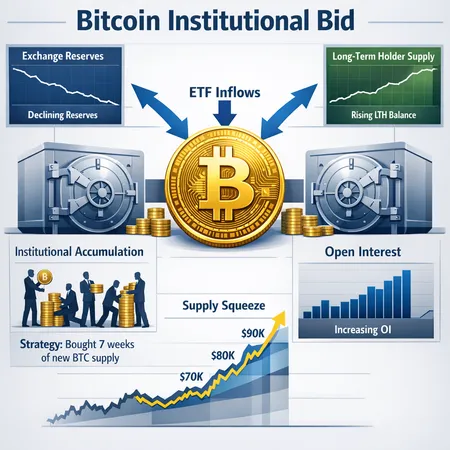
Recent headlines highlighted a concrete tactic: funds or strategies that aggressively buy several weeks' worth of newly issued BTC in a narrow window. Cointelegraph covered an example where a strategy purchased seven weeks of new supply at once—an intentional supply‑sourcing technique that front‑loads purchases to secure inventory before prices move higher.
Why this matters: miners and regular sellers introduce a roughly steady stream of supply (miner rewards, exchange outflows from profit‑taking). If an institution pre‑emptively purchases what would otherwise be sold into the market, that supply never reaches exchanges. The result is a simple inventory math problem: the flow of coins into custody > flow of coins available to trade → shortage of immediate sell liquidity, which amplifies price moves when additional buyers step in.
Which on‑chain metrics actually signal a genuine supply squeeze
Not every green candle signals structural change. Below are the on‑chain metrics that matter most for distinguishing a transient rally from a durable supply squeeze:
Exchange reserves (exchange wallet balances). A sustained decline in exchange balances—particularly on major custodial exchanges—means fewer coins available to satisfy market orders. Watch for weeks‑long declines rather than one‑day drops.
Long‑Term Holder (LTH) cohort behavior. LTHs accumulating and not moving balances into exchange wallets indicate that the supply is being locked up. AMBCrypto noted LTHs were holding tight as ETF inflows increased—an important corroboration of reduced net supply.
Flow into institutional custody addresses. Transfers to known custodian on‑chain addresses (and subsequent dormancy) show ETF buys and institutional custody in action. These are often visible as large, labeled transfers on chain analytics platforms.
Open interest and derivatives positioning. If open interest in perpetual swaps and futures remains elevated while exchange reserves fall, the market has leveraged speculation sitting on a reduced cash‑market float—this increases the odds of sharp moves and squeezes when funding rates spike.
Funding rates and basis. Persistent positive funding and a spot‑future premium imply demand for long exposure that isn't being satisfied in the spot pool.
Look for convergence across these metrics. A drop in exchange reserves + visible transfers to custodians + rising ETF AUM and persistent positive funding is the cocktail that historically precedes durable rallies.
How institutions are sourcing and custodying large amounts of BTC
Institutions typically source BTC through a mix of channels—OTC desks, authorized participants purchasing on behalf of ETFs, and direct bilateral block trades with miners or large holders. Execution choice depends on size, urgency and the desire to minimize market impact.
Once acquired, custody matters. Institutional custodians (regulated custodial entities, insured cold storage providers) and dedicated omnibus addresses for ETFs are designed to keep coins out of the tradable supply. Because these custodians segregate assets and often maintain conservative withdrawal procedures, coins sitting in custody are effectively immobile for trading purposes, even if they remain on‑chain.
The net effect for markets: when institutions source at scale and immediately move coins into custody, the tradable float shrinks. Retail platforms and services—ranging from exchanges to installment platforms like Bitlet.app—operate on a different timescale and liquidity profile; institutional custody is simply less available to satisfy near‑term market orders.
Price‑path scenarios if current flows persist
No model predicts prices with certainty, but thinking in terms of scenarios helps frame risk and reward. Below are three plausible paths over the next 3–12 months if ETF inflows and strategic accumulation continue at or near current pace.
Bear/Mean‑reversion (20–30% probability): ETF flows slow or reverse, exchange balances stop declining, and derivatives deleveraging triggers buyers to step back. In this case, BTC could retrace to recent structural support levels as liquidity returns—this might look like a pullback into the $50k–$65k range depending on macro conditions.
Base continuation (50–60% probability): ETF inflows continue at a steady clip, large holders and LTH cohorts remain dormant, and custodial balances grow while exchange reserves fall. Momentum carries prices through previous highs; a realistic target band in this scenario is $95k–$130k within 3–9 months as buying pressure compounds with tighter supply. Data coverage from ETF flows and commentary in CryptoSlate and AMBCrypto support the plausibility of sustained accumulation pushing prices higher.
Accelerated bull/supply squeeze (10–25% probability): ETF inflows accelerate, multiple strategies front‑load several weeks of issuance simultaneously, and derivatives positioning is net long with rising open interest. This is when a true squeeze can form—thin order books, fierce buy‑side urgency, and rapid rallies. In such an environment, BTC could overshoot traditional targets and test $150k–$200k within months, though volatility and swift corrections remain likely.
These bands are illustrative, not prescriptive. The key takeaway: sustained, sticky demand that removes tradable coins materially raises the probability of higher price targets, but it also increases the risk of violent intra‑move drawdowns if leveraged positions unwind.
Tactical positioning and risk management for institutions and advanced retail
If you accept that the supply picture is tighter, how do you position? Consider these practical guidelines:
Size to conviction and liquidity needs. Institutions should size allocation with an eye toward how long custodyed coins cannot be liquidated without market impact. Advanced retail should avoid concentrated positions that require quick exits.
Use layered entries. Dollar‑cost averaging or time‑sliced block purchases reduce impact and lower average cost in volatile markets.
Hedge selectively. Options structures (protective collars, put spreads) let you retain upside while limiting downside if the flow dynamic shifts.
Watch the signal suite. Establish watch thresholds for exchange reserves, flows into custody, and derivatives open interest. For example: an X% week‑over‑week drop in exchange reserves combined with a Y% increase in ETF AUM could be your trigger to scale exposure.
Avoid overleveraging in futures. A supply squeeze can create sharp moves that wipe out leveraged long positions quickly if funding or liquidations cascade.
What to monitor in real time
Keep a small, reliable dashboard: exchange reserves, ETF AUM updates, identified custodian inflows, LTH balance changes, open interest, and funding rates. Correlation among these metrics is more informative than any single data point. When analysts cited the role of ETFs reclaiming price levels around $75k, it was the alignment of flows and on‑chain dormancy that made the move meaningful (CryptoSlate; AMBCrypto).
Final thoughts
March 2026 is a reminder that structure matters: it’s not just headline buyers, but the mechanics of how they buy, custody and hold. ETF inflows can be transformative because they convert flow into long‑term custody, and tactical strategies that front‑load supply only accelerate that conversion. For institutional and advanced retail investors, the current evidence supports a higher probability of an extended bull case than a purely retail‑driven froth—provided inflows persist. Position with respect to liquidity needs, use hedges to protect downside, and keep a compact set of on‑chain and derivatives metrics at hand.
Sources