Why Ethereum and the XRP Ledger Are Leading Real-World Asset Tokenization for Institutions
Summary
Executive summary
Tokenizing real-world assets (RWA tokenization) is no longer a thought experiment. Institutions are building issuance, custody, and secondary market plumbing that link legal claims to on-chain tokens. Two ledgers repeatedly surface in these conversations: Ethereum — for programmability and DeFi composability — and the XRP Ledger (XRPL) — for low-cost, high-throughput settlement and native issued-currency capabilities. This guide explains why each chain is attractive to institutional issuers, the custody and settlement trade-offs, how staking and ETF/staking products like BlackRock’s ETHB interact with demand, and a practical pilot checklist for legal and product teams.
Why RWA tokenization matters now
Tokenized RWAs — from tokenized bonds and real estate shares to invoices and commodity receipts — promise several concrete benefits to institutions:
- 24/7 settlement and faster finality, reducing intraday liquidity needs.
- Fractionalization and broader investor access, enabling new pools of capital.
- Programmability, so coupons, covenants, and corporate actions can be partially automated.
- Composability with DeFi primitives, enabling yield overlay or repo-like markets.
These are not hypothetical: recent industry coverage highlights accelerating RWA projects on Ethereum and the XRPL, showing growing institutional interest across both rails (NewsBTC overview of RWA builds).
Why Ethereum and XRPL are front-runners
Ethereum and XRPL approach the problem from different starting points — and those differences map to institutional priorities.
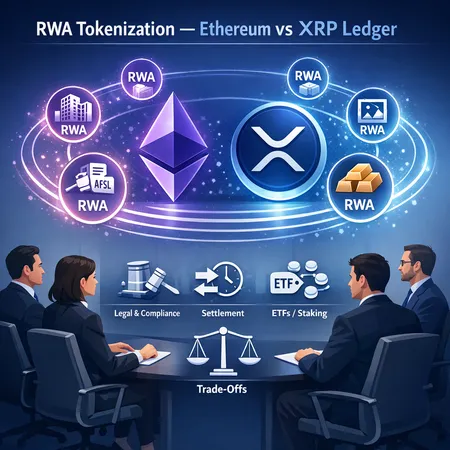
Ethereum: has the richest smart-contract ecosystem and a vast array of security-token and permissioned-token frameworks (ERC-20, ERC-1400-like conventions, tokenized real-world asset registries). That ecosystem supports complex on-chain compliance, programmable workflows, and integration with DeFi liquidity pools and custody providers. For many institutions, the path to composability is a major draw — and it’s why platforms and custodians are investing heavily in Ethereum tooling (see also how staking products create on-chain demand below).
XRP Ledger (XRPL): offers native issued currencies (IOUs), deterministic settlement finality within seconds, extremely low transaction costs, and a simplified issuance model that appeals to payments-oriented and high-throughput RWA use cases. XRPL's design reduces gas-cost unpredictability and opens straightforward rails for issuing and redeeming tokenized assets.
Both rails attract issuers for different reasons; your choice should be driven by the asset type, required programmability, settlement risk tolerance, and integration with existing custody and accounting systems.
Technical comparison: smart contracts, token standards, and finality
Consensus and finality
Ethereum (ETH) runs on a Proof-of-Stake architecture with probabilistic block finality and increasing tooling for fast finality via Layer 2s and settlement bridges. Finality is robust for most institutional workflows, but gas fees and network congestion remain operational concerns unless L2s or private permissioned chains are used.
XRPL (XRP) uses a federated consensus model with deterministic finality in seconds. That predictable finality and low fee structure make XRPL attractive for high-frequency settlement or custody reconciliations where millisecond-to-second certainty matters.
Token standards and programmability
Ethereum: rich token standards (ERC-20, ERC-721, ERC-1400/3643 for regulated securities) and composable DeFi stacks. Complex business logic, on-chain compliance hooks (e.g., allowlists, transfer restrictions), and integrated oracles are straightforward to implement via smart contracts.
XRPL: issues tokens as native IOUs with escrow and metadata support. XRPL lacks Ethereum-style Turing-complete smart contracts in the same way, but its issuance model is simpler and can be combined with off-chain legal agreements and an on-ledger reference to those agreements.
How that maps to asset types
- Use Ethereum for assets requiring complex automated workflows (structured products, conditional payouts, on-chain corporate actions) or where composability with DeFi is a core part of the value proposition.
- Use XRPL when predictable settlement, low fees, and high throughput are the priority — e.g., tokenized payments, invoice financing with high transaction volumes, or cross-border tokenized fiat rail pilots.
Regulatory and legal differences: compliance is the gating factor
Regulatory compliance is often the primary blocker for institutional issuance. Key questions for legal teams:
- Is the token a security under local law? If yes, what securities laws and prospectus obligations apply?
- Are transfer restrictions required (e.g., accredited investor filters, jurisdictional blocks)?
- Which custody and custody-reporting regimes apply (trust company, regulated custodian, bank)?
Ethereum’s programmability helps embed compliance directly into tokens (allowlists, transfer hooks, and KYC attestations). XRPL’s simpler issuance model can be paired with robust off-chain legal wrappers and operator-controlled flows that satisfy regulators. Both approaches demand clear legal documentation mapping the off-chain claim to the on-chain token.
Regional licensing matters. For example, Ripple’s work on regional licenses such as an Australian Financial Services Licence (AFSL) affects how XRPL-based issuances might be offered to Australian institutional clients via locally authorized intermediaries — a reminder that legal licensing and local market structure drive adoption as much as technology.
Custody, staking, and settlement implications
Custody
Institutions require regulated custodians that can hold private keys, provide insurance, and offer operational controls (MPC, multisig, HSM, or qualified custodian services). Custody choices interact strongly with ledger selection:
Ethereum custody must support smart-contract interaction (mint/burn permissions, multisig modules, gas management). Custodians often provide transaction orchestration and allowlisting to meet transfer controls.
XRPL custody needs to support the XRPL account model, issuance redemption workflows, and enforced metadata for compliance. Because XRPL transactions are cheap and final quickly, custody operations can be faster and cheaper to run.
In either case, institutional custodians should provide audit trails, certified proof-of-reserves for underlying off-chain assets, and integration with existing trustee frameworks.
Staking and on-chain demand
Staking and institutional staking products affect the liquidity and yield profile of a network’s native token and can indirectly influence RWA economics.
- BlackRock’s iShares Staked Ethereum Trust (ETHB) — and its Nasdaq listing — are examples of institutional staking products that give institutional investors exposure to staked ETH without direct validator responsibilities. Coverage of ETHB by CryptoNews and TheNewsCrypto underscores how institutional staking products can funnel demand into the ETH economy and increase on-chain activity that RWA markets can leverage (CryptoNews on ETHB and TheNewsCrypto on ETHB Nasdaq listing).
For tokenized RWAs, that matters because higher institutional demand for ETH can lower borrowing costs in ETH-denominated markets, increase liquidity on L2s, and make DeFi overlays more attractive for yield-enhancing strategies.
Settlement and reconciliation
Finality and settlement speed affect operational risk and capital requirements. Where settlement can be atomic (e.g., delivery-versus-payment via integrated rails) your counterparty risk and margin needs fall. XRPL’s deterministic finality simplifies reconciliation; Ethereum-based flows often rely on L2s, message bridges, or custodial batching to achieve equivalent operational guarantees.
How ETFs, staking products and licenses intersect with RWA adoption
Institutional products like ETHB create two structural impacts for RWA issuance:
- Demand channeling: By providing regulated exposure to staked ETH, products such as ETHB lengthen the institutional investor pipeline into Ethereum-based markets, increasing liquidity for tokenized assets that use ETH or ERC-denominated collateral.
- Regulatory precedent: Successful listings and clear custody arrangements (ETF/similar products) create templates for compliant custody, reporting, and distribution that RWA issuers can reuse.
Meanwhile, regional licenses and local regulator approvals (for example, Ripple’s AFSL-related activities in Australia) matter because they enable authorized distribution and custody inside jurisdictional regimes with clear consumer protections. In short: institutional issuers need both on-chain technical rails and off-chain regulatory pathways to scale.
Practical steps for institutions planning an RWA pilot
Below is a pragmatic checklist product and legal teams can use when designing a pilot issuance.
- Define the asset and legal wrapper — Determine whether the asset is debt, equity, or a commodity claim. Draft the legal instrument that maps the on-chain token to off-chain rights (trust deed, custodial agreement, or contractual IOU).
- Choose the ledger by use case — If you need complex automation and DeFi composability, consider Ethereum. If you prioritize low-cost, fast settlement, or payment-native issuance, evaluate XRPL.
- Select custody and attestation providers — Use regulated custodians with experience in tokenized securities; confirm multisig/MPC, insurance, and audit capabilities.
- Embed compliance controls — Build KYC/AML, jurisdictional blocking, allowlists, and transfer restrictions into the token design (on-chain where possible, off-chain with cryptographic attestations where not).
- Design settlement rails — Decide whether you will use atomic DvP, custodial batching, or a hybrid. Map reconciliation procedures and failure modes.
- Pilot limited issuance and secondary market — Start with a controlled investor set, limited supply, and a closed-market environment to test redemption, disputes, and regulatory reporting.
- Monitor and iterate on operational risk — Focus on oracle reliability, custody failover drills, and incident response for private-key compromise or ledger instability.
- Engage regulators early — File no-action requests, consult with securities regulators, or partner with locally licensed intermediaries (e.g., entities operating under an AFSL in Australia) to reduce legal uncertainty.
These steps are intentionally prescriptive: institutional pilots succeed when product, legal, compliance, and ops teams operate against clearly scoped objectives and failure modes.
Practical examples and current builds
There are multiple pilots and product announcements that illustrate the landscape: tokenized commercial paper and invoice-financing pilots on Ethereum, and payment-focused tokenizations or fiat-denominated IOUs on XRPL. Industry coverage has highlighted accelerating RWA experiments across both chains, underscoring that institutions are actively choosing rails based on their operational needs (NewsBTC’s overview).
Risks and mitigation
Key risks include regulatory re-classification (security/token debate), custody compromise, oracle failure, and liquidity mismatch between on-chain tokens and off-chain assets. Mitigations are straightforward but operationally heavy: secure, insured custody; robust legal wrappers and transfer restrictions; multi-jurisdictional compliance programs; and conservative capital buffers for settlement mismatches.
Conclusion: choose the ledger that matches your legal and operational constraints
There’s no single ‘‘right’’ chain for RWA tokenization. Ethereum excels where programmability and composability matter; XRPL shines where settlement speed, low cost, and simple issuance are paramount. Institutional issuance is less about the shiny features and more about legal clarity, custody robustness, and predictable settlement. Products like BlackRock’s ETHB and regional licensing moves demonstrate the market infrastructure maturing — and institutions that run structured pilots with clear legal wrappers will be best positioned to scale once regulatory frameworks settle.
If your team is evaluating a pilot, start with a tightly scoped asset, engage custody and legal early, and test settlement flows in a paired off-chain/on-chain environment. Tools from the custodian ecosystem and market software providers (including integrations available via platforms like Bitlet.app) can shorten the path from pilot to production.
Sources
- NewsBTC — overview of accelerating real-world asset tokenization on Ethereum and the XRP Ledger: https://www.newsbtc.com/news/not-xrp-or-ethereum-rwa-users/
- CryptoNews — BlackRock launches iShares Staked Ethereum Trust (ETHB): https://cryptonews.com/news/blackrock-launches-ishares-staked-ethereum-trust-ethb/
- TheNewsCrypto — BlackRock lists iShares Staked Ethereum Trust (ETHB) on Nasdaq: https://thenewscrypto.com/blackrock-lists-ishares-staked-ethereum-trust-etf-on-nasdaq/?utm_source=snapi