Tether’s $500B Valuation Talk: Audit Timeline, Ark Labs Bets, and Stablecoin Risk Scenarios
Summary
Why the $500B figure matters
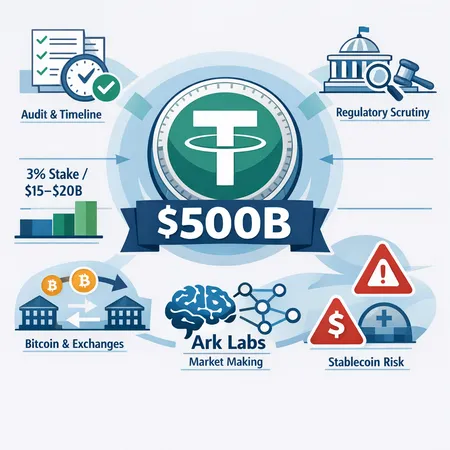
A $500 billion implied valuation for Tether — derived from reports that a $15–$20 billion bid could purchase roughly a 3% stake — is not just a headline. It’s a framing device that tells counterparties how the private market might be pricing control, future profits, and franchise value tied to USDT issuance and market-making. If taken at face value, that range (roughly $500B–$667B using simple math) elevates Tether from a large payments-like business to the scale of top global financial services firms.
That kind of valuation matters for three interlocking reasons:
- Concentration risk: USDT already commands a large share of stablecoin volumes. An outsized private valuation signals market expectations that USDT will remain dominant — which increases counterparty concentration risk for exchanges, custodians, and funds.
- Confidence signaling: High valuations can be stabilizing if backed by transparent reserves and audited controls; conversely, they amplify downside if the supporting evidence is delayed or incomplete.
- Regulatory scrutiny: A valuation in the half-trillion range invites closer attention from banking, securities, and AML regulators in multiple jurisdictions.
For compliance officers and traders, the math is simple: implied valuations amplify the economic and operational consequences of any credibility shortfall.
Audit timeline and transparency concerns: what markets are flagging
Market commentary has focused less on the arithmetic and more on proof. Questions about the proposed $500B target and the timing of any audit have been widely circulated — a useful primer on the market narrative can be found in reporting that highlights these specific concerns. Coincu’s review of the chatter on valuation and audit timing summarizes why the community wants contemporaneous, independent attestation rather than retrospective statements.
Key concerns for risk teams:
- Timeliness: An audit that arrives months after valuation-based announcements is far less stabilizing than an immediate third-party attestation or continuous proof-of-reserves mechanism.
- Scope: Do assertions cover liquid cash, short-term treasuries, repos, and counterparty exposures? Are there carve-outs (related-party loans, illiquid holdings) that materially change the reserve picture?
- Audit standard and independence: Which firm, what standard (agreed-upon procedures vs. full financial statement audit), and what access to third-party bank records?
Opacity or evasive timelines raise two immediate practical issues: counterparties may tighten funding and redemption terms, and regulators can intensify supervisory inquiries if they perceive a gap between claims and verifiable proof.
Why regulators will take notice
A private valuation in the hundreds of billions reframes USDT from a utility token to a systemically important instrument in many jurisdictions. That attracts scrutiny on multiple fronts:
- Prudential and deposit-like treatment: Stablecoins that serve as widespread media of exchange and settlement invite bank-like oversight — capital, liquidity, and resolution planning.
- AML/CTF and sanctions compliance: Regulators will probe KYC, transaction monitoring, and the provenance of reserve assets.
- Market integrity and disclosure: Securities or market regulators may demand clearer public reporting if stablecoins materially underpin trading and settlement in spot and derivatives markets.
For compliance officers, the practical implication is heightened regulatory risk: more frequent information requests, potential limits on USDT usage, and increased compliance costs.
Tether’s strategic bets and the Ark Labs signal
Market observers have also parsed the strategic dimension: small direct investments or trading relationships can operate as signals even if the capital involved is modest. For instance, reporting about a $5.2 million Ark Labs stake tied to Tether has been interpreted by some as an indicator of greater alignment with spot BTC market-making or research partnerships; a detailed take is available in analysis that explores precisely how the Ark Labs move could influence BTC flows (AmbCrypto coverage).
A few points for traders and risk teams:
- Economic scale vs. signaling: A $5.2M bet is immaterial to Tether’s balance sheet, but it can alter expectations. Market participants may infer future coordinated liquidity provision or preferred execution pathways that could route meaningful BTC flows.
- Market-making and inventory effects: If Tether were to shift reserve composition toward BTC or fund third-party BTC purchases as part of a strategic posture, that could create one-way demand that amplifies price moves, at least temporarily.
- Counterparty behavior: Exchanges and OTC desks may adjust their provisioning (corridor liquidity, inventory buffers) if they expect Tether-linked flows to push BTC price or change spread dynamics.
Signal risk therefore matters independently of the dollar size: perception can change behavior, and behavior changes price.
Stablecoin-driven stress scenarios (practical, ranked)
I describe three plausible scenarios, from contained to severe, so compliance officers and traders can calibrate contingency planning.
Scenario A — Confidence dip (mild)
Trigger: Market commentary about valuation and audit timing causes short-lived uncertainty.
Impact: USDT trades at a small on-chain premium/discount on certain rails; short-term redeem requests increase but are met without market-wide stress.
Likely timeline: Hours–days.
Mitigation response: Exchanges tighten intraday liquidity buffers and shorten settlement windows; funds reroute a small percentage of cash holdings to alternative stablecoins.
Scenario B — Redemption wave and market-making pullback (moderate)
Trigger: Audit timeline delays combine with a high-profile exchange or institutional seller signaling reduced USDT acceptance.
Impact: Market-making desks widen spreads, OTC liquidity thins, and trading desks begin forced liquidation of margin positions; BTC experiences elevated volatility and directional selling as margin calls are satisfied.
Likely timeline: Days–weeks.
Mitigation response: Activate contingency liquidity lines, implement temporary withdrawal limits, and use pre-arranged asset swaps (e.g., fiat rails or alternate stablecoins) to preserve settlement.
Scenario C — Systemic run and contagion (severe)
Trigger: Evidence emerges that reserves are materially constrained or subject to long-dated illiquid holdings; simultaneous regulatory actions restrict USDT rails.
Impact: Large-scale redemptions, exchange insolvency risk in spot and derivatives, forced asset sales across correlated markets, and potential cascading liquidations hitting BTC and other crypto assets.
Likely timeline: Days with multi-week aftershock.
Mitigation response: Activate resolution playbooks, coordinate with custodians and prime brokers, marshal cross-market liquidity, and, where possible, use central counterparty (CCP)-style coordination to avoid fire sales.
Practical mitigation steps for exchanges and funds
Below are concrete measures organized by immediacy and cost/complexity. Many are already industry best practices, but they deserve renewed focus given current chatter.
Immediate (hours–72 hours)
- Snapshot exposures: run a rapid reconciliation of USDT holdings across hot wallets, custodial accounts, and internal ledgers.
- Liquidity triage: ensure fiat settlement corridors (bank lines, rails) are operational; pre-fund critical corridors if necessary.
- Communication plan: prepare templated client messages and regulatory notifications; transparency reduces rumor-driven runs.
Short-term (3–14 days)
- Exposure limits: impose temporary max concentration limits on USDT exposure per strategy or desk.
- Redemption mechanics: test and, if necessary, shorten settlement windows for USDT conversions to fiat or alternative stablecoins.
- Counterparty diligence: request up-to-date attestations or proof-of-reserves from stablecoin counterparties and tier-1 exchanges.
Medium-term (2–12 months)
- Diversification strategy: reduce single-stablecoin risk by onboarding and operationalizing multiple reputable stablecoins, and document fallback liquidity arrangements.
- Stress-testing: incorporate stablecoin-run scenarios into regular liquidity stress tests and capital planning exercises.
- Contractual protections: revise master agreements to include accelerated remedies, margin recalculation triggers, and settlement rerouting options tied to stablecoin credit events.
Operationally, trade desks should also consider dynamic hedging strategies for directional BTC exposure that could arise from stablecoin-driven flows. Platforms such as Bitlet.app monitor and provide tools that can help trading teams keep track of stablecoin balances and exposures in real time.
What to watch next (indicators and red flags)
Risk teams should track a short list of high-signal indicators daily:
- Audit and attestation releases: source, scope, and timing.
- USDT mint/burn cadence and on-chain concentration metrics.
- Cross-rail spreads (USDT vs. USD on major OTC desks and exchanges).
- Unusual Ark or market-making announcements that could change reserve allocation or execution preferences.
- Regulatory filings or public guidance from major jurisdictions.
A rapid change across several indicators — for instance, delayed audit + rising on-chain concentration + increased cross-rail spreads — should trigger elevated playbook status.
Conclusion
The recent private-market valuation chatter and the related $15–$20B offer for a 3% stake are significant because they crystallize expectations about Tether’s franchise value and therefore the stakes of any credibility gap. The market’s demand for timely, rigorous audit evidence is rational: when a single stablecoin underpins much of on-chain and off-chain liquidity, transparency becomes a public good.
Strategic bets like the Ark Labs connection matter more for signaling than for immediate balance-sheet impact; nonetheless, perceived coordination between a dominant stablecoin issuer and large BTC-focused actors can influence flows and market-making behavior. Compliance officers and stablecoin-sensitive traders should ensure they have layered, operational mitigations — from immediate liquidity triage to medium-term diversification and contractual protections — so that they can act decisively across the mild, moderate, and severe scenarios described above.
Ultimately, the right posture is not panic, but preparation: stress-tested liquidity, clear counterparty limits, and demand for timely, independent attestation are the practical defenses against stablecoin tail risk.
Sources
- Coincu — market questions on valuation and audit timing: https://coincu.com/news/tether-faces-questions-on-500b-target-audit-timeline/?utm_source=snapi
- AmbCrypto — how Tether’s $5.2M Ark Labs bet could signal Bitcoin’s next move: https://ambcrypto.com/how-tethers-5-2m-ark-labs-bet-could-signal-bitcoins-next-move/