Solana’s Institutional Momentum: ETF Inflows, Open Interest, and Stablecoin Dominance
Summary
Executive overview
Solana (SOL) has quietly moved from a niche high-throughput experiment into a rehearsed institutional narrative: spot ETF inflows, a meaningful open interest breakout, and an emerging role as a stablecoin settlement hub. Over the past weeks SOL has traded in the high-$80s to mid-$90s, underpinned by ETF-related demand and renewed developer attention. For crypto asset managers and growth investors, this piece decodes the flows, the on-chain signals, and the behavioral headlines—so you can judge whether the fundamentals support a fresh allocation.
Recent price action and the ETF inflow story
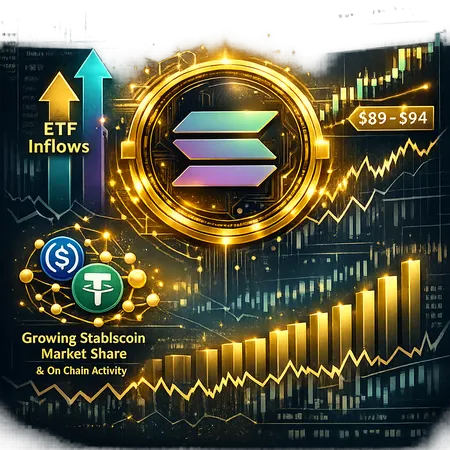
SOL’s run above roughly $89–$94 has not been random; it’s being supported by continued spot ETF inflows that funnel capital into benchmarked baskets and direct SOL exposure. Coverage of fund flows shows inflows helping to establish a higher auction price for SOL when institutional desks rebalance inventories. For a recent market read on this momentum, see the Invezz report noting SOL trading above $89 as ETF inflows continued to support momentum (Invezz).
Why ETF inflows matter to allocators:
- They create predictable, programmatic demand versus the more episodic retail bids. Institutions buying through ETFs often execute on schedules—rebalance windows, mandate-driven purchases—that underpin liquidity.
- ETFs also improve market access for constrained allocators who cannot custody directly, broadening the pool of potential buyers.
But ETF flows are not a standalone durable thesis. They can be reversed, redirected, or concentrated in a handful of APs and custodians. Treat ETF inflows as a strong flow signal but not a substitute for on-chain adoption or revenue metrics.
Derivatives dark matter: open interest breakout and volatility implications
Open interest—the notional outstanding in futures and options—has spiked meaningfully on Solana. Recent reporting places SOL’s derivatives open interest around $5 billion, a watershed that signals more professional leverage entering the market (Finbold).
What a higher open interest implies:
- Faster price discovery and larger intraday moves. With more leverage on the books, liquidations and gamma flows can amplify both upswings and drawdowns.
- Increased hedging activity from institutions. Asset managers building exposure may use futures to synthetically adjust net exposure before or while sourcing spot allocation.
- Greater sensitivity to liquidity events. Exchanges and OTC desks must manage funding rates and capacity; stressed liquidity can widen realized volatility and slippage for large executions.
For allocators this means expected return profiles change: higher potential short-term returns come with a steepened tail of downside risk. Position sizing, liquidity windows, and limit/stop frameworks should be adjusted to account for higher realized volatility driven by derivatives amplification.
Solana as a stablecoin settlement layer: market share and on-chain economics
Beyond price flows, Solana’s on-chain footprint is shifting. Analysis shows Solana increasing its role as a settlement layer for stablecoin volumes and cross-border transfers, with several stablecoin rails and market-making activity migrating to the chain (ZyCrypto).
Why this matters for fundamentals:
- Transaction revenue and fee economy. As stablecoin settlements grow, so does predictable base-layer throughput. Solana’s low-latency, low-fee environment is attractive for high-frequency stablecoin flows. Even if per-transaction fees are small, cumulative revenue and long-term utility can improve network economics.
- Developer incentives. A reliable settlement layer for stablecoins brings builders—exchanges, bridges, DeFi protocols—who can monetize activity through MEV capture, swap fees, or ancillary services.
- User stickiness. Large capital rails denominated in stablecoins can create recurring on-chain flows (payments, settlements, custodial operations) that are harder to replicate elsewhere without migration costs.
However, an important caveat: growth in settlement volumes does not automatically translate into higher token value unless the network captures more of that economic surplus (fees, staking demand, or protocol-level revenue). Solana’s fee model and validator economics must be analyzed to determine how much of that activity benefits SOL holders.
On-chain fees, developer activity, and practical capacity
Solana’s architecture emphasizes throughput and low fees, which helps attract stablecoin activity and microtransactions like NFTs and memecoins. But higher stablecoin volume can push up congestion during peak windows, which in turn affects fees and UX.
Observations for allocators:
- Fees remain low today relative to EVM chains, but episodic surges can cause spiky UX problems. Monitoring congestion patterns is critical—persistent fee inflation would erode the convenience advantage that drew stablecoin flows in the first place.
- Developer pipeline is improving. More settlement-focused integrations increase the on-chain addressable market: bridges, custodial services, and DeFi primitives tailored to low-fee environments. These projects matter because developer activity is a leading indicator of sustainable network growth.
- Competition for settlement flows is intense. Layer-2s on Ethereum, other high-throughput chains, and cross-chain rails can steal share if Solana’s reliability or fee profile deteriorates.
If you’re modeling SOL’s fair value, factor in a sensitivity analysis: how much fee capture and staking demand accrues to token holders under low/medium/high settlement scenarios.
Community branding, marketing signals and retail behavior
Narratives shape demand. Recently Solana’s community teased a “precious metal” positioning for SOL—a branding move that can influence retail psychology and FOMO-driven flows (Benzinga).
Why this matters:
- Branding magnifies sentiment-driven inflows. When a community successfully recasts a token as a store-of-value analogue, retail demand spikes and volatility can increase as narrative traders pile in.
- Short-term price elasticity. Teaser campaigns and memes can accelerate momentum but also quicken the unwind when narratives shift. Think of it as marketing-driven gamma: fun while it lasts, painful when sentiment reverses.
- Institutional perception. Sophisticated allocators separate narrative-driven retail mania from durable macro-level demand. That said, narrative can still change the liquidity landscape and make timing and sizing decisions more complex.
A practical note: exchanges and platforms, including brokerages and P2P venues like Bitlet.app, will see differential retail orderflow during narrative cycles. Track orderbook depth and taker buy/sell imbalances to quantify retail effect.
What this means for allocators and a practical allocation framework
For asset managers assessing whether Solana’s fundamentals justify an allocation, here’s a pragmatic checklist and sizing framework:
- Thesis alignment: Does SOL fit your mandate? (growth vs. store-of-value vs. play allocation). Solana’s case today blends growth (on-chain usage, stablecoin flows) with flow-driven momentum (ETF inflows).
- Flow vs. fundamentals split: Allocate a notional percentage to capture flow-driven upside and a smaller core position for on-chain adoption—e.g., 60/40 flow-to-fundamentals weight when sizing exposure.
- Volatility buffers: Use smaller position sizes and wider execution windows if open interest is elevated. Consider staged entry (dollar-cost averaging) around liquidation-prone levels.
- Liquidity and exit plan: Ensure market depth supports your desired trade size without excessive slippage—test OTC counterparties or use derivatives to hedge during build-out.
- Fee-capture sensitivity: Model three scenarios for stablecoin activity and calculate incremental yield to validators/holders; determine breakeven adoption needed to justify a long-term core allocation.
- Governance and centralization risk: Monitor validator concentration, bridge counterparty risk, and upgrades that could affect settlement reliability.
Position sizing example (illustrative): If SOL’s expected volatility jumps by 50% because of open interest growth, reduce naive allocation by ~30–40% versus a baseline target so the dollar-VaR impact remains constant.
Risk considerations
- Flow reversals: ETF outflows or rebalancing can create sharp downside even if on-chain metrics remain positive.
- Derivatives squeezes: Elevated open interest can produce violent deleveraging cascades.
- Fee capture mismatch: Stablecoin routing increases activity but might not materially accrue to SOL holders unless protocol economics change.
- Operational risks: Bridge exploits, validator faults, or software regressions can quickly erase narrative gains.
Bottom line
Solana’s current setup—ETF inflows, a $5B-scale open interest market, and growing stablecoin settlement share—creates a credible institutional narrative. That narrative is real capital: it changes liquidity, onboarding mechanics, and pricing dynamics. But the transition from activity to sustainable token value depends on fee capture, validator economics, and continued developer/product-market fit.
For allocators: consider a bifurcated approach. Use a tactical sleeve to capture flow-driven upside (with strict execution and hedges) and a smaller strategic core tied to on-chain adoption metrics. Monitor open interest, settlement volume trends, and fee-share dynamics closely—those are the variables that will determine whether SOL becomes a durable allocation or remains a narrative-driven momentum trade.
For those building exposure operationally, track orderbook depth on major venues and monitor retail flow signals; narratives (like the ‘precious metal’ tease) can both amplify gains and accelerate reversals. Also watch on-chain developer activity and stablecoin volume growth as leading indicators of sustainable demand—these fundamentals will matter most over multi-quarter horizons.
Sources
- Invezz — Solana approaches $94 as ETF inflows continue: https://invezz.com/news/2026/03/13/solana-approaches-94-as-etf-inflows-continue-check-forecast/?utm_source=snapi
- Finbold — Solana breaks key trendline as open interest surges to $5B: https://finbold.com/solana-breaks-key-trendline-as-open-interest-surges-5-to-5-billion/?utm_source=snapi
- ZyCrypto — Solana becomes stablecoin market leader: https://zycrypto.com/solana-becomes-stablecoin-market-leader-but-price-remains-stagnant-below-90/
- Benzinga — Solana’s ‘precious metal’ tease: https://www.benzinga.com/crypto/cryptocurrency/26/03/51235387/solanas-precious-metal-tease-evokes-curiosity-as-sol-spikes-4?utm_source=benzinga_taxonomy&utm_medium=rss_feed_free&utm_content=taxonomy_rss&utm_campaign=channel&utm_source=snapi
Note: For macro context, compare activity across chains and established benchmarks—many allocators still use Bitcoin flows and DeFi metrics as cross-checks when sizing blockchain allocations.