Why BitMine’s ~61k ETH Move Matters: Custody Flows, Coinbase Prime and DVT‑lite
Summary
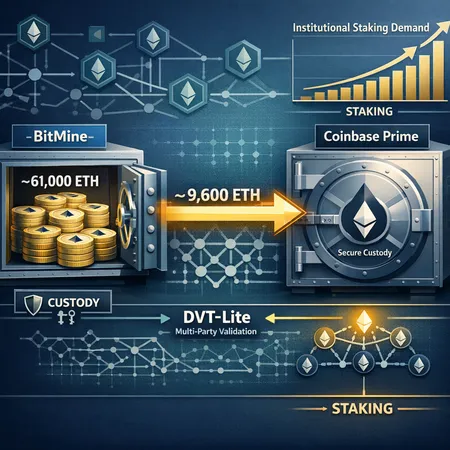
BitMine Immersion Technologies’ reported purchase of roughly 61,000 ETH and the subsequent movement of about 9,600 ETH to addresses linked to Coinbase Prime have put institutional custody flows back in focus. For asset managers and infrastructure teams, this isn’t just another whale story: it’s a case study in how large treasuries may navigate the tradeoffs between liquidity, yield, and operational risk as Ethereum staking becomes a material part of portfolio strategy.
The numbers matter because they’re large enough to influence short‑term liquidity dynamics while revealing preferred custody counter‑parties. On top of that, proposals like Vitalik’s DVT‑lite aim to lower the technical barriers to institutional staking — and that could change how these flows are routed.
What the on‑chain record shows
Public reporting first flagged BitMine’s accumulation. NewsBTC reported that BitMine Immersion Technologies amassed nearly 61,000 ETH into its treasury, characterizing the holding as a strategic Ethereum exposure for the firm reporting the 61,000 ETH acquisition. On‑chain follow‑ups then documented an outflow of about 9,600 ETH to wallets linked with Coinbase Prime, according to blockchain‑analysis reporting showing transfers to Coinbase‑connected addresses.
Specifically, tracking services and analysts identified transfers consistent with custody or settlement flows to institutional infrastructure operated by Coinbase Prime; one report summarized the roughly 9,600 ETH move to Coinbase‑linked wallets as a discrete on‑chain event showing BitMine sending ~9,600 ETH to Coinbase. Those two datapoints — large treasury accumulation plus a sizeable transfer into a regulated prime custody venue — create several plausible interpretations.
Interpreting the Coinbase Prime transfer: custody, staking, or settlement?
A transfer to Coinbase Prime does not mechanically imply immediate selling. Coinbase Prime is an institutional custody, trading and staking service; incoming deposits can be used for custody, staking activation, margin, or internal settlement. Institutional treasuries typically route funds through such providers to access fiat liquidity, custody insurance, and delegated staking services.
Three plausible uses for the 9.6k ETH transfer are:
- Custody onboarding: moving a tranche to a regulated custodian to reduce self‑custody operational risk and obtain insurance or accounting convenience.
- Delegated staking or staking pre‑setup: preparing ETH for staking via Coinbase’s institutional staking offering, which can simplify validator management and compliance.
- Liquidity management or trading: staging assets for potential market activity or to collateralize OTC trades.
Each pathway has different market and operational implications. A custody onboarding reduces on‑chain sell pressure risk but signals institutional preference for regulated counterparties. A delegated staking flow indicates appetite to earn yield from Ethereum staking, while staging for trades could presage liquidity events.
Treasury strategy: staking vs custody — tradeoffs for institutions
Institutional ETH strategies revolve around three priorities: capital appreciation, yield generation, and liquidity. Choosing how much ETH to keep in self‑custody, how much to delegate, and how much to place with custodians like Coinbase Prime is a multi‑dimensional optimization.
Key considerations include:
- Yield vs. liquidity: Native Ethereum staking yields passive income but introduces lockup windows (native protocol unbonding mechanics or operational constraints). Liquid staking tokens (LSTs) provide liquidity but introduce smart‑contract and counterparty risk. Institutions must weigh immediate yield against potential liquidity needs.
- Operational burden and slashing risk: Running validators in‑house requires robust key management, monitoring, and mitigation of slashing scenarios. Delegating to a custodian or third‑party staking provider reduces operational load but concentrates counterparty risk.
- Accounting, compliance, and insurance: Custodians typically provide audit trails, regulatory compliance support, and insurance — valuable for institutional treasuries. Self‑custody can be cheaper but requires bespoke insurance arrangements and tighter internal controls.
- Market signaling and governance: Large on‑chain staking can signal long‑term commitment to Ethereum, which may influence market perceptions and token economics.
For a firm like BitMine, splitting a large acquisition between in‑house staking, delegated staking, and custodial holdings is rational. Moving a tranche to Coinbase Prime could be the custodial leg of such a diversified treasury allocation.
Custody‑to‑staking pathways and the DVT‑lite inflection
One of the main frictions for native institutional staking is key management: who holds the signing keys, and how are validator duties split to avoid single‑point failures? Vitalik Buterin’s DVT‑lite proposal aims to simplify distributed validator technology, lowering the barrier for institutions to participate in native staking without surrendering custody full stop. The proposal and its rationale were outlined as a streamlined approach to make staking more accessible for larger participants Vitalik introduces DVT‑lite to streamline staking.
DVT‑lite changes the calculus in a few ways:
- Reduced integration complexity: by standardizing lighter weight distributed validator setups, infrastructure teams can run robust validator clusters with fewer bespoke components.
- Clearer custody boundaries: DVT patterns allow key‑holders to retain custody over signing material while still participating in shared, fault‑tolerant validator operations.
- Compliance and auditability: a more standardized DVT stack can be audited and certified, making it easier for custodians and institutional compliance teams to sign off.
If DVT‑lite is adopted widely, institutions may prefer running their own validators or partnering with professional node operators using DVT arrangements, reducing reliance on delegated staking via custodians. That could shift custody flows away from centralized staking desks over time — though custodians may adopt DVT themselves and offer hybrid products.
Market and signalling implications for institutional ETH demand
Large treasury buys like BitMine’s are liquidity‑relevant: 61k ETH is a meaningful sum. The path those assets take — into cold storage, into staking, or onto an exchange — determines short‑term market pressure. A transfer into Coinbase Prime might worry traders if interpreted as a prelude to selling, but as noted, it can just as plausibly be a custody or staking step.
From a signalling perspective, several themes stand out:
- Growing institutional appetite for ETH exposure: accumulating large native ETH holdings suggests institutions are treating ETH as both an asset and an income‑bearing instrument through staking. This is a structural demand signal for institutional ETH.
- Preference for regulated counter‑parties: flows to Coinbase Prime demonstrate a tilt toward regulated custody and staking providers, especially when insurance and compliance are priorities.
- Technology‑driven shift in custody design: with proposals like DVT‑lite, some institutions may change their default from delegated staking to controlled, DVT‑enabled native staking — altering future flows and reducing concentration risk at major custodians.
For infrastructure teams, the takeaway is clear: monitor not only raw holdings but also the destination and cadence of transfers to understand whether inflows reflect custody onboarding, staking activation, or trading preparation.
Practical checklist for institutional managers and Ethereum infrastructure teams
To evaluate custody‑to‑staking pathways, teams should run through operational and strategic checks:
- Define treasury goals: income vs liquidity vs exposure. Establish target bands for self‑custody, delegated staking, and liquid staking instruments.
- Risk appetite and insurance: quantify slashing, smart contract and custodian counterparty risks; validate insurance scope and coverage from providers like Coinbase Prime.
- Technical capacity: assess readiness to operate DVT or DVT‑lite setups, including monitoring, key management, and incident response.
- Compliance and reporting: ensure custody and staking choices meet audit, tax and regulatory requirements in relevant jurisdictions.
- Counterparty due diligence: evaluate custodians’ SLAs, segregation of duties, and historical performance. Track on‑chain flows as part of vendor monitoring.
Teams should also consider hybrid models: custody with delegated DVT‑enabled staking, or a split across custodians and self‑operated validators. Platforms such as Bitlet.app are part of an expanding ecosystem where managers compare custody and yield options across providers.
Conclusion — a small transfer, a larger trend
BitMine’s reported 61k ETH acquisition and the subsequent ~9.6k ETH movement to Coinbase Prime are more than headline numbers: they’re a window into the evolving institutional approach to Ethereum. Institutions are balancing yield, liquidity and compliance, and the emergence of DVT‑lite could materially lower the barriers to native institutional staking.
For institutional crypto managers and infrastructure teams the questions are operational and strategic, not binary. Will you delegate and rely on custodians, or adopt DVT‑enabled native staking to keep tighter custody controls? The answer will shape where future ETH flows appear on‑chain — whether sitting with centralized custodians, pooled into liquid staking products, or distributed across institutional validator clusters.
Sources
- NewsBTC: BitMine Immersion Technologies acquires nearly 61,000 ETH and commentary on the company's Ethereum treasury — https://www.newsbtc.com/news/ethereum/bitmine-acquires-60000-eth-chair-discusses-outlook-for-ethereum-and-crypto-prices/
- Crypto.News: Blockchain data showing BitMine sent around 9,600 ETH to wallets linked to Coinbase Prime — https://crypto.news/data-shows-bitmine-sending-9600-eth-to-coinbase/
- Blockonomi: Vitalik Buterin introduces DVT‑lite to streamline the Ethereum staking process — https://blockonomi.com/vitalik-buterin-introduces-dvt-lite-to-streamline-ethereum-eth-staking-process/