XRP Market Dynamics: Retail Surge, Binance Reserve Shifts, and ETF Signals into Q2 2026
Summary
Snapshot: conflicting signals as Q2 2026 approaches
XRP’s price action lately has been driven by two divergent narratives: a retail-led pickup visible across trading and on-chain flows, and a more cautious institutional story signaled by mixed ETF flows. At the same time, liquidity metrics — most notably movements in the Binance XRP reserve — are shifting in ways that change how market participants should think about execution risk.
This article lays out the evidence, contrasts retail vs institutional dynamics, and gives pragmatic implications for holders and allocators deciding whether to scale into rallies or wait for clearer institutional confirmation.
Evidence of retail-led activity
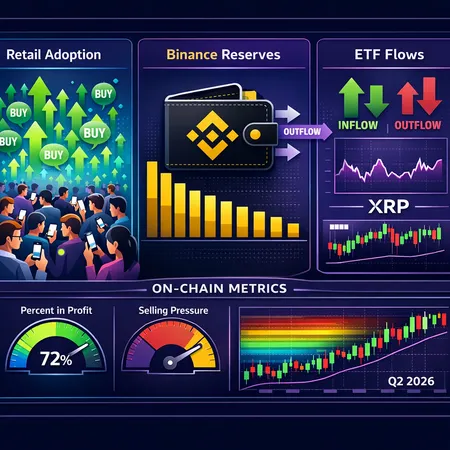
Over the past weeks, several data points point to retail participants stepping back into XRP. Reporting from U.Today highlights strong retail demand driving a pick-up in trading volumes and on-chain activity, especially around smaller wallets and P2P flows. These patterns are consistent with episodic, retail-driven rallies that historically produced sharp short-term price moves but limited staying power without institutional follow-through (U.Today — retail demand report).
Two behavioral signs to watch for when diagnosing retail dominance:
- Concentration of transaction counts and flows in small-to-medium addresses rather than a sustained accumulation by large custodial wallets.
- Rapid deposit/withdrawal cycles around centralized exchanges and P2P platforms, which suggest trading rather than long-term holding.
Retail-led rallies can be powerful and self-reinforcing — think social-media-driven squeezes — but they also tend to be more sensitive to liquidity and order-book thinness. For many traders, Bitcoin cycles show how retail enthusiasm can pre-date or overshoot institutional entries.
Binance reserve movements: liquidity is migrating
A crucial accompaniment to rising retail activity has been observable changes in Binance’s XRP reserve. Reporting shows the Binance reserve pulling back from the roughly 28 billion zone as withdrawals and demand increase, a dynamic that often removes sell-side buffer from the market and can steepen volatility (U.Today — Binance reserve retreats).
Why this matters:
- Exchange reserves act as liquidity cushions. When reserves fall, the same buy pressure can move price more because fewer coins are immediately available to sell.
- Withdrawals can mean accumulation or migration to custodial/institutional stacks. If withdrawal flows are to cold wallets, that’s long-term accumulation; if they’re to other exchanges or staking-like products, liquidity remains mobile.
Current on-chain readings suggest much of the outflow is correlated with retail withdrawals and non-custodial accumulation rather than a single whale deposit. That nuance matters for predicting price persistence: retail accumulation increases the number of small holders with low liquidity thresholds.
ETF flows: mixed picture and why institutions remain cautious
Institutional channels tell a different story. Weekly aggregate flows into XRP-related ETF products — as tracked in recent commentary and flow analyses — have been mixed, with pockets of inflows but also notable rejections and intermittent outflows. CryptoPotato’s weekly roundup captures this oscillation and explains how ETF performance and investor appetite have so far failed to provide a decisive push (CryptoPotato — XRP ETF flows weekly).
Key takeaways on ETF-related institutional behavior:
- Inconsistent net flows reduce the probability that institutions will be the primary price piston in the near term. Institutions often require sustained, predictable inflows to justify large, multi-week accumulation windows.
- Regulatory and allocation friction continues to slow institutional adoption; even when retail rallies, institutions can sit on the sidelines pending clearer custody, compliance, or macro signals.
This divide — retail excitement vs muted institutional flow — is central to the current consolidation narrative. Institutions buying heavily would likely add depth to the order book and tamp down intraday volatility; the absence of that depth explains why retail-driven moves still swing widely.
On-chain metrics: are we at a bottom or merely consolidating?
Several on-chain indicators suggest selling pressure has eased and that price downside may be limited near current levels. TheCurrencyAnalytics piece argues that XRP may be hitting a bottom as selling pressure drops, with metrics like percent-in-profit and realized loss windows indicating less forced selling (The Currency Analytics — selling pressure drops).
Metrics to monitor closely:
- Percent-in-profit: a rising share of addresses or supply in profit provides a cushion — holders are less likely to capitulate if they’re back in the green. A low percent-in-profit historically leaves room for deeper drawdowns.
- Selling pressure / spent output age: declining spent output from previously active sellers suggests fewer coins are hitting exchanges and pressure is abating.
- Exchange inflows/outflows: persistent net outflows from large exchange wallets (like Binance) can indicate either accumulation or illiquidity; direction matters.
Taken together, reduced selling pressure and a slowly rising percent-in-profit often precede ranges or slow recoveries rather than immediate parabolic moves. That fits the current pattern: a potential local bottom with a high probability of extended consolidation until institutional flows firm up.
What this means for price direction into Q2 2026
Scenario framing is useful here because the market is sending mixed signals.
- Base case (most likely): Consolidation with upward bias. Retail demand and shrinking exchange reserves support modest asymmetric upside, but mixed ETF flows cap momentum. Price may grind higher in fits, dependent on liquidity windows.
- Bull case: Sustained institutional inflows. If ETF flows turn decisively positive and remain steady, liquidity deepens and a multi-week rally is plausible as institutions scale. This would be the clearest signal that the bottom is behind us.
- Bear case: Retail exhaustion and forced selling. If social momentum fades and macro conditions push risk-off, thin exchange reserves could accelerate moves down as stop-lists get hit.
Practical thresholds to watch: sustained net-positive ETF flows (weekly), Binance reserve flattening or continued withdrawal to cold wallets, and a rising percent-in-profit above the prior local distribution peak.
Investment implications: retail vs institutional playbooks
Retail allocators:
- Scale in with staggered buys. Given volatile liquidity, dollar-cost averaging or a laddered limit-order approach reduces timing risk. Be mindful of slippage during low-liquidity windows.
- Use on-chain signals for sizing. If exchange outflows accelerate and percent-in-profit climbs, consider increasing exposure; if both reverse, trim.
- Guard execution risk. Platforms like Bitlet.app and P2P routes can help enter without large order-book impact, but watch withdrawal/transfer costs.
Institutional allocators:
- Demand flow confirmation. Institutions should look for multi-week positive ETF flow trends and deeper order-book liquidity before scaling large buys.
- Layer exposure and use OTC where possible. When reserves are low, OTC desks mitigate market impact; staggered fills and VWAP execution are prudent.
- Model liquidity scenarios. Stress-test positions for sudden exchange-liquidity shifts; thin books amplify tail risks.
Tactical checklist heading into Q2 2026
- Monitor weekly ETF flows and headlines from custody/regulatory developments.
- Watch Binance reserve movements and net exchange flows daily; consistent withdrawals are a bullish signal if they land in cold storage.
- Track percent-in-profit, spent output age, and median holding time to gauge selling pressure.
- For active traders: prefer limit orders and smaller notional sizes when reserves fall to minimize slippage.
Conclusion
XRP’s current profile is a classic market tug-of-war: energetic retail demand and shrinking exchange liquidity pushing in one direction, and cautious, mixed institutional ETF flows pulling in another. On-chain metrics today lean toward a localized bottom or prolonged consolidation rather than an immediate breakout. Retail participants can capitalize on this environment with scaled entries and liquidity-aware execution; institutions should wait for clearer, sustained ETF flow confirmation or deepen execution channels via OTC.
For allocators, the pragmatic middle path is to scale exposure while monitoring institutional flow signals and exchange reserves — be ready to accelerate buys if ETF flows firm up, and to defend positions if selling pressure returns.
Sources
- U.Today — Report highlighting strong retail demand driving XRP activity: https://u.today/xrp-enjoying-strong-retail-demand-report-says?utm_source=snapi
- U.Today — Coverage of XRP reserve movements on Binance as demand grows: https://u.today/xrp-reserve-on-binance-retreats-from-28-billion-zone-as-demand-grows?utm_source=snapi
- CryptoPotato — Weekly view of XRP ETF flows: https://cryptopotato.com/ripple-xrp-etf-flows-weekly-the-good-the-bad-and-whats-next/
- The Currency Analytics — Macro view suggesting XRP may be hitting a bottom as selling pressure drops: https://thecurrencyanalytics.com/altcoins/xrp-hits-bottom-signals-as-selling-pressure-drops-248543
For broader context on market liquidity mechanics and cross-asset behavior, see reporting on DeFi trends and how exchange reserves influenced prior cycles.