Why Bitcoin Needs BIP-360 Now: Quantum-Resistant Wallets as Dormant Whales Wake
Summary
Executive summary
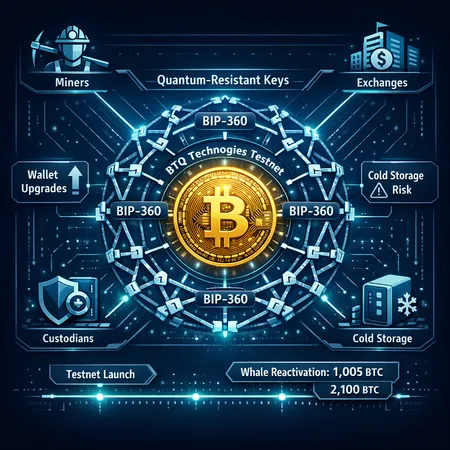
BTQ Technologies' BIP-360 testnet is the clearest signal yet that quantum-resistant Bitcoin security is moving from academic research into engineering and commercial deployment. The technical debate about when large-scale quantum computers will exist matters less than the operational reality: archived blockchain data and newly reactivated whales mean adversaries could apply a “record now, decrypt later” strategy, and custodians holding long-term cold storage must anticipate future threats today. This article unpacks what BIP-360 proposes, the current status of the BTQ testnet, why recent whale reactivations (1,005 BTC and 2,100 BTC) make rapid adoption prudent, and a pragmatic roadmap for miners, exchanges and custodians to prepare.
What BIP-360 proposes — the technical and commercial idea
BIP-360 is being pitched as a path for Bitcoin to gain practical post-quantum protections without fracturing the ecosystem. In engineering terms, the proposal frames a standard for wallets and transaction formats that can support quantum-resistant key material and signature schemes, while remaining interoperable with existing secp256k1-based transactions. Commercially, BIP-360 emphasizes incremental adoption: hybrid or fallback flows where wallet vendors and custodians can add post-quantum keys alongside existing ECDSA/secp256k1 keys, enabling gradual migration rather than an all-or-nothing fork.
Technically this looks like three complementary patterns:
- Hybrid signatures or threshold arrangements that combine a classical (secp256k1) signature and a post-quantum signature, requiring both for spends — preserving backwards compatibility while bridging to PQ algorithms.
- Address and output descriptors that can reference post-quantum public keys (or key commitments) so wallets can construct and recognize PQ-capable UTXOs.
- Testnet and tooling support to allow vendors to exercise key rotation, multisig ceremonies and firmware updates before any mainnet changes.
Those patterns leave room for multiple algorithm classes (hash-based, lattice-based, etc.) and for different custody models. The point is practical interoperability: vendors can deploy hybrid wallets today, validate them on testnets, and then harden processes for customer migrations.
BTQ Technologies’ testnet: where we stand now
BTQ Technologies has publicly launched a BIP-360 testnet to get developers, wallet builders and custodians into the trenches early. Coverage of the launch highlights that the testnet is actively inviting integration testing, signing libraries and node validation logic to be exercised in realistic conditions (Blockonomi report on the BTQ BIP-360 testnet).
The immediate practical benefit of a testnet is twofold:
- It surfaces engineering gaps early — hardware wallet firmware, HSM integrations, key-ceremony UX, and multisig wallet flows all reveal edge cases under load.
- It creates a reproducible environment for custodians and exchanges to prove their migration and incident-response playbooks.
If you manage Bitcoin keys in production, participating in or following early BTQ testnet work provides empirical data you can use to justify budgets, timelines and insurance conversations.
Why quantum-proof wallets matter now: dormant whales and archival risk
There are two common misperceptions about quantum risk: "it’s decades away" and "we can upgrade when the threat arrives." Both are dangerously incomplete.
First, a practical adversary model includes store now, exploit later. Public block data, signed transactions and broadcasted keys can be archived by anyone today. If a quantum-capable adversary emerges later, they could attempt to derive private keys from recorded public keys or hijack future spends that reuse or reveal keys.
Second, whale and dormant-wallet activity is re-shaping the risk environment. In recent weeks, long-dormant wallets — ones that have not moved funds for a decade or more — have reactivated, moving large sums: a transfer of 1,005 BTC after 14 years and a separate 2,100 BTC wakeup were reported publicly (CurrencyAnalytics on 1,005 BTC move, Cointelegraph on 2,100 BTC move).
Why that matters: cold storage risk is not static. Dormant supply can become active unpredictably — perhaps due to estate planning, a key-holder deciding to move funds, or custodians doing consolidation. Each reactivation is an operational window where keys are transitioned, addresses are revealed, and counterparty trust is re-asserted. The more high-value UTXOs start moving, the greater the chance an adversary has opportunities (or incentives) to exploit weak migration practices or to attempt to capture funds during key rotation.
Put simply: whale reactivation compresses the timeline for secure migration. You cannot assume an orderly migration that happens only when the first viable quantum computer appears; market events will force upgrades on timelines determined by humans, not researchers.
Cold storage risk — technical nuance for engineers
A measured view of cold storage risk helps prioritize actions:
- UTXO exposure: outputs that already expose a public key (e.g., P2PK outputs or spent outputs) are vulnerable if quantum computing reaches the necessary scale. Most modern standards (P2WPKH, P2SH-P2WPKH) hide public keys until a spend occurs, which reduces immediate attack surface.
- Address reuse: reusing addresses increases exposure because a public key is published on first spend; future spends then rely on the private key. Avoid reuse and favor fresh key derivation.
- Firmware and supply-chain compromise: long-term air-gapped devices are not bulletproof; exfiltration or supply-chain compromise can leak seeds which later can be attacked offline.
- Archive attacks: adversaries who record full blockchain traffic and network metadata can build datasets to exploit once quantum capability exists.
Engineers should therefore focus on minimizing public-key exposure windows, strengthening key ceremonies, and designing migration flows that avoid simultaneous mass-exposure of customer funds.
Implications for wallet vendors and custodians
Wallet vendors, custodians and exchanges each have different constraints but shared responsibilities:
- Wallet vendors must ship UX for hybrid key generation, robust test vectors, and hardware-wallet firmware that supports PQ primitives (or at least hybrid signing flows). They should work with HSM providers to certify PQ key storage and signing.
- Custodians need to redesign key-rotation playbooks: multi-stage migrations that include dry runs on testnet, audited key-ceremonies, and staged client opt-ins for migration windows. Insurance vendors will expect documented mitigation steps and proof of testing.
- Exchanges must update withdrawal and cold-wallet pipelines, add extra validations when processing migrated UTXOs, and coordinate with liquidity teams to avoid market shocks during mass migrations.
From a commercial standpoint, early adopters who can demonstrate tested hybrid custody models will win trust from large clients who require survivability assurances over decades.
A pragmatic roadmap: steps for miners, exchanges and custodians
Below is an actionable, prioritized plan split into immediate, near-term and mid-term workstreams. Aim for practical milestones rather than hypothetical perfection.
Immediate (0–6 months)
- Inventory and classification: map all address types (P2PK, P2PKH, P2WPKH, P2SH, multisig) and identify exposures where public keys are already revealed.
- Join the testnet: run client software that supports BIP-360 testnet features and exercise signing flows with inert funds. BTQ’s testnet is intended for this purpose; follow the Blockonomi coverage and test vectors to validate behavior. Blockonomi report.
- Update vendor track: require hardware wallet vendors and HSM suppliers to provide PQ-capable firmware roadmaps and cryptographic proof-of-concept integrations.
- Policy and incident playbooks: draft clear migration SOPs, rollback procedures, and communications templates for customers.
Near term (6–18 months)
- Deploy hybrid custody: introduce a hybrid 2-of-3 or 2-of-2 threshold where at least one key is post-quantum-capable. Hybrid approaches reduce migration risk and allow fallbacks to classical signatures if necessary.
- Staged customer migrations: move inactive, low-liquidity holdings first to PQ-capable addresses; expand to larger holdings after audits and insurance sign-off.
- Coordinate with exchanges and miners: miners must upgrade validation logic (nodes) to recognize hybrid transaction scripts; exchanges must test inbound/outbound flows. Public testnet results should be used as acceptance criteria.
- Audit and certification: perform third-party cryptographic and operational audits on key-rotation ceremonies, HSM integration and firmware updates.
Mid term (18–36 months)
- Full production rollouts: once hybrid flows are battle-tested, schedule broader migrations and offer PQ-capable custody tiers as an option for large clients.
- Mainnet soft-forks (if required): depending on community consensus and BIP maturation, prepare for protocol-level upgrades that may standardize PQ address recognition. This requires miner coordination and clear economic incentives.
- Legal and insurance alignment: update custody agreements, SLAs and insurance policies to reflect the new threat model and mitigations.
Practical engineering notes
- Favor algorithms with clear, vetted standards and multiple independent implementations. Avoid bespoke, unreviewed PQ schemes.
- Prioritize deterministic test vectors for signing and verification; cross-implementations must produce bit-for-bit consistent results to avoid false failures in production migrations.
- Keep UX simple: migration prompts for end-users should be concise, explain the why (survivability) and the what (what will change), and minimize the number of clicks required for safe migration.
Closing thoughts — survivability over speculation
Quantum resistance is not a product marketing line; it’s a survivability requirement for a long-lived monetary network. BTQ Technologies’ BIP-360 testnet puts the engineering problem in front of custodians, wallet vendors and node operators — and the recent reactivation of large dormant wallets underscores the urgency. Actors who wait for a crisis will face compressed timelines and higher operational risk.
For security engineers and custodial managers: start with inventory, run the testnet exercises, adopt hybrid custody models, and plan staged migrations. Exchanges and miners should coordinate validation and rollout timelines now so that when a protocol standard stabilizes, the industry can move in a measured, auditable way. Practical steps taken today buy years of survivability for Bitcoin tomorrow.
Bitlet.app and other custodial platforms will need to bake these tests and controls into their product roadmaps as clients increasingly ask about long-term security guarantees.
Sources
- BTQ Technologies launches BIP-360 testnet (Blockonomi): https://blockonomi.com/btq-technologies-launches-bip-360-testnet-pushing-bitcoin-toward-quantum-proof-security/
- Dormant Bitcoin wallet wakes after 14 years with 1,005 BTC (CurrencyAnalytics): https://thecurrencyanalytics.com/altcoins/dormant-bitcoin-wallet-wakes-up-after-14-years-with-massive-28-million-haul-248357
- Bitcoin wallet with 2,100 BTC wakes up after 14 years (Cointelegraph): https://cointelegraph.com/news/bitcoin-wallet-with-2100-btc-wakes-up-after-14-years?utm_source=rss_feed&utm_medium=rss&utm_campaign=rss_partner_inbound