Ethereum: Whale Accumulation vs Structural Stress — $19.5M Buy, ETF Outflows & L2 Migration
Summary
Surface strength vs structural stress: framing the debate
Ethereum’s recent narrative is a study in contrasts. On one level you have clear signs of accumulation: headline whale buys, resumes of long‑term holder stacking, and public notes from market strategists arguing that a price bottom may be behind us. On the other, the protocol’s economic plumbing is changing — ETF flows are pressuring prices, daily base‑layer fees are falling, and user activity is increasingly moving to Layer‑2s. For intermediate to advanced investors this isn’t a binary call; it’s a portfolio weighting exercise that must reconcile short‑term price drivers with structural revenue shifts.
Whale accumulation and record buyer activity
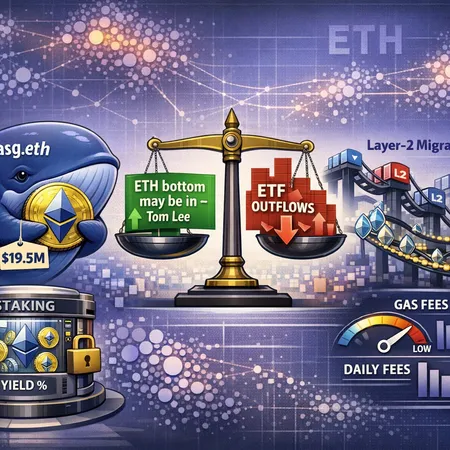
The most visible bullish datapoint in recent days was the large purchase attributed to thomasg.eth — roughly $19.5 million of ETH according to reporting that tracked the transaction. That kind of concentrated buying does several things at once: it reduces liquid supply on exchanges, signals confidence from a deep‑pocket holder, and often triggers follow‑on activity from momentum traders who interpret whale buys as an asymmetric risk signal. Coverage of this buy also feeds into a broader narrative of renewed accumulation among large addresses.
Beyond a single trade, veteran market watchers like Tom Lee have publicly suggested that Ethereum’s bottom could be in, pointing to long‑term holder accumulation as supporting evidence (Tom Lee’s note). That combination — substantial, publicized buys plus macro‑style conviction — can produce meaningful short‑to‑medium‑term price momentum.
But a caveat: not all whale activity is equal. Some whales are strategic long‑term holders; others are tactical, moving positions between derivatives, staking, and spot. Observing on‑chain flows (exchange inflows/outflows, staking inflows, OTC reporting) alongside single large buys gives a clearer read than focusing on the headline alone.
Why on‑chain accumulation matters
On‑chain accumulation is not just price pressure; it’s information. Large, sustained outflows from exchanges and growing balances in non‑custodial addresses can tighten available float and increase realized supply held by holders unwilling to sell into volatility. That said, these signals work best in context — against liquidity conditions, derivatives open interest, and macro flows such as ETF allocations.
ETF outflows and near‑term price pressure
ETF flows remain an underappreciated lever. When spot and futures ETF activity shows sustained outflows, it can overwhelm the positive price effects of a few large purchases, especially if institutional reallocation occurs at scale. The market’s sensitivity to ETF flows is higher than in prior cycles because ETFs concentrate buyer interest; inflows amplify purchase demand while outflows remove a structural bid.
In short windows, a whale buy can counteract ETF outflows and trigger rallies. Over longer windows, persistent outflows mean demand from retail and whales must be sufficiently large and sustained to offset the missing institutional base. This dynamic helps explain why a market can look strong on chain (accumulation) and still struggle to break higher on price charts.
Layer‑2 migration and falling fees: a structural revenue shift
A clear structural story is unfolding in Ethereum’s economics. Multiple analyses show daily base‑layer fees declining as activity shifts to Layer‑2s — a trend that’s becoming durable rather than episodic (TokenPost analysis on falling fees and L2 migration). Layer‑2s are absorbing transaction volume (and user activity) because they offer lower costs and faster UX, which is precisely what mainstream dApps and end users demand.
This migration matters for ETH’s long‑term revenue model. Post‑Merge, the base‑layer fee capture and burning mechanisms changed the way ETH accrues monetary value: a portion of fees is burned, and staking captures a different slice of network economics. If more activity permanently moves off‑chain to Layer‑2s, on‑chain fee revenue for validators and the implicit value accrual through burns will decline at the base layer.
That’s not necessarily existential — Layer‑2s still rely on the security of Ethereum and often settle value back to the base layer — but it does mean the magnitude and composition of revenue that supports ETH’s valuation may shift materially.
Implications for staking, yields and ETH’s revenue model
Staking dynamics interact with these structural changes. Lower base‑layer fees translate to reduced fee‑derived income for validators; staking rewards then rely more on protocol issuance and MEV than on fee capture. That can compress effective staking yields, especially if ETH price appreciation is muted.
Investors should watch three linked variables:
- Staking inflows and the growth of staked supply (which affects available float and centralization risks).
- MEV and Layer‑2 settlement patterns (which determine where extractable value ends up).
- The evolution of fee‑sharing or rollup fee sinks (protocol tweaks or new economic primitives that could redirect revenue).
The TokenPost survey on investor sentiment reinforces this mixed picture: wealthy crypto investors continue to anchor portfolios to BTC and ETH even as altcoins lag, reflecting confidence in the protocol while acknowledging structural shifts (TokenPost investor insights). That tells you the smart money is not ignoring the protocol transition — it's factoring it into asset allocations.
Weighing on‑chain accumulation against platform transitions
So how should an investor synthesize these signals? Here’s a practical framework:
Time horizon matters. If you’re trading on weeks to months, whale accumulation and headline sentiment (Tom Lee’s note, large buys) can drive price action and create tactical entries. If you’re allocating multi‑year capital, structural changes to revenue and settlement deserve greater weight.
Combine signals. Use on‑chain metrics (exchange flows, large transfers, staking balances) alongside product adoption metrics (L2 TVL, active users, fee share). No single datapoint should dictate position sizing.
Stress‑test staking exposures. If you rely on staking yields for income, model scenarios with lower fee capture and higher MEV variance. That may change where you custody or how long you lock funds.
Size for optionality. Whale buys reduce near‑term supply but can also be reversed; manage position sizes so that a change in the fee economy or a burst of L2 migration doesn’t force liquidation.
Monitor institutional flows. ETF inflows/outflows are real liquidity forces; track them and be ready to adjust conviction when institutional demand pivots.
For many traders, Ethereum remains the primary smart‑contract bellwether; for others reallocating between protocols requires watching where fees and users actually go — often to DeFi apps on L2s.
Practical takeaways for investors
- Treat thomasg.eth’s $19.5M buy and Tom Lee’s bottom thesis as important but not dispositive; they increase the probability of near‑term upside but don’t obviate structural risk.
- Track daily fee trends and L2 adoption metrics weekly — these are leading indicators for long‑term revenue change.
- If you stake ETH, run yield scenarios that assume lower base‑layer fees and higher MEV variability.
- Use position sizing and time‑based risk management: smaller initial sizes with scaling rules as structural signals confirm.
- Keep an eye on ETF flows: large, sustained outflows can swamp isolated accumulation events.
On balance, Ethereum’s surface strength (whale accumulation, buyer activity) matters — it tightens float and signals conviction — but investors need to reconcile those signs with a shifting economic model driven by Layer‑2s and changing fee dynamics. Platforms like Bitlet.app and on‑chain analytics tools make monitoring these signals easier; the smarter trades will blend on‑chain reads with macro and product adoption evidence.
Sources
- "Ethereum’s price bottom could be in, says Tom Lee" — Crypto.News: https://crypto.news/ethereums-price-bottom-could-be-in-says-tom-lee/
- "Ethereum whale thomasg.eth buys $19.5M" — Cointelegraph: https://cointelegraph.com/news/ethereum-whale-thomasg-eth-buys-19-5m?utm_source=rss_feed&utm_medium=rss&utm_campaign=rss_partner_inbound
- "Analysis: Falling daily fees and L2 migration" — TokenPost: https://www.tokenpost.com/news/insights/19169
- "Survey: Wealthy crypto investors anchor to BTC and ETH" — TokenPost: https://www.tokenpost.com/news/insights/19171