Bittensor (TAO) Explained: AI-Native Marketplaces, Bitcoin-Style Scarcity, and How to Evaluate Entry
Summary
What is Bittensor and why it matters
Bittensor bills itself as an AI-payments-native protocol: a decentralized network that rewards models, data providers, and compute nodes for useful machine intelligence outputs. Instead of sending fiat or centralized cloud credits, buyers pay in the network’s native token, TAO, which both captures utility (payments for inference and training) and acts as the incentive layer for the protocol’s governance and reputation systems.
That combination — marketplace + native money — is not novel in Web3, but Bittensor’s twist is explicit: the team has borrowed Bitcoin-style scarcity and monetary rules to shape TAO’s economics, positioning the token as both a medium of exchange and a long-term store-of-value for participants. For many traders, Bitcoin remains the primary market bellwether, and Bittensor intentionally references that ledger-layer design philosophy to make a token that’s attractive for long-horizon stakeholders. A readable profile framing this design choice is available in a recent feature that argues Bittensor is “built like Bitcoin, designed for AI” (see linked coverage below).[1]
How Bittensor creates an AI marketplace (value proposition)
Buyers and sellers: payments, discovery, and quality signals
At its core, the protocol connects two roles:
- Sellers: models, datasets, and compute nodes that provide inference or other AI services.
- Buyers: apps, researchers, and other models that call those services and pay for useful results.
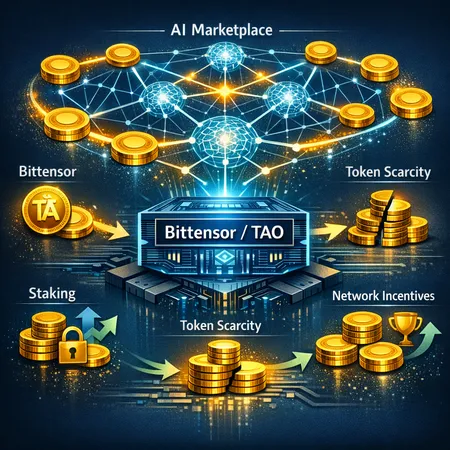
Bittensor layers payment flows on top of incentive mechanisms: participants stake TAO to signal belief in a node’s efficacy, nodes earn TAO for verifiably useful outputs, and the network’s scoring system elevates high-performing contributors. That creates three practical benefits:
- Discoverability: buyers can find high-quality models through on-chain reputation rather than opaque API marketing.
- Aligned incentives: compensation ties directly to the usefulness of outputs, which should reduce low-quality spam and encourage continual model improvement.
- Composability: because payments and reputation are tokenized, developers can compose services (e.g., chaining multiple models) and settle with TAO without off-chain billing plumbing.
From an AI-developer perspective, the promise is compelling: you can monetize models and spin up lightweight inference nodes, while capturing upside if the network’s token value grows. From an investor perspective, TAO becomes both an access token and a prospective value accrual vehicle for the growth of on-chain AI demand.
Staking and network incentives
Staking in Bittensor functions as the economic signal for node quality and eligibility. Nodes or “neurons” stake TAO to participate in the validation and reward curves; staking adjusts ranking and influences how much reward a node can capture for serving requests. These sorts of mechanics are important because they align token holders’ interests with network health: good nodes are rewarded, poor nodes lose relative share.
Those dynamics also create governance levers: token holders have economic skin in the game, which can shape parameter changes, reward schedules, and dispute resolution. But staking locks and bonding periods can also introduce liquidity risk for speculators — an aspect investors must weigh carefully.
TAO’s scarcity: how it resembles Bitcoin, and why that matters
Bittensor explicitly borrows scarcity design philosophies from Bitcoin to give TAO supply discipline. The idea is simple and strategic: if TAO is used widely as the unit of account inside an AI marketplace, then a predictable, scarcity-minded monetary policy reduces inflation risk and supports long-term value capture for providers and investors.
- Bitcoin-style discipline: Unlike tokens with unconstrained inflation, Bittensor’s roadmap and public commentary emphasize a capped or tightly controlled issuance model that aims to emulate Bitcoin’s long-term scarcity properties (see the feature article describing this design rationale).[1]
- Why it matters: Scarcity matters because it changes the incentives for long-term infrastructure providers. If the rewards they earn are from a token with expected appreciating purchasing power, they may be more willing to invest in reliable infrastructure, training, and community-building.
That said, scarcity alone is not enough. Value capture depends on real demand for TAO as a medium of exchange inside the AI marketplace and on how much on-chain activity translates into token velocity or burning mechanisms that reduce supply. The market also prices scarcity against speculative narratives: short-term momentum, macro liquidity, and token listings can dominate price action regardless of protocol-level monetary policy. Recent market updates note volatile TAO price behavior and trader debates about momentum and timing for decisive moves — a reminder that design and market reality can diverge in the near term.[2]
Likely use cases for an AI marketplace denominated in TAO
Bittensor’s architecture supports several realistic and near-term use cases:
- Pay-per-query inference marketplaces: apps route user queries to the best-performing models and pay per response in TAO. This reduces friction for micro-payments across providers.
- Composable AI stacks: developers stitch multiple models together (retrieval + reasoning + specialized classifiers) and settle costs automatically in TAO, enabling new business models for lightweight AI agents.
- Decentralized inference networks: nodes in edge or cloud environments offer latency-optimized inference for niche use cases (voice assistants, on-device vision) and monetize those edges without centralized API providers.
- Reputation-driven model licensing: organizations license high-performing models whose reputation and audit trails are embedded on-chain and collateralized via staking.
Each use case shifts who benefits: data scientists and small labs get monetization channels; app developers get cheaper, more competitive model access; and token holders potentially capture protocol growth via staking and fees.
Key risks and caveats
No protocol is risk-free. For Bittensor and TAO, the main risk categories are:
- Market and liquidity risk: TAO’s price can be volatile. Even with scarcity mechanics, token value depends on adoption and market sentiment. Price swings can undermine its effectiveness as a stable unit of account.
- Technical and latency constraints: on-chain settlements add overhead. For high-throughput, low-latency inference, bridging on-chain payments with off-chain performance is nontrivial.
- Centralization pressure: if a small number of stakers or validator operators control large TAO pools, the network’s security and neutrality can erode.
- Regulatory uncertainty: tokenized payments for AI services may attract scrutiny in jurisdictions where securities, payments, or data laws are in flux.
- Competition and network effects: centralized API providers (e.g., major cloud/AI vendors) can undercut price or offer superior developer ergonomics, making it hard for decentralized alternatives to gain mainstream traction.
A balanced reading of the landscape is important: protocol design can mitigate some risks (transparent reward curves, slashing, distributed validator sets), but others — like market adoption and regulatory posture — depend on external actors and time.
Tactical entry considerations for crypto and AI investors
If you’re an intermediate investor or AI developer evaluating TAO, consider these tactical steps:
Understand token mechanics and distribution. Read the protocol’s tokenomics docs: what is the issuance schedule, are there halving-like events, and how concentrated is the supply? Scarcity narratives matter less if distribution is highly centralized.
Assess staking rules and lock-up terms. How long are bonding periods? Are rewards claimable immediately? Lock-up windows can limit liquidity and affect position-sizing.
Evaluate on-chain activity vs. narrative. Look at on-chain metrics (active addresses, fee revenue, number of inference calls) rather than only price charts. Adoption is the real engine that could convert scarcity into value.
Risk-manage allocation. Given TAO’s volatility and protocol risk, treat allocations as speculative infrastructure exposure. Use position-sizing and consider laddered entry to average cost.
Use liquid access points and custody best practices. If you plan to stake, use reputable interfaces and understand slashing conditions. Short-term traders may prefer spot liquidity on exchanges; long-term supporters may stake or run nodes.
Watch macro and AI-cycle catalysts. Enterprise buys, partnerships, or significant increases in on-chain inference demand are material events. Conversely, negative regulatory headlines or security incidents can compress prices quickly.
For developers: prototype conservatively. Test using small TAO amounts or testnets, measure latency and settlement friction, and consider hybrid architectures that combine off-chain inference with on-chain settlement for cost efficiency.
Finally, remember that platforms and tooling matter. Services like Bitlet.app and other wallet/fiat-rail providers can ease fiat-to-token flows for developers and buyers, which in turn supports real-world usage and demand.
How to think about TAO relative to other crypto plays
TAO is neither purely an application token nor purely a commodity: it’s designed to be a unit of account, incentive, and potential store of value inside an AI-native marketplace. That hybrid role creates unique upside but also unique failure modes.
Compare TAO to utility tokens used for compute markets (such as some decentralized cloud projects): the difference here is the explicit alignment to model quality and scarcity mechanics that aim to reward long-term participation. Yet that alignment only pays off with genuine marketplace demand and a competitive edge versus centralized incumbents.
Traders should therefore think in scenarios: a bull-case where TAO becomes the de facto unit of account for decentralized AI inference (leading to persistent fee revenue and token appreciation), and a bear-case where centralized APIs dominate and TAO remains a niche, illiquid collateral. Position sizing should reflect which scenario you believe is more likely.
Conclusion — a pragmatic, time-aware view
Bittensor is an intriguing experiment at the intersection of crypto and AI: an on-chain marketplace that pays intelligence providers in a token deliberately designed with scarcity and staking incentives. That design philosophy — borrowing from Bitcoin’s monetary discipline — can strengthen long-term alignment between providers and holders, but it is not a guarantee of network success.
For intermediate investors and AI teams, the prudent path is to combine technical due diligence (tokenomics, staking rules, on-chain activity) with tactical risk management (allocation limits, liquidity planning, and staged entries). Keep an eye on adoption signals — actual paid inference calls and developer integrations — since those fundamentals will ultimately determine whether scarcity translates to tangible value.
Sources
- Built like Bitcoin, designed for AI — is Bittensor TAO? — feature profile framing Bittensor as an AI-first network and explaining TAO’s Bitcoin-like scarcity mechanics.
- TAO hits 300 zone again, but when should traders expect next decisive move? — market update describing recent TAO price action and trader-focused timing context.
(If you’re building or researching this space, prototype on testnets, validate latency and settlement models, and keep an eye on evolving token rules — the technical and economic experiments here will matter for years.)