What the SEC/CFTC Guidance on XRP Means: Legal Stakes, Market Impact, and ETF Prospects
Summary
Executive summary
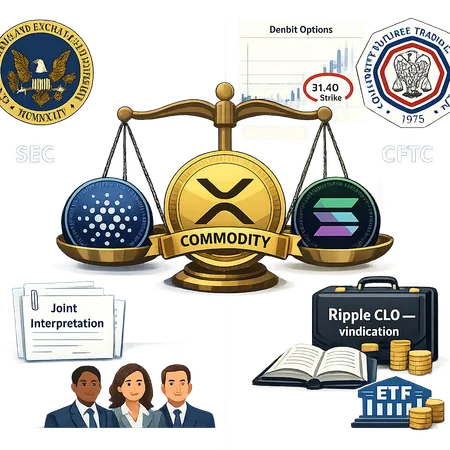
A recent joint interpretation by the SEC and CFTC has shifted the conversation about how certain tokens—most notably XRP—should be treated under U.S. law. Regulators signaled that a group of tokens fall outside the SEC’s securities remit and may be treated as digital commodities, which reallocates enforcement and market-structure implications toward the CFTC. Ripple’s CLO framed the move as a vindication, and markets immediately priced the implication: derivatives desks showed concentrated interest in strikes near $1.40 on platforms such as Deribit. This analysis explains the legal mechanics of the guidance, what it means for trading and custody, implications for ETFs and institutional product development, and practical next steps for token projects and compliance teams.
What the joint interpretation says — a concise read
The guidance—reported across market outlets—effectively distinguishes a subset of tokens from securities, calling them digital commodities rather than investment contracts that would trigger the Howey analysis under securities law. Reporting indicates the SEC and CFTC have coordinated to clarify where jurisdiction overlaps and where the SEC will not treat certain tokens as securities. Coverage summarized this as a formalized recognition that tokens like XRP are not securities in the regulators’ view and therefore fall into commodity territory (CoinPaper).
Ripple’s Chief Legal Officer Stuart Alderoty publicly framed the interpretation as a vindication of Ripple’s decades-long position that XRP is not a security (Bitcoinist). Broader reporting listed other coins (e.g., ADA, DOGE, SHIB) as included in the non‑security characterization, though specifics and legal nuance differ by token and context (U.Today).
Legal mechanics — why this matters and how it works
Jurisdictional division: SEC versus CFTC
- The SEC enforces securities law; the CFTC regulates commodities and derivatives markets. The central question is whether a token qualifies as an "investment contract" under the Howey test (an investment of money in a common enterprise with an expectation of profits derived from the efforts of others).
- If regulators treat a token as a commodity, the CFTC gains primary jurisdiction for market oversight and derivatives regulation while the SEC’s securities framework is less likely to apply. That does not immunize token activities from all SEC scrutiny (e.g., tokenized securities, tokenized investment products, or unregistered offerings may still raise SEC concerns).
Why the guidance isn't a universal green light
- Classification decisions are fact‑specific. The interpretation sets a roadmap but not a one-size-fits-all pass for every token. The SEC/CFTC statements will be evaluated against token economics, distribution history, developer control, marketing, and buyer expectations.
- Courts and future enforcement actions can still refine or challenge the interpretation. Compliance teams should treat this as a meaningful but not definitive change.
Market and derivatives implications
Immediate market reaction
The market response was swift. Derivatives markets—sensitive to jurisdictional certainty—showed increased appetite for XRP exposure, with attention on strikes like $1.40 on Deribit as traders repositioned around new regulatory tailwinds (TokenPost). That kind of options activity signals both directional bets and hedging demand by market makers and institutional desks.
Why derivatives benefit first
- Derivatives activity is largely regulated by the CFTC; clearer commodity status reduces legal uncertainty for exchanges, clearinghouses and market participants writing futures and options.
- Liquidity providers and institutional desks prefer well-defined legal frameworks. Commodity characterization lowers counterparty legal risk and can encourage tighter spreads and deeper markets.
Secondary trading and custody effects
- Spot trading platforms will still consider prudential and compliance obligations (KYC/AML, sanctions checks, custody assurances) before expanding support.
- Custodians and prime brokers will be more willing to offer custody and staking/settlement services when a token is seen as a commodity with established derivatives markets, but they will still demand airtight operational and legal controls.
ETF and institutional product development: possibilities and limits
Does commodity classification enable spot ETFs? Not automatically
- ETF products in the U.S. are typically structured under SEC rules (e.g., 1940 Act or 1933/34 regimes), so the SEC’s approval remains a gating factor for spot ETFs even if a token is characterized as a commodity. The SEC’s recent treatment of spot Bitcoin ETFs demonstrates the agency’s evolving approach, but each token will face its own threshold tests around market manipulation, surveillance sharing, custody and investor protection.
- A commodity designation simplifies the path for CFTC-regulated derivatives ETFs or ETNs referencing futures, but a true spot ETF that holds the token may still require SEC sign-off or tailored structuring that addresses investor-protection concerns.
Practical consequences for product builders
- Market-makers, exchanges and fund sponsors can accelerate derivative product design (futures, options, ETPs tied to derivatives) with more legal clarity.
- Custody solutions and surveillance mechanisms must still meet institutional standards. Large custodian banks and specialized crypto custodians will be central to any institutional-grade ETF or ETP rollout.
What this precedent means for other tokens (ADA, SOL and beyond)
- The guidance sets a meaningful precedent: tokens with broad decentralization, mature trading markets, and limited reliance on issuer managerial efforts have a stronger argument to be treated as commodities.
- Tokens like ADA and SOL will be evaluated on the same axes: decentralization of governance, distribution and the economic realities of purchaser expectations. Reporting suggests several tokens were explicitly discussed as non-securities in the list that circulated publicly (U.Today).
- But each token’s path depends on history: token sales, lockups, developer conduct, and explicit marketing/promises. Projects with early centralized token sales or ongoing developer control should expect closer scrutiny.
Practical next steps for token projects, legal and compliance teams
Document decentralization and economic realities
- Maintain contemporaneous records that demonstrate a shift toward decentralized governance (timelines of decentralization, working groups, on‑chain governance actions).
- Preserve and publish data on token distribution, vesting schedules and secondary market liquidity.
Strengthen governance and operational independence
- Where feasible, accelerate on‑chain governance, reduce unilateral developer controls, and establish independent multisig custody/treasuries.
Obtain and update legal opinions and disclosures
- Work with external counsel to craft fact‑specific legal analyses; do not rely on generic legal memos. Update offering materials and public disclosures to reflect actual token economics.
Build institutional-grade custody and surveillance
- Engage qualified custodians, implement robust proof-of-reserves and surveillance agreements, and design market‑abuse monitoring compatible with institutional counterparties.
Engage regulators and market infrastructure early
- Seek direct engagement or no-action clarity where possible, participate in industry working groups, and coordinate with potential market-makers and exchanges on surveillance-sharing arrangements.
Revisit commercial partnerships and products
- If classification risk is materially reduced, prioritize derivatives product readiness, prime brokerage integration and ETF feasibility studies—while recognizing SEC approval remains central to many products.
Risk factors and remaining unknowns
- The interpretation narrows but does not eliminate legal risk. Enforcement policy, future rulemaking, and litigation can change the landscape.
- Cross-border considerations: other jurisdictions have different securities/commodity thresholds; global product design must account for divergent regimes.
- Market-structure issues like liquidity fragmentation, custodial risk and counterparty exposure remain operational barriers to institutional adoption despite improved regulatory clarity.
Conclusion: calibrated optimism, tactical work
The SEC/CFTC guidance marks a significant shift toward clearer demarcation between securities and commodities in the crypto space, and it provides a firmer footing for derivatives growth and institutional participation in tokens like XRP. Ripple’s legal team views the move as a vindication, and market participants immediately adjusted hedges and options positions—evidence that legal clarity begets market activity. However, commodity classification is not an automatic license for every product or token: SEC sign-off, custody rigor and market surveillance remain essential for institutional products such as spot ETFs.
Legal and compliance teams should treat the new guidance as an invitation to accelerate governance reforms, documentation and custody standards. For institutional investors and product teams, the window to build compliant derivatives, ETP and custody solutions is open—but only if projects can demonstrate the operational and legal maturity that institutions require.
For readers tracking broader market signals, remember that Bitcoin often functions as a bellwether for commodity-derived product flows, and decentralized finance developments continue to reshape how token classification debates are framed. See related coverage on Bitcoin and the evolving ecosystem around DeFi. Bitlet.app users and institutional partners will be watching custody and product announcements closely as sponsors and custodians react to this new guidance.
Sources
- "Ripple CLO: What New SEC Guidance Means for XRP" — Bitcoinist: https://bitcoinist.com/ripple-clo-what-new-sec-guidance-means-xrp/
- "XRP declared a digital commodity, not security: SEC and CFTC clarify its status" — CoinPaper: https://coinpaper.com/15523/xrp-declared-a-digital-commodity-not-security-sec-and-cftc-clarify-its-status?utm_source=snapi
- "XRP, SHIB, DOGE, ADA classified as non-securities" — U.Today: https://u.today/xrp-shib-doge-ada-classified-as-non-securities-full-list-disclosed-binances-cz-ripple-clo-react?utm_source=snapi
- "XRP trading and options strike interest near $1.40 on Deribit" — TokenPost: https://www.tokenpost.com/news/investing/19099