Curve vs. PancakeSwap: Code Attribution, Licensing Risks, and What DeFi Teams Should Learn
Summary
Why the Curve–PancakeSwap dispute matters
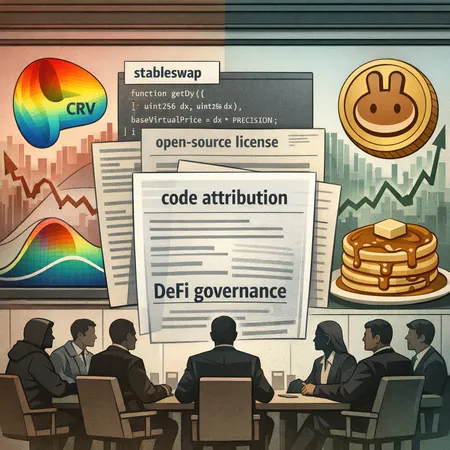
In April 2024 Curve Finance publicly accused PancakeSwap of replicating the core of its stableswap code without adequate attribution — a claim that immediately raised questions about how permissive open-source practices interact with commercially driven DeFi forks. The story is not just about two protocols; it touches licensing precedent, governance enforcement, and the commercial calculus for teams that reuse or fork foundational DeFi primitives.
Both technical reuse and license enforcement have real-world consequences: they affect developer trust, the ability to collaborate across ecosystems, and token-market perception for projects like CRV and CAKE. For builders and legal advisors, the incident is a timely case study in the limits of informal norms and the practical steps teams should take to reduce risk.
The technical claim: how similar is “stableswap” reuse?
Curve’s stableswap invariant and implementation became a widely adopted template for low-slippage stablecoin liquidity pools. The accusation centers on PancakeSwap’s implementation reportedly mirroring Curve’s algorithmic structure and parameters in ways Curve considers beyond trivial inspiration.
From a technical lens, there are two distinct questions:
- Is the PancakeSwap code a line-for-line or closely derivative copy of Curve’s repository?
- Or did PancakeSwap independently reimplement the same algorithm (the stableswap invariant) using the same mathematical ideas but different source code and structure?
Both scenarios carry different legal and community implications. A verbatim copy leans toward a licensing/attribution violation if the original license demands it; an independent reimplementation of public-domain ideas or algorithms is a more defensible position, though attribution is still customary in open-source culture.
Coverage of the initial complaint and market reaction is available in crypto reporting, including a summary of Curve’s accusation and the public thread that followed here, and subsequent write-ups noting that PancakeSwap moved to private negotiations after the accusation here.
Why stableswap code is sensitive
Stableswap is both an algorithmic innovation and a commercially valuable design: it optimizes for low slippage between pegged assets. That means a working implementation is economically valuable and competitively sensitive for AMM operators. When a protocol copies that implementation, the copying party obtains a time-to-market and integration advantage that can be worth meaningful fees and market share.
The public accusation and private talks: sequence and signposts
Public accusations do several things at once: they force transparency, rally community opinion, and create market noise. Curve went public with its concerns, which prompted media coverage and community debate. According to reporting, PancakeSwap then moved into private discussions with Curve, opening the door for either a licensing negotiation or a broader technical alliance rather than immediate escalation to litigation.
Private talks are a pragmatic first step. They preserve optionality: a licensing deal, an attribution fix, a technical redesign, or a commercial partnership are all feasible outcomes without the reputational and cost burdens of courtroom battles. News outlets tracking the story flagged these private negotiations and highlighted the market’s watchful stance for any official licensing announcement (or, conversely, signs of legal escalation) here.
Open-source license realities for DeFi teams
Open-source licenses are not all the same. For DeFi teams and legal advisors, the applicable license determines what’s required and what remedies exist.
- Permissive licenses (MIT, Apache 2.0) generally allow reuse, including commercial reuse, often only requiring preservation of copyright notices and attribution.
- Copyleft licenses (GPL, AGPL) can require derivatives to be distributed under the same license terms and may have broader obligations for source disclosure.
- Some projects adopt custom terms or dual-licensing models that explicitly permit commercial sublicensing under negotiated terms.
Two important practical points follow:
- Attribution matters. Even when a license is permissive, failure to honor copyright notices and attribution clauses damages trust and can prompt enforcement actions or public condemnation.
- Copy-left obligations can be triggered by derivative works. If a protocol’s contract or front-end is a derivative under jurisdictional interpretation, obligations to share source or license alike may follow.
For teams uncertain about their position, the right move is early legal review and transparent community communication — not silence.
Best practices: code attribution, governance, and licensing hygiene
DeFi teams should treat licensing and attribution as part of product risk management rather than an afterthought. Practical steps include:
- Maintain clear license headers and a top-level LICENSE file in repositories.
- Use tools to scan dependencies and detect copied code (license scanners, static analysis).
- Adopt Contributor License Agreements (CLAs) or Developer Certificates of Origin (DCOs) to clarify ownership and permissions.
- If reusing design/algorithms, add clear attribution in code comments and documentation, and link to the original project.
- Consider dual-licensing or a permissive baseline plus a commercial license to handle enterprise usage.
- Put a governance motion or RFC in place before integrating externally-sourced code that could have legal constraints.
A short practical checklist for teams preparing to fork or reuse significant DeFi primitives:
- Confirm original license and any contributor agreements. 2. Run automated and manual code-diff checks if you started from another repo. 3. Document design decisions in a governance proposal and open them to on-chain/off-chain votes if possible. 4. Budget legal review for commercial integrations.
These measures are not purely legal theater — they reduce the likelihood of disruptive public disputes and token-market shocks.
Potential outcomes and token-market implications (CRV and CAKE)
There are a few plausible outcomes from the Curve–PancakeSwap episode, each with different implications for CRV and CAKE holders.
Licensing deal or attribution settlement: Curve secures licensing fees or a formal attribution. This outcome tends to be the least disruptive to markets. CRV could see a modest reputational win (positive governance signal), while CAKE's price impact would likely be muted once the matter is resolved and any retroactive compliance is visible.
Technical alliance or joint development: If the parties collaborate (shared audit, co-branded pools, or joint licensing), the market may view this as constructive. CRV could benefit from licensing revenue or broader adoption of the stableswap model; CAKE could benefit from improved technical credibility.
Technical rewrite by PancakeSwap: If PancakeSwap chooses to avoid licensing costs by reengineering the pool, short-term development and UX disruptions could hurt user liquidity and put selling pressure on CAKE while investors wait for feature parity.
Legal escalation and enforcement: Litigation or aggressive enforcement of copyleft terms would inject uncertainty. Such escalation risks negative market sentiment for both sides — CRV because the suit might be seen as adversarial, and CAKE due to operational risk. Legal battles are slow and expensive, and markets typically dislike protracted uncertainty.
Token-market reaction will depend on perceived clarity of the outcome and speed of resolution. Historically, transparency and quick settlements calm markets; extended ambiguity amplifies volatility.
Governance lessons and precedent for commercial forks
The episode is a governance test case. Protocols with on-chain governance like Curve can escalate community norms into enforceable policy (e.g., requiring attribution or licensing standards for integrations). But governance bodies must balance enforcement with the open innovation that powered DeFi’s growth.
For governance participants and legal advisors, the pragmatic path is to translate norms into explicit rules and processes. That may include:
- Governance proposals specifying acceptable licensing frameworks for projects that intend to reuse protocol code.
- Treasury-based mechanisms to fund legal defense, licensing negotiations, or bounties to remediate third-party reuses.
- Formalizing technical review boards or working groups that sign off on external code reuse before deployment.
These steps protect both IP integrity and the broader ecosystem’s ability to iterate.
Practical takeaway for builders, governors, and counsel
This dispute underscores that open-source status is not a carte blanche for ignoring attribution or license obligations. Whether you are a developer integrating a stable AMM, a governance voter assessing risk, or legal counsel advising a protocol, prioritize: license clarity, documented provenance, contributor/CLA processes, and a governance path for remediation.
For market watchers — including platforms like Bitlet.app that integrate multiple DeFi services — the key signal is how quickly and transparently disputes are resolved. Fast, constructive resolutions preserve liquidity and trust; drawn-out conflict erodes both.
Conclusion
The Curve vs. PancakeSwap friction is a useful reminder that norms in open-source communities can and should be codified into concrete licensing, attribution, and governance practices. The technical similarity of stableswap implementations makes disputes possible; how teams respond — with licensing deals, alliances, rewrites, or litigation — will set precedent. DeFi projects that treat licensing hygiene as a first-class risk item will be better positioned to avoid costly disputes and stabilize token-market impacts.
Sources
- Curve questions PancakeSwap's use of its codes — BeInCrypto
- Curve Finance accuses PancakeSwap of copying stableswap code — The News Crypto
- Curve Finance accuses PancakeSwap of copying stableswap code — The News Crypto (follow-up)
For further reading on licensing frameworks in DeFi and practical tooling, teams should consult legal counsel and integrate license-scanning tools into CI pipelines. For community context and similar disputes, watch broader DeFi discourse and past precedents to understand how norms become enforceable.