Bitdeer Posts 174% Q3 Revenue Jump, Adds 500+ BTC Ahead of Halving
Summary
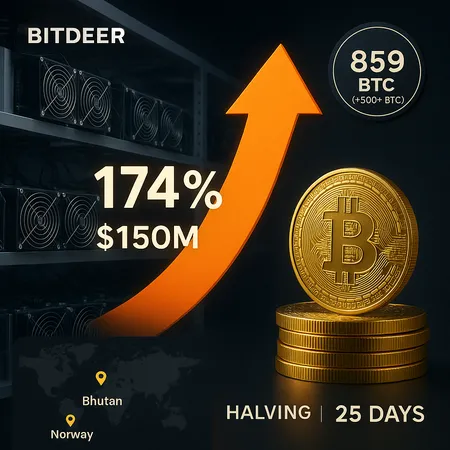
Bitdeer closed Q3 with a performance that grabbed attention across the mining sector: $150 million in revenue, a 174% year-over-year increase, and more than 500 BTC added to its treasury. Those headline numbers reflect a blend of operational scale-up, improved efficiencies, and active BTC accumulation. The quarter also included capacity gains from new sites in Bhutan and Norway — moves that broaden Bitdeer’s geographic and renewable-energy footprint as the market looks toward the halving.
Q3 Financial Performance and Drivers
Revenue growth was the marquee outcome: Bitdeer reported $150M, largely attributable to higher hash rates and better miner utilization. Higher bitcoin network difficulty and transient mining rewards typically pressure margins, yet Bitdeer’s scaling and cost management translated into outsized top-line expansion. Management cited stronger machine deployment and reduced downtime as material contributors. In short, the company turned operational improvements into meaningful revenue gains during a period of rising competition among miners.
Mining Operations and BTC Accumulation
Operationally, Bitdeer added over 500 BTC during Q3, bringing on-chain reserves to 859 BTC. Accumulating BTC while operating at scale signals a dual strategy: monetize production to cover costs and retain a meaningful treasury stake to benefit from long-term BTC appreciation. For miners, holding BTC can both increase balance-sheet strength and expose the company to price volatility — a trade-off management appears willing to accept as part of a growth posture.
Capacity Expansion: Bhutan and Norway
Expansion in Bhutan and Norway was highlighted as a capacity boost this quarter. Both jurisdictions offer attractive features for large-scale mining: favorable energy contracts, grid access, and opportunities to leverage renewable sources. These additions not only increase aggregate hash rate but also diversify geographic risk. Greater exposure to low-carbon energy aligns with broader industry trends toward sustainability and can be a differentiator as institutional scrutiny of miner emissions increases.
Halving Preparation and Market Positioning
With the Bitcoin halving approaching, miners that expand capacity now can capture a larger share of network rewards even as block subsidies fall. Bitdeer’s Q3 moves — capacity growth and BTC accumulation — suggest management is positioning the firm to weather a post-halving supply shock. This strategy interacts with broader blockchain dynamics: reduced issuance tends to tighten supply while demand drivers from institutional and retail channels remain intact. Miners that manage costs and scale effectively often emerge stronger after halving events.
Strategic Takeaways for Investors and Users
Key takeaways: scale matters, and Bitdeer’s Q3 shows execution on both deployment and treasury strategy. For platform users and traders — including those on services like Bitlet.app — this performance signals a healthier upstream mining ecosystem, which can influence BTC liquidity and macro sentiment. Investors should view Bitdeer as a miner that is actively balancing production, reserve accumulation, and regional diversification to capture upside from future BTC price appreciation.
Risks, Outlook and What to Watch
Despite the positive quarter, risks remain. BTC price volatility, changes in mining economics (e.g., hash price swings), and regulatory developments in host countries could affect future profitability. Operational risks — supply-chain delays for hardware and local permitting — are also relevant as Bitdeer scales. Watch upcoming production guidance, estimated hash-rate additions, and any updates on power contracts: these will clarify whether Q3 was an inflection point or part of a shorter cycle.
Conclusion
Bitdeer’s Q3 was a clear operational and financial step forward: 174% revenue growth, capacity expansion in strategic markets, and a meaningful increase in BTC reserves to 859 BTC. The company’s moves position it to contend with the halving-era dynamics, but outcomes will hinge on BTC price trends, cost discipline, and regulatory climates. For readers tracking miner performance or the broader DeFi and mining landscape, Bitdeer’s quarter is a reminder that scale plus strategic reserve management can reshape competitive standing.