Can Ripple’s $750M Buyback and Rising On‑Chain Activity Change XRP’s Market Story?
Summary
Executive snapshot
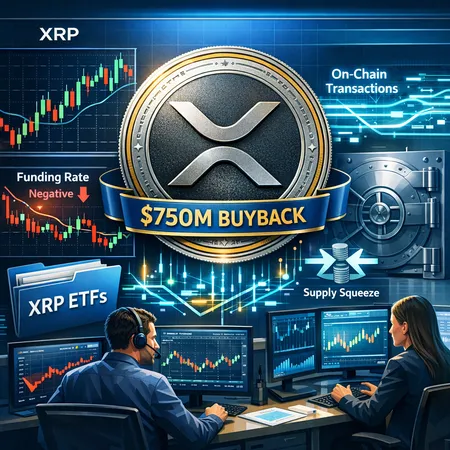
Ripple’s newly announced $750 million buyback grabbed headlines and stirred debate among traders and analysts: is this a tactical price-support move or the start of a structural supply squeeze? The answer sits between hype and certainty. Corporate treasury actions, ETF flows, and on‑chain usage all interact, but each moves on its own cadence and with different market mechanics.
For active traders and crypto analysts, the immediate questions are practical: how big is the buyback relative to float, how transparent will execution be, does increased ledger activity translate to lower circulating supply, and what does a persistently negative funding rate tell us about sentiment? This article walks through each element and closes with tactical signposts to watch.
What Ripple announced and its strategic aims
In short: Ripple disclosed a program to repurchase up to $750 million of XRP from the market. Media coverage framed it as both a confidence vote and a way to reduce available supply; commentators even suggested Ripple may be positioning for a much higher corporate valuation if market conditions improve.
- The explicit aims appear to be a mix of signaling and balance‑sheet engineering: show conviction in the asset, tighten available float, and potentially move investor perceptions toward a higher valuation for Ripple the company. Coverage of the plan and market reactions can be found in reporting on Ripple’s announcement and valuation ambitions.Crypto.News reports on the buyback plan and market response and AmbCrypto examines how the buyback ties to valuation talk.
Why execution details matter
A $750M headline sounds large, but impact depends heavily on three practical factors:
- Pace of purchases: One‑time bursts move price quickly; slow, multi‑quarter programs can be absorbed.
- Source and method: Will Ripple buy on open markets, OTC, or via structured programs? OTC buys reduce exchange liquidity impact and are less visible.
- What happens to repurchased XRP: Is it retired (burned) or held on Ripple’s balance sheet? Permanent removal is a true supply contraction; retention is less mechanically impactful.
Absent fast, transparent buybacks that remove coins from circulation, the program risks being more of a confidence play than a durable supply squeeze.
On‑chain transactions: rising activity and what it really signals
On‑chain metrics on the XRP Ledger have moved higher: daily transactions recently surged past the multi‑million mark, a sign that more users and flows are using the ledger for transfers and micro‑use cases. CoinPaper covered this uptick in transaction activity and what it implies for network utility.CoinPaper’s report on transaction growth is a useful reference.
More transactions can help the market absorb supply in two ways:
- If on‑chain activity reflects genuine demand (payments, rails, on‑ramping), tokens move into productive use and long‑term holders may accumulate.
- Higher usage can attract institutional products (payment partnerships, custody demand) that create ongoing bid.
But there’s a counterpoint: increased velocity can also mean more distribution. Every payment or smart‑contract movement is a potential liquidation event if recipients decide to sell. In other words, activity alone does not equal scarcity.
XRP ETFs (and funds): resilience and potential structural demand
Where listed or proposed, XRP ETFs or exchange‑traded products could create a steady institutional channel for buying. Compared to ad‑hoc retail demand, ETF mechanics (creation/redemption, index tracking, custody) can provide persistent inflows when investor interest rises.
However, the resilience of XRP ETFs is conditional:
- Regulatory clarity and listing approvals determine scale.
- Fee structures, accessibility for large managers, and whether ETFs truly capture spot liquidity matter.
- Even with ETFs, fund flows have to be meaningful relative to market float to offset sell‑side pressure from a corporate treasury.
Think of ETFs as potential scaffolding for demand: helpful, possibly durable, but not guaranteed. Like spot Bitcoin ETFs, they can amplify both bullish and bearish phases depending on flows and macro context.
Funding rate trends and trader sentiment
Perpetual futures funding rates are a short‑term trader thermometer. Persistent negative funding — where longs pay shorts — signals that active traders are lined up on the short side and that leverage favors downward pressure. Historical analysis shows funding rates can remain negative for extended stretches even while bulls tout corporate moves.
NewsBTC noted past periods when XRP’s funding rate weakness contrasted with corporate activity, illustrating that buybacks don’t immediately flip trader positioning.NewsBTC’s analysis of negative funding and short‑term pressure is a useful precedent.
What negative funding implies practically:
- Market makers and leveraged funds are amplifying sell bets — they’re not convinced a buyback or PR narrative will outpace liquidity.
- Options markets may price a higher probability of downside, increasing puts demand and skew.
- A short‑saturated market is more vulnerable to squeezes if buybacks are aggressive, but until buybacks change the economics of shorting (costs rise), shorts can persist.
How supply dynamics combine: corporate treasury, buybacks, and the supply squeeze thesis
Several moving parts define whether a real supply squeeze is plausible:
- Ripple’s corporate treasury holdings are large relative to daily traded volumes; how Ripple allocates, sells, or buys its reserves shapes available float.
- A buyback of $750M will reduce circulating supply if repurchased tokens are removed; but measured against the total market cap and typical daily volumes, it may be a low‑single‑digit percent effective reduction — helpful, not transformative.
- On‑chain adoption reduces the marginal propensity to sell only if token recipients choose to hold rather than monetize.
Put differently: corporate repurchases can nudge supply dynamics, but on their own they rarely generate a sustained narrative shift unless paired with structural demand (ETF inflows, sustained ledger utility, institutional custody adoption).
Short‑term volatility vs. long‑term structural change
Expect divergence between headline reactions and structural outcomes:
- In the short term, announcements and early buyback executions often raise volatility and can trigger squeezes if shorts are crowded. Momentum traders will react fast.
- In the medium to long term, the market will ask for proof: repeatability of buybacks, evidence that repurchased XRP is locked or burned, consistent ETF inflows, and real revenue or use‑case growth on the ledger. Without these, price bumps can fade as traders profit‑take and shorts re‑enter.
Historically, single corporate actions move price but don't usually rewrite fundamentals. To shift narrative permanently, Ripple needs a combination: transparent and meaningful buybacks, measurable on‑chain adoption (not just spikes), and institutional channels like ETFs that routinely absorb supply.
Signals traders and analysts should watch next
Concrete indicators to monitor:
- Buyback cadence and venue: public disclosures of amounts, timing, and whether purchased XRP is retired.
- Exchange inflows/outflows: are exchanges seeing net withdrawals (supply tightening) or deposits (potential selling)?
- Funding rate and open interest: persistent negative funding and rising open interest suggests continued short pressure.
- ETF flows (where available): creation/redemption data and net inflows by fund managers.
- On‑chain metrics beyond tx count: active unique addresses, token age distribution, and large wallet movements. CoinPaper’s coverage of the transaction uptick is a starting point for those deeper checks.CoinPaper on the ledger’s transaction growth
Tactically, many traders will prefer event‑driven strategies: trade the announcement and early execution windows, watch funding rate flips for short squeezes, and avoid directional bets until buyback mechanics become transparent.
Bottom line: what Ripple’s buyback likely buys — and what it doesn’t
- The $750M buyback is a meaningful corporate signal and could support price in short windows, especially against a crowded short market.
- By itself, it is unlikely to be a silver bullet that permanently changes XRP’s market structure unless paired with sustained ETF demand and demonstrable ledger‑level adoption that reduces the propensity to sell.
- Persistent negative funding rates and the scale of Ripple’s treasury mean that traders should remain cautious: expect volatility, monitor flow data, and demand transparency.
For analysts building models, include buyback scenarios as supply‑shock inputs but stress‑test assumptions around buyback speed and token retirement. And if you’re scanning for catalysts, add fund flow data and funding‑rate shifts to your watchlist.
Bitlet.app users and other platform traders should treat the buyback as a material but partial factor — important, not definitive.
Sources
- https://crypto.news/will-xrp-price-react-ripple-launches-750m-buyback-plan/
- https://coinpaper.com/15372/xrp-ledger-hits-new-gear-as-daily-transactions-surge-past-2-7-m?utm_source=snapi
- https://ambcrypto.com/ripple-eyes-50b-valuation-with-750m-buyback-is-xrp-paying-the-price/
- https://www.newsbtc.com/analysis/xrp/xrp-negative-funding-2022/