What Pump.fun’s $1B Means for Solana: Monetization, Cross-Chain Subdomains, and SOL Flows
Summary
Executive overview
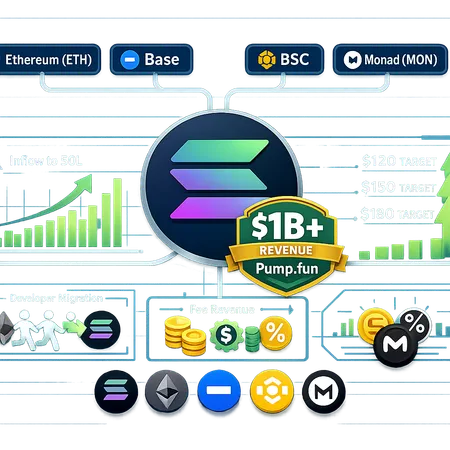
Two concurrent signals deserve attention: a major application inside the Solana stack—Pump.fun—has reportedly crossed the $1 billion revenue mark, and on-chain exchange flows for SOL have spiked, pushing technical commentators to identify price targets. Taken together these events suggest monetization is arriving at platform scale, and that the ecosystem is actively experimenting with cross-chain surfaces via subdomains on Ethereum, Base, BSC and Monad. For protocol analysts and Web3 founders, the core question becomes: does this represent a sustainable shift in where value accrues (to apps, to the base layer, or to both), and how will developer migration respond?
Pump.fun’s revenue milestone and its cross-chain footprint
Pump.fun’s reported revenue milestone is notable for several reasons beyond the headline figure: it demonstrates that consumer-facing, high-frequency marketplaces on Solana can capture substantial economic value, and it acts as a proof point for monetization product-market fit on a low-fee, high-throughput chain. TheBlock’s reporting highlights not only the $1B revenue threshold but also the presence of subdomains registered on other chains — a visible indicator that the platform is preparing for or already experimenting with cross-chain routing and discovery (The Block).
This matters because subdomains on ETH, Base, BSC and MON (Monad) are more than marketing: they are a signal of intent to capture users and liquidity that live outside native Solana interfaces. If a high-revenue app like Pump.fun deploys or points to multi-chain entry points, it reduces friction for users who prefer wallets, custodians, or tooling on other chains — and that can accelerate user acquisition without relying solely on native Solana tooling.
SOL exchange inflows and the technical price read
Coinciding with these platform-level moves, analysts have flagged sharp spikes in SOL exchange inflows as a leading indicator of price pressure and potential liquidation cycles. One recent analysis links an exchange inflow surge to a technical upside target in the mid-double-digits for SOL, around $65, based on flow-adjusted momentum and historical price reaction to large inflow pulses (Blockonomi).
Exchange inflows often precede volatility: large deposits can be a prelude to selling (which increases supply on exchanges) or to margin/liquidation events when leveraged positions are opened. The interpretation matters: if inflows are primarily dealers and market makers hedging aggregated onchain exposure from multi-chain activity, price impact will differ from a wave of retail profit-taking. Either way, flows tell a cleaner story than price alone when assessing near-term token fundamentals.
What platform-level monetization implies for SOL fundamentals
When an app on a layer-1 captures sizable revenue, several channels can strengthen token fundamentals — but outcomes depend on tokenomics and governance choices.
Sell pressure vs. capture mechanisms. If app revenue is denominated off-chain (fiat) or in other tokens and flows out of the Solana economy, the base-layer token sees little direct benefit. Conversely, if apps settle fees on-chain, remit a share to protocol treasuries, or incentivize staking through revenue-backed rewards, the monetary link to SOL becomes meaningful and can reduce net sell pressure.
Valuation and optionality. Large, predictable platform revenue allows market participants to model the chain’s cashflows similarly to how one might value a traditional platform business. That can expand narratives around SOL as not just a speculative asset but a claim on ecosystem activity — especially if projects adopt mechanisms like token buybacks, burns, or treasury accrual.
Liquidity and market structure. High app revenue attracts market makers and specialized counterparties, which improves liquidity and tightens spreads. But it also invites derivatives desks and staking service operators — actors who change the volatility profile of the asset.
Developer incentives and sustainability. If app-level monetization translates to grants, bounties, or clearer revenue-sharing primitives, developer migration and retention become easier. That in turn can increase the pace of innovation and create a virtuous cycle for SOL demand.
These theoretical channels are real but conditional. The material benefit to SOL depends on how apps choose to route revenue and whether governance mechanisms lock value into the native economy.
Cross-chain subdomains: why they matter for developers and adoption
Subdomains on Ethereum, Base, BSC and Monad are a pragmatic growth lever: they lower the perceived switching cost for users and developer tooling, while signaling openness to composability across chains. For founders and protocol architects, several practical implications follow.
Frictionless UX for multi-chain users. Developers can onboard users who already trust wallets and custodial flows on other chains. That matters for NFTs and marketplaces, where buyer trust and wallet compatibility often determine conversion.
Interoperability vs. fragmentation. Cross-chain presence increases total addressable market but can fragment liquidity and state. Teams must decide whether to operate as a cohesive multi-chain protocol (synchronizing liquidity and orderbooks) or accept segmented pools on each chain.
Developer migration choices. Historically, migration out of Solana has been framed as a trade-off between performance and EVM ecosystem compatibility. Cross-chain subdomains lower the migration friction surface but don’t eliminate the core architectural differences (account model, runtime, tooling). Some projects may prefer a hybrid approach: keep high-throughput primitives on Solana while exposing interfaces on EVM-compatible chains to capture distribution.
Security and operational risk. Cross-chain bridges, relayers, and off-chain discovery layers introduce attack surfaces. Projects with substantial on-chain revenue become higher-value targets; thus, security and audit posture must scale in parallel with monetization.
If cross-chain growth accelerates, expect a more heterogeneous developer ecosystem: native Solana tooling will remain valuable for latency-sensitive products, while many consumer-facing funnels will use multi-chain presence for distribution.
Risks, open questions and metrics to watch
Monetization at scale is exciting, but it also raises a set of risks and measurement needs:
- Sustainability of revenue sources. Is Pump.fun’s revenue repeatable or cohort-driven? Is it dependent on promotional activity or short-term speculative demand?
- Revenue capture mechanisms. How much revenue remains in the Solana economy versus flowing out through stablecoins, fiat conversions, or off-chain settlements?
- Bridge and custody risk. Cross-chain subdomains imply more bridges or multisig integrations — watch exploit history and time-to-recover metrics.
- Centralization tendencies. Large-revenue apps may centralize decision-making or custody to optimize monetization, which could create governance tensions.
Key on-chain and off-chain metrics to track:
- Exchange inflows/outflows and reserve balances
- On-chain revenue by protocol and token composition (SOL vs. stablecoins)
- Active developer counts, deployment frequency, and grant program size
- Bridge transaction volumes and mean-time-to-finality for cross-chain messages
Practical takeaways for analysts and founders
For protocol analysts: incorporate flow-based indicators into your SOL models. Exchange inflow spikes and concentrated app revenue are now leading indicators of volatility and potential re-rating. Track whether app revenue is being converted to SOL-denominated treasury assets — that’s a material input for valuation.
For founders and Web3 teams: evaluate multi-chain strategies not as an either/or choice but as a distribution layer decision. Use subdomains and cross-chain UX to expand reach, but prioritize liquidity management and unified market-making to avoid fragmentation. Invest in security ops: higher revenue means more attention from bad actors.
Finally, keep an eye on the interplay between monetization and governance. If profitable apps begin to demand protocol-level revenue sharing, the incentives that once attracted developers to Solana could be reshaped — for better or worse. For teams exploring monetization and exchange services, platforms like Bitlet.app illustrate how P2P and exchange features can dovetail with broader ecosystem monetization strategies.
Conclusion
Pump.fun’s reported $1B milestone and the visible cross-chain subdomain activity are early signals that monetization is scaling in the Solana ecosystem. When combined with pronounced SOL exchange inflows, these developments force a recalibration: token fundamentals are increasingly tied to application-level economics and cross-chain distribution choices. The net effect for SOL will depend on how much revenue is retained within the native economy, how bridges and subdomains are implemented, and whether developer incentives keep pace with the new scale of monetization.
For analysts and founders, the immediate task is to convert these signals into measurable hypotheses: how much on-chain revenue flows back to SOL, how cross-chain UX affects retention, and whether liquidity fragmentation will be managed effectively. Those answers will determine whether Solana’s growing monetization is a sustainable competitive advantage or merely a transient headline.
Sources
- Pump.fun becomes Solana’s first $1B revenue platform — The Block: https://www.theblock.co/post/393358/pump-fun-becomes-solanas-first-1b-revenue-platform-as-ethereum-base-bsc-and-monad-subdomains-hint-at-cross-chain-move
- Solana (SOL) exchange inflow spike and price target analysis — Blockonomi: https://blockonomi.com/solana-sol-price-800-spike-in-exchange-inflows-points-to-65-target/
For many traders, Solana remains the primary market bellwether, and NFT volumes on DeFi platforms illustrate why cross-chain distribution matters.