Behind Bitcoin’s Sprint Above $70K: ETF Flows, Short Squeezes, and What It Means for Altcoins
Summary
Quick context: what just happened
Bitcoin briefly surged above $70,000 last week, with headlines pointing to a mix of positive ETF flows, institutional buying programs and large short liquidations that together produced fast upside. Reports flagged BTC trading above $71K amid Monday ETF net inflows and a rising memecoin market cap, suggesting multiple demand engines were active at the same time (Benzinga). For many traders, Bitcoin still functions as the primary bellwether — but that alone doesn't tell us whether this advance is durable.
Below I break the move down into its core drivers, explain how to tell a squeeze from genuine buying, walk through the technical picture, and outline how ETH, XRP and major memecoins are likely to behave in the coming 30–90 days. This is aimed at intermediate traders who need actionable context for allocating or hedging into the rally.
Drivers: ETF inflows, institutional programs, and forced liquidations
The move above $70K had three overlapping components. Each matters differently for durability.
ETF inflows and institutional capacity
Spot ETF inflows create fresh spot demand by converting fiat into BTC holdings — that’s structural, not a leveraged market backfill. Coverage of ETF net inflows coinciding with higher BTC prints points to continued institutional interest (Benzinga).
Beyond ETFs, larger institutional programs can matter. Reports that Strategy (MicroStrategy-style buying capacity) expanded its purchasing plan provide a multi-quarter tailwind: a meaningful commitment to buy (or capacity to fund purchases) absorbs supply and reduces the likelihood that price collapses on thin liquidity windows (CryptoSlate). When institutional balance-sheet buying is active, rallies have a higher chance of persistence because the buys are not purely leveraged trading flows.
Short squeezes and liquidation cascades
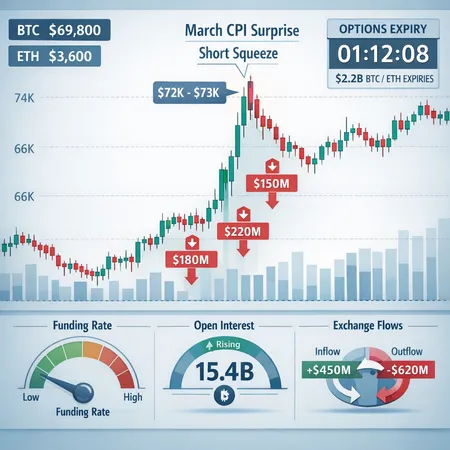
At the same time, futures markets saw very large short liquidations. CoinDesk documented more than $550M in short liquidations during the rebound — and some hourly bursts (reported by NewsBTC) show concentrated $44M+ liquidations on exchanges like Binance. Those events can force price higher rapidly because exchanges buy into spot liquidity to close positions (CoinDesk, https://www.newsbtc.com/news/bitcoin/bitcoin-shorts-squeezed-out-as-spot-demand-stays-weak/).
Mechanically, a cascade is a temporary kicker: leveraged shorts get closed, bid-ask depth thins and price gaps widen. But this buying is often not the same as fresh long-term capital; it can be neutral or even negative for durability if long-only buyers don’t step in after liquidations subside.
Reconciling the two: squeeze-driven rally vs. structural demand
Which dominated this run? The evidence suggests both played roles. The size and speed of liquidations explain intraday spikes and the quick run-up, while concurrent ETF inflows and reported institutional programs provide a base that could prevent an immediate collapse once the squeeze is over. On-chain and spot-volume context matters here: upticks in spot volume and steady UTXO/holding metrics point toward real accumulation rather than purely synthetic orderbook noise (Blockonomi). Treat the rally as conditioned — amplifiable by squeezes but underpinned by some fresh demand.
Technical structure: channels, supports, and bear-flag risk
The market structure after a squeeze can look impulsive, but that’s also a classic setup for a bull-flag or a false breakout.
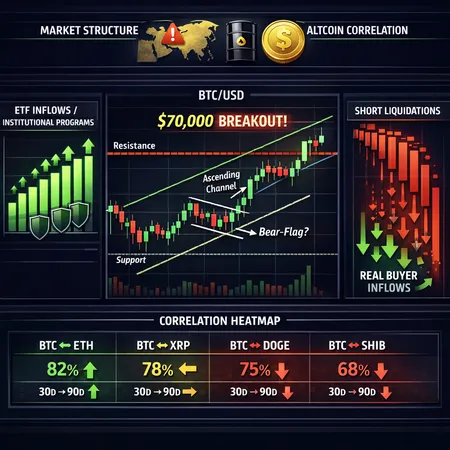
- Short-term structure: The rapid move produced a steep channel of higher highs and higher lows. Quick moves often leave little liquidity beneath price, creating tight short-term support levels but a risk of sharp pullbacks to fill orderbooks.
- Key levels to watch: the area just below $70K (mid-to-high $60Ks) will function as first-line support if the rally fades. A clean reclaim and hold above that band improves the odds of continuation. Failure to hold would likely reopen prior consolidation zones and invite another test of demand.
- Bear-flag traps: If price forms a shallow consolidation after the surge (a tight-range flag with declining volume), that pattern can be a squeeze remnant. Traders should watch for decreasing spot volumes and contracting open interest — both are red flags that the move is exhaustion-driven rather than accumulation-driven.
Practical risk management: keep position sizing disciplined, prefer scaling in on pullbacks, and use trailing stops or option-based hedges rather than fixed “all-or-nothing” bets after a squeeze.
Macro crosswinds: geopolitics, gold, and oil
Macro narratives still color crypto flows. Recent Middle East tensions can cut two ways:
- Risk-off leg: when geopolitical risk spikes, safe-haven flows to gold or fiat may increase and risk assets—including crypto—can sell off.
- Risk-on/reflex: if tensions accelerate concerns about currency debasement or supply chains, some investors treat BTC as an alternative store of value, pushing demand.
Commodity moves also matter. Rising oil prices can lift inflation expectations, indirectly supporting narratives for inflation hedges. Conversely, a broader risk-off shock that rallies gold could suck liquidity out of crypto. Traders need to watch cross-asset moves: if BTC is moving with gold/oil on the same risk impulse, that gives more conviction; if BTC is moving alone while equities and commodities diverge, treat the move as more idiosyncratic and fragile.
Altcoin implications: ETH, XRP, DOGE, SHIB (30–90 days)
Altcoins rarely behave identically to BTC in every rally. Here’s a tactical read for ETH, XRP and memecoins.
Ethereum (ETH)
ETH historically correlates strongly with BTC on major market moves, but the strength of ETH’s own narratives (EVM activity, staking, rollup adoption) can produce independent upside. In a durable BTC rally backed by institutional flows and growing spot liquidity, ETH usually participates — albeit with higher volatility. If BTC’s move is largely a short squeeze and spot flows fade, ETH may lag or even underperform as leverage and retail flows unwind.
Actionable: keep ETH exposure if you believe in continued risk-on flows or layer-2/consumption narratives; otherwise hedge with short-dated put options or reduce size until spot-volume support appears.
XRP
XRP’s moves are more idiosyncratic — legal and regulatory headlines remain a major driver. If BTC dominance increases (i.e., institutional BTC accumulation), XRP may lag. However, if renewed retail appetite and payments narratives rekindle, XRP can outperform in short bursts.
Actionable: treat XRP as a tactical alpha play rather than a direct BTC proxy; smaller, event-driven positions are appropriate.
Memecoins (DOGE, SHIB)
Memecoins are the most sensitive to retail liquidity and leverage. Historically they amplify rallies when retail FOMO returns and funding rates are permissive. Large squeezes that attract retail attention can lift DOGE and SHIB rapidly, but they collapse faster if the squeeze reverses.
Actionable: allocate memecoin exposure only as a defined fraction of risk capital and be prepared to scale out quickly. Use stop-loss rules or limit orders to protect gains.
Scenario planning and trade ideas
Three practical scenarios and how to act:
Durable institutional-led rally
- What happens: steady ETF inflows + institutional buy programs expand demand; spot volumes climb and open interest adjusts gradually.
- How to trade: add to BTC on healthy pullbacks; keep a tactical allocation to ETH; small, opportunistic memecoin exposure.
Squeeze-driven spike with weak spot follow-through
- What happens: funding resets, liquidations subside, spot demand evaporates and price falls back to prior consolidation.
- How to trade: trim longs taken near the top, buy back on confirmed pullback to beaten-in support, consider buying protective puts.
Mixed outcome (range-bound with episodic squeezes)
- What happens: price oscillates; altcoins show short-lived bursts but no sustained breakout.
- How to trade: trade structure — buy dips near support, take profits into rallies, use smaller position sizes and tighter risk controls.
Signals to watch closely
- ETF net flows and filings (daily/weekly): sustained net buys are a positive structural signal.
- Open interest and funding rates: look for climbing OI with positive funding as confirmation of durable demand; collapsing OI after a spike suggests squeeze unwinding. CoinDesk’s liquidation coverage is a good reference for gauging amplitude (CoinDesk).
- Spot volume and UTXO/holding data: rising spot volume + improving on-chain holder metrics mean accumulation, not just orderbook noise (Blockonomi).
- Macro headlines: Middle East developments, swaps in gold and oil prices — they can either amplify or mute crypto flows.
- Retail activity and memecoin volume: watch DOGE/SHIB order books and social signals; memecoins move fast and fade faster.
Final takeaways for intermediate traders
- The recent breach of $70K is a hybrid event: large short liquidations provided the spark, while ETF inflows and institutional program news supplied a partial fuel tank for continuation. Both elements matter for assessing durability.
- Don’t treat a squeeze as the same as organic accumulation. Confirm with spot volume, on-chain holder behavior and persistent ETF buying before increasing risk exposure.
- Manage position size and use protective hedges (puts, collars, or systematic trailing stops). For altcoins, prefer event-driven allocations and be mindful that memecoins are highest-beta and require strict risk controls.
For investors allocating capital, Bitlet.app and similar platforms make it easier to implement dollar-cost strategies or structured entries — but the core decision remains the same: confirm underlying flow and liquidity before committing large, undiversified bets.
Sources
- https://www.benzinga.com/crypto/cryptocurrency/26/03/51427535/bitcoin-at-71000-ethereum-xrp-dogecoin-gain-1?utm_source=benzinga_taxonomy&utm_medium=rss_feed_free&utm_content=taxonomy_rss&utm_campaign=channel&utm_source=snapi
- https://www.coindesk.com/markets/2026/03/24/bitcoin-leads-crypto-rebound-to-usd71-000-as-usd550-million-in-shorts-liquidated
- https://www.newsbtc.com/news/bitcoin/bitcoin-shorts-squeezed-out-as-spot-demand-stays-weak/
- https://cryptoslate.com/strategys-expanded-64b-bitcoin-buying-plan-leans-on-high-yield-funding-but-could-push-btc-higher/
- https://blockonomi.com/bitcoin-market-shows-stability-despite-price-pullbacks-utxo-data-confirms/