What Cardano’s LayerZero Integration Means for ADA, DeFi & Cross‑Chain Composability
Summary
LayerZero lands on Cardano: why this is more than another bridge
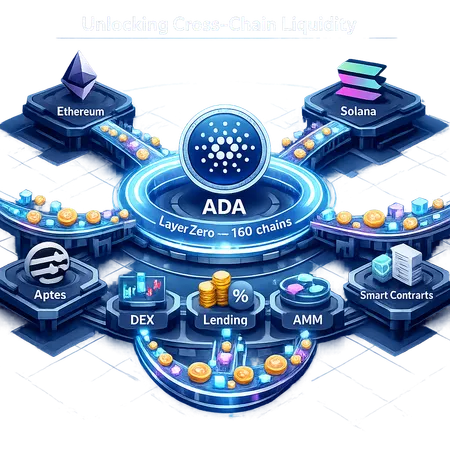
The recent announcement that LayerZero has officially integrated Cardano — connecting it to roughly 160 blockchains — is a structural moment for Cardano’s ecosystem. The rollout, covered in industry reporting, means Cardano now has an established messaging corridor to major ecosystems such as Ethereum, Solana and Aptos, not merely one‑off bridge contracts but a general-purpose cross‑chain messaging layer (source).
Put plainly: Cardano gains the technical plumbing to speak directly with many chains. For developers this reduces friction building composable, multi‑chain dApps; for liquidity it opens new corridors that can route token flows to Cardano and back. That said, integration is the beginning — adoption, security hardening, and UX will determine impact.
For many traders, Bitcoin still sets macro tone, but cross‑chain rails shift where alpha can be captured at the dApp level. Platforms like Bitlet.app and others that rely on multi‑chain liquidity will benefit from lower frictions as bridging UX improves.
What the LayerZero link actually provides (technical view)
LayerZero is a messaging protocol built around lightweight cross‑chain proofs and a split trust model: a relayer delivers the transaction payload and an oracle attests to the source chain’s block information. On other chains — historically EVMs — LayerZero exposes an endpoint contract that receives messages and triggers local contract logic.
On Cardano the model requires adapting to the eUTXO/Plutus runtime rather than a straight EVM contract. That means:
- Endpoint adapters must translate LayerZero messages into actions within Plutus validators or specialized on‑chain bridges.
- Token flows often use wrapped or redeemable representations: an asset locks on chain A and mints a representative token on Cardano, or a canonical token is moved via cross‑chain transfer semantics.
- A relayer/oracle pair remains the critical trust surface — their governance, decentralization and ops model directly affect security assumptions.
LayerZero’s integration reduces the need for ad‑hoc bridges between Cardano and other chains, but developers will still handle token standards, metadata mapping, and UX for finality differences across chains.
Security and operational tradeoffs to watch
Cross‑chain messaging is powerful but not magic. Key risks include:
- Bridge/relay compromise: if relayers or the oracle layer are misbehaving, cross‑chain messages can be censored or spoofed.
- Token wrapping & redemption logic bugs: mint/burn mistakes or poorly guarded redemption flows remain a leading source of losses in multi‑chain systems.
- Finality mismatches: Solana, Ethereum and Cardano have different finality and reorg models — messages must account for these differences to avoid double spends or stuck transfers.
Practically, teams should insist on multi‑party relayer designs, transparent attestation sources, third‑party audits, and escrowed economic guarantees for wrapped assets.
What cross‑chain access unlocks for dApps and token flows
Connecting Cardano to Ethereum, Solana and Aptos changes the narrative from isolated smart‑contract islands to composable archipelagos. Some concrete changes:
- Liquidity routing: DEX aggregators on Cardano can pull liquidity from Ethereum‑based pools or route Solana LP positions into Cardano products, improving depth and slippage for large trades.
- Native cross‑chain composability: A Cardano dApp can trigger logic on Ethereum (or vice versa) within a single user flow — e.g., a collateral swap on Ethereum can automatically mint a Cardano‑native stablecoin used in a Cardano lending market.
- New token economics: Projects can design multi‑chain token sinks/rewards; cross‑chain staking derivatives can be issued where staking rights on one chain back a liquidity token on Cardano.
- Faster experimentation: Developers can prototype cross‑chain primitives (flash‑loan‑style arbitrage, cross‑chain AMM routing) without bespoke bridges.
This also enables more advanced UX: wallets that surface balances across chains, single‑click cross‑chain swaps, and aggregated dashboards for TVL — all of which reduce friction for end users and traders.
Which DeFi primitives are best positioned on Cardano?
Not every protocol benefits equally. Given Cardano’s architecture and the new LayerZero rails, the early winners likely include:
- AMMs and cross‑chain DEX aggregators: immediate gains from deeper liquidity and routing across EVM, Solana, Aptos pools.
- Cross‑chain lending/margin platforms: collateral sourced from multiple chains can unlock larger borrowing capacity and novel risk pooling.
- Wrapped/bridged asset custodians and redemption services: secure mint/burn flows will be essential infrastructure with steady revenue via fees.
- Yield aggregators and vaults: ability to capture inefficiencies across chains gives aggregators a substantial edge.
- Synthetic asset platforms: cross‑chain oracle feeds and message passing make multi‑chain synthetic exposure viable.
On Cardano there’s also room for specialized primitives leveraging eUTXO constraints — for example, batched settlement engines that exploit Cardano’s parallel transaction model to reduce gas costs for certain cross‑chain operations.
ADA price: does the move above $0.30 mean a sustained narrative shift?
Market reaction has been positive: ADA’s technical close above $0.30 attracted attention and was noted by market reports as a breakout trigger (price note). Headlines matter; integrations like LayerZero offer real fundamental catalysts. But a few caveats:
- Headlines are only catalysts if they produce measurable activity: TVL growth, active developers, on‑chain transfers and sustained DEX volumes.
- Macro correlation remains strong: ADA’s price will still be pulled by broader crypto risk appetite and Bitcoin moves.
- Short‑term traders may buy the news and then profit‑take; medium‑term durability requires protocol integrations to show utility (e.g., real cross‑chain trades, liquidity migration).
In short, $0.30 is a positive technical sign and validates renewed investor interest, but it’s not proof that a new structural market regime has begun.
Practical investor takeaways and a tactical checklist
If you’re tracking ADA as an investor or building on Cardano, consider this checklist:
- Monitor TVL and cross‑chain transfer volume (are assets actually moving to Cardano or merely mirrored?).
- Watch developer metrics: GitHub activity, new smart contracts deployed, and major projects announcing LayerZero‑native integrations.
- Scrutinize relayer/oracle governance: who operates them, how decentralized are they, and are there contingency plans for failure?
- Avoid concentration risk: bridges introduce unique systemic exposures; diversify across staking, liquid derivatives, and on‑chain yields.
- Time horizons matter: for builders, now is a window to experiment; for investors, look for sustained adoption signals rather than a single price breakout.
For users and traders, platforms that simplify cross‑chain UX (wallets, aggregators, on/off ramps) will be the adoption gatekeepers. Track the infrastructure players enabling seamless flows — they often capture the largest fees before end‑user products mature.
Final perspective: composability is a marathon, not a sprint
LayerZero’s Cardano integration is a pivotal technical milestone that materially improves interoperability. It reduces engineering overhead for multi‑chain dApps and opens Cardano to liquidity, innovation and new token economics. But integration alone doesn’t equal immediate solved problems: trust models, security, developer tooling for Plutus, and user UX will determine whether this becomes the foundation for a thriving cross‑chain Cardano economy.
For investors, ADA’s move above $0.30 is a bullish signal but not a seal of permanence — keep an eye on TVL, developer activity and actual cross‑chain flows. For builders, this is a chance to design natively multi‑chain products that exploit Cardano’s unique architecture while respecting the operational realities of cross‑chain messaging.
Adoption will likely be stepwise: early infrastructure and bridge custodians, followed by AMMs and lending, then more sophisticated synthetic and composable stacks. That pathway is where real value accrues — and where careful security and governance choices will make the difference.
Sources
- LayerZero integration announcement: https://coinpedia.org/news/charles-hoskinson-posted-a-smiling-gif-and-the-reason-behind-it-changes-cardano-forever/
- ADA price technical note: https://cryptonews.com/news/ada-price-breakout-rally-30-cents/