JPYC after Metaplanet’s Investment: A Playbook for Japan-Focused Stablecoin Rails
Summary
Executive snapshot
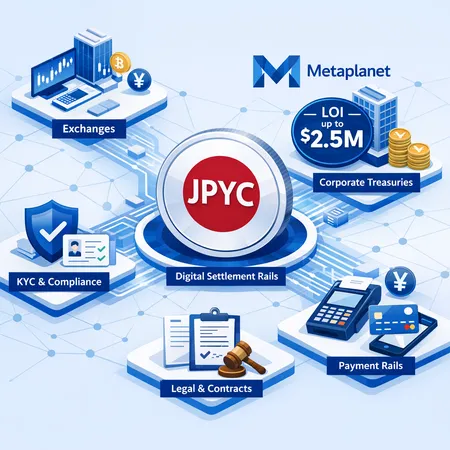
Metaplanet’s recently announced up-to-$2.5M Letter of Intent to invest in JPYC frames the stablecoin as more than a speculative token: the stated goal is to help develop digital settlement infrastructure inside Japan. That emphasis — a domestic, regulatory-conscious settlement rail — changes the conversation for corporate treasurers and payments architects who have traditionally considered USD-denominated stablecoins as the default on/off-ramps for crypto liquidity.
For readers deciding whether to pilot JPYC in production flows, this article breaks down what the Metaplanet move implies, how JPYC structurally differs from global stablecoins, potential partner and on-ramp strategies, and realistic adoption scenarios for Japanese corporates and remittance corridors.
Metaplanet’s LOI: what’s in the signal
Metaplanet’s Letter of Intent — reported as up to $2.5 million — is framed as a strategic investment to accelerate JPYC’s role in digital settlement infrastructure. The LOI is not merely capital; it’s a directional endorsement that can unlock partnerships, pilot programs, and regulator dialogue. In practice, that means JPYC’s team could prioritize integration with domestic banking rails, corporate treasury tooling, and regulated exchanges rather than chasing global market share the way many USD-pegged issuers do. The NewsBitcoin coverage of the announcement provides the primary reporting on the investment size and Metaplanet’s stated intent.
The political economy here matters: a Japan-focused backer with a clear LOI sends a signal to local banks, payment service providers, and large enterprises that JPYC aims to sit inside a compliant Japanese ecosystem — not operate mainly as cross-border speculation. That positioning reduces one category of uncertainty for corporates—but it raises others around liquidity and corridor access.
How JPYC differs from USD-denominated stablecoins
A regional stablecoin is not just a currency label. JPYC’s Japan-first stance produces meaningful differences in regulatory posture, KYC/AML expectations, and typical corridor use-cases.
Regulatory and compliance profile
A Japan-anchored token will face different supervisory expectations than many dollar-backed issuers who onshore reserves in multiple jurisdictions. JPYC teams will likely emphasize Japanese legal structures for reserves, trustee relationships, and audit transparency to align with local regulators and financial institutions. That focus can make JPYC more palatable to banks and corporate treasuries that must comply with domestic financial laws and customer due diligence requirements.
Concretely, corporate risk officers should expect stricter KYC/AML standards from counterparties handling JPYC, because domestic regulators will prioritize consumer protection and domestic anti-money-laundering controls. For payments architects, this means integration work will often include additional identity and transaction-monitoring hooks compared with some offshore stablecoin flows.
Corridor and use-case orientation
USD-backed stablecoins historically function as international liquidity conduits: fast on/off-ramps to dollar liquidity across exchanges, OTC desks, and remittance networks. JPYC’s natural use-cases tilt toward domestic settlement: payroll, supplier payments, intra-group transfers, and point-of-sale payment modernization in Japan. That orientation does not preclude cross-border remittances, but it changes the counterparty assumptions — counterparties on the receiving end need familiarity with the yen-denominated token and access to local rails or conversely, reliable off-ramp partners.
JPYC’s shallow global liquidity might limit immediate usage for high-frequency trading or international treasury netting that relies on deep USD rails. But for corporates seeking faster reconciliation and lower FX friction inside Japan, JPYC could offer clear efficiency gains.
Potential partnerships: exchanges, payment rails, and tokenized integration
Building settlement rails is as much about partnerships as it is about code. JPYC’s path to utility depends on a pragmatic ecosystem strategy: selective exchange listings, payment gateway integration, custody and trustee arrangements, and bank-facing rails for corporate settlement.
Exchanges and custodians: Primary targets are regulated Japanese exchanges and licensed custodians willing to support on-chain JPYC flows while satisfying domestic custody rules. Listing JPYC on domestic exchanges improves liquidity for on/off ramps and makes it simpler for treasurers to move between fiat accounts and token balances.
Payment processors and rails: Integration with POS providers and payment gateways enables merchant adoption. For corporate use, API-driven treasury integrations that allow automated payroll, supplier settlement, and reconciliation will be a decisive differentiator.
Tokenized securities and institutional rails: There’s a growing European example where regulators and market infrastructures explore tokenized collateral and securities. The ECB’s evolving stance and experiments with tokenized securities — including explorations using ledgers beyond Ethereum — highlight how national/regional initiatives can fold tokenized instruments into formal settlement frameworks. For context, coverage of continental experiments with tokenized securities and the role of different ledgers illustrates how domestic stablecoins like JPYC could plug into institutional rails if local infrastructure adapts similarly (see discussion in Coinpaper on tokenized securities and ledger options)[https://coinpaper.com/15442/ecb-set-to-greenlight-tokenized-securities-as-collateral-with-xrp-ledger-in-the-mix?utm_source=snapi].
Platforms like Bitlet.app and other payment-layer vendors will likely evaluate JPYC integrations to offer clients native yen-stable settlement options alongside USD rails.
Strategic adoption scenarios: corporates and remittances
There are pragmatic phased paths JPYC can take to achieve meaningful traction. Below are high-probability scenarios payments architects and treasurers should model.
Scenario A — Corporate AP/AR pilot (low-friction, high-impact)
Large corporates and conglomerates with intra-group flows can pilot JPYC to reduce reconciliation time and FX conversion steps when settling domestic supplier invoices denominated in yen. The pilot would typically involve a handful of trusted suppliers, a custody provider, and automated reconciliation tools. Advantages: faster settlement, lower banking fees for same-day transfers, and simplified ledgered audit trails.
Scenario B — Payroll and micropayments (merchant and salary use)
Firms that run large payroll or gig-economy payouts in Japan could trial JPYC for near-instant disbursements. For employees who accept tokenized yen and have reliable rails to convert to fiat, the user-experience can be compelling. The main constraint is building liquidity and fiat off-ramps that preserve trust.
Scenario C — Remittances with a domestic anchor
JPYC could serve as a yen-denominated corridor currency for remittances into and out of Japan. Rather than transact through USD rails, a remitter can source JPYC domestically and route it through partner rails or on-ramps in receiving jurisdictions. Success here depends on bilateral liquidity partnerships and correspondent agreements with local exchanges and payout networks.
Each scenario requires explicit SLAs on settlement finality, dispute resolution processes, and clear compliance playbooks for on/off ramps.
Compliance trade-offs and operational risks
Adopting JPYC introduces benefits but also trade-offs.
Liquidity risk: Compared to global USD stablecoins, JPYC will likely exhibit narrower liquidity pools and larger spreads when converting to other currencies. Treasurers must model funding strategies and potential FX slippage.
Counterparty and custody risk: Domestic trustee arrangements and licensed custodians mitigate certain legal risks but create operational dependencies. Robust treasury controls and multi-sig custody models remain essential.
Regulatory uncertainty: A Japan-first approach reduces cross-jurisdictional ambiguity for domestic operations but binds JPYC to the vagaries of local policy evolution. Future regulatory tightening or restrictions on tokenized settlement could affect viability.
KYC/AML and privacy: Tighter KYC/AML makes JPYC attractive to regulated institutions but increases integration complexity for counterparties. Expect more identity checks and transaction monitoring than with some offshore alternatives.
Practical checklist for payments architects and treasurers
- Define pilot boundaries: limit counterparty set, volume, and transaction types.
- Evaluate custody and reserve transparency: demand audited attestations aligned with Japanese legal frameworks.
- Map liquidity corridors: identify exchanges and OTC partners that will support on/off ramps for JPYC.
- Integrate AML hooks: ensure transaction monitoring and KYC processes are compatible with existing compliance tech stacks.
- Negotiate operational SLAs: settlement finality windows, dispute resolution, and reconciliation APIs.
These steps reduce execution risk and help deliver a measurable ROI case for continuing or expanding JPYC use.
Conclusion — a regional asset for regional problems
Metaplanet’s up-to-$2.5M LOI is a catalytic signal: JPYC is being positioned as a yen-native settlement layer, not merely another stablecoin chasing dollar liquidity. For Japanese corporates and payment architects, JPYC offers distinct advantages when the problem set is domestic settlement, reconciliation speed, and regulatory alignment. However, the trade-offs — liquidity depth, corridor partnerships, and evolving regulation — mean careful piloting and solid partner selection are prerequisites for success.
For strategy teams weighing JPYC against USD-pegged alternatives, the question is not which is objectively superior, but which best matches the settlement topology and compliance constraints of the business. As regional tokenized infrastructure experiments (including European tokenized securities pilots) show, the future is likely hybrid: localized rails for local needs, interoperable channels for cross-border flows.
If JPYC achieves credible bank, custodian, and exchange integrations, it could become a useful tool in the treasurer’s toolkit—especially for firms that prioritize yen liquidity and regulatory certainty.
Sources
- NewsBitcoin — Metaplanet announces strategic investment in JPYC: https://news.bitcoin.com/metaplanet-announces-strategic-investment-in-jpyc-stablecoin-through-new-venture-arm/
- Coinpaper — ECB set to greenlight tokenized securities as collateral with XRP Ledger in the mix: https://coinpaper.com/15442/ecb-set-to-greenlight-tokenized-securities-as-collateral-with-xrp-ledger-in-the-mix?utm_source=snapi
For broader context on market dynamics, many treasurers still watch market bellwethers like Bitcoin and on-chain infrastructure trends in DeFi while evaluating stablecoin counterparties and rails. Platforms such as Bitlet.app may begin evaluating JPYC integrations as these rails mature.