Can Evernorth’s $685M XRP Treasury Stop the Outflows? Liquidity, Resistance, and the Path to Recovery
Summary
Executive snapshot
Evernorth’s announcement that it is assembling roughly 473 million XRP (about $685 million) has put a new spotlight on how concentrated institutional treasuries interact with broader market flows and price structure. For investors and token analysts, the question is simple but multi‑layered: can a treasury‑scale buy and hold program neutralize exchange outflows, overcome technical resistance, and catalyze a sustainable rally for XRP? This piece walks through the evidence—on‑chain accumulation, exchange volume dynamics, technical constraints around $1.80, and the supply/liquidity mechanics—then lays out a practical risk/reward framework.
Evernorth’s public treasury build and Nasdaq ambitions
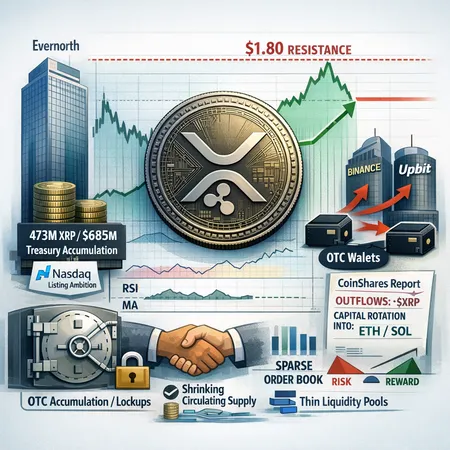
Public reporting indicates Evernorth Holdings is building a roughly 473M XRP position (~$685M) as part of a broader, visible strategy ahead of a planned Nasdaq listing. The accumulation reads like a classic treasury playbook: assemble a large strategic reserve that can both back corporate goals and act as a narrative anchor for institutional investors (ZyCrypto).
Why it matters beyond headline size:
- Signal and legitimacy: A named entity openly aggregating supply gives markets a clear buyer narrative—useful in a market still driven by sentiment.
- Potential long‑term holder: If Evernorth treats its XRP as a treasury reserve rather than trading inventory, those tokens can be functionally removed from short‑term circulating supply.
- Nasdaq linkage risk: Listing ambitions can cut both ways—access to public capital may reduce forced liquidations, but IPO liquidity events or token monetization tied to corporate milestones could introduce scheduled sell pressure.
Taken together, Evernorth’s plan is a structural input to the market, not a short‑term pump. But structural inputs only matter when they interact with daily liquidity, order book depth, and trader psychology.
Exchange flows and volume: surge vs rotation
The on‑exchange picture is mixed. On one hand, short‑term trading activity has spiked on major venues: recent reporting shows surging XRP volumes across Binance and Upbit, suggesting pockets of renewed retail and regional demand that can amplify intraday moves (Coinpaper). On the other hand, weekly institutional product flows tell a different story: CoinShares‑style reports note that XRP products experienced net outflows while capital rotated into other risk narratives such as Ethereum and Solana (ZyCrypto).
What that divergence means practically:
- High exchange volume + product outflows = churning liquidity. Volume spikes can reflect short‑term rebalancing, arbitrage, or retail FOMO, which may not translate to lasting net demand.
- Institutional product outflows matter for longer windows. When managed funds or ETFs pull capital, the structural demand cushion shrinks even if on‑exchange activity looks healthy.
- Regional and venue concentration matters. Surges on Binance/Upbit are useful but fragile if supply continues to be available elsewhere or if OTC counterparties pick up and move positions.
Technical constraint: $1.80 flipped to resistance
From a charting standpoint, $1.80 has become a psychological and technical hurdle. Recent technical commentary notes that this level, once support, has flipped to resistance and needs to be reclaimed convincingly for bullish momentum to reassert itself (Invezz).
Why $1.80 matters beyond a round number:
- Order book clustering: Many stops and limit orders cluster around former support levels; a failed reclaim leaves sell liquidity stacked above price.
- Sentiment flip: Reclaiming a clear resistance level changes narrative—buyers gain confidence, short sellers face pressure; failing to reclaim keeps sellers comfortable.
- Leverage and derivatives: Funding rates and open interest often pivot off key levels; a break above $1.80 could force deleveraging of short positions and accelerate a squeeze.
In short: without a credible break and hold above $1.80, any isolated buying—whether from a treasury or retail pockets—can be absorbed by sellers and fail to produce a sustainable trend change.
How treasury accumulation, OTC buys and lockups affect liquidity and circulating supply
A large institutional treasury changes the microstructure of supply in a few concrete ways:
- Direct reduction in exchange float (if accumulated off‑exchange). When tokens move into an institutional treasury—especially via OTC—those units are effectively removed from exchange order books, tightening immediate liquidity.
- Psychological scarcity premium. Market participants see a large, known holder and may reprice available free float with a premium, particularly if the holder signals long‑term intent.
- Concentration (single‑point) tail risk. The flip side is that a large, concentrated holder can become an outsized supply source if they choose to monetize—this increases counterparty and investor risk.
- Lockups and announceable vesting schedules. If part of the accumulated XRP is subject to lockups or contractual holding periods tied to the Nasdaq push, the market treats those tokens as temporarily illiquid—again shrinking effective circulating supply.
Sizing perspective: even a 473M token accumulation is a fraction of total XRP supply (and a sub‑1% share of the circulating stock in most estimates), so its mechanical effect on market cap is limited. The real leverage of a treasury build comes from where those tokens would otherwise have been traded (exchanges vs. OTC), whether they are announced/locked, and whether that holder behaves as a seller or a steward.
Risk/reward framework: when can treasury buys overcome outflows and resistance?
Institutional treasury accumulation can help—but it is not a guarantee. Below are plausible scenarios investors should use when sizing positions or stress‑testing assumptions.
Bull case: Treasury accumulation plus technical breakout
- Evernorth and other large buyers continue to accumulate primarily OTC and announce lockups or conservative treasury policy.
- Exchange balances draw down and on‑chain exchange reserves decline, tightening available sell liquidity.
- On‑exchange volume spikes convert into sustained demand, and price reclaims and holds above $1.80, forcing shorts to cover.
- Result: concentrated buy narrative, positive feedback loop, and an extended rally.
Probability drivers: demonstrable decline in exchange reserves, explicit lockup commitments, and a confirmed daily close above $1.80 with rising volume.
Base case: Partial stabilization without a sustained trend
- Treasuries accumulate, reducing some float, but capital rotation into ETH/SOL continues to sap broader risk appetite for XRP products.
- Price tests $1.80 several times but only occasionally closes above it; rallies are short‑lived as other venues and funds still favor alt allocations.
- Result: choppy, range‑bound action with occasional spikes tied to headline events.
Probability drivers: mixed on‑chain signals, persistent outflows from funds, and no formal lockup schedules.
Bear case: Treasury accumulation insufficient or monetized
- Evernorth or other large holders need liquidity (e.g., to fund a listing or corporate expenses) and sell into rallies, or markets price in a future sell schedule.
- Exchange outflows continue but are replaced by OTC sellers or rotating liquidity into other tokens; $1.80 acts as firm resistance and sells the rallies.
- Result: renewed downtrend as concentrated holdings function as a latent supply overhang.
Probability drivers: announcements of monetization plans, lack of clear lockups, and sustained capital rotation away from XRP products (as observed in CoinShares‑style outflow reports).
Practical checklist for investors and analysts
Watch the following data points to update your view in real time:
- Exchange reserves and daily withdrawal patterns (is exchange float declining?).
- Large OTC block prints and on‑chain transfers into known treasury wallets (are tokens going into custody?).
- Weekly product flow reports (e.g., CoinShares‑style data) showing whether institutional capital is exiting or returning.
- Volume and price action around $1.80: look for a clean breakout on above‑average volume and follow‑through.
- Announcements from Evernorth about lockups, treasury policy, or Nasdaq timeline—transparency matters.
- Sector rotation signals: inflows to ETH/SOL can subtract from XRP’s bid even if on‑chain demand looks healthy.
A data‑driven approach—leaning on exchange and on‑chain metrics—beats narrative alone. Tools and platforms, including Bitlet.app, can help track liquidity shifts and on‑chain accumulation in real time, but always cross‑check with public filings and market‑flow reports.
Bottom line: can treasury buys stabilize the path to recovery?
Yes—but with caveats. Treasury‑scale buys like Evernorth’s create a constructive structural narrative and can reduce effective circulating supply, especially if accumulation is OTC and accompanied by lockups. However, the impact is conditional: it needs to coincide with declining exchange reserves, a halt to institutional outflows, and a decisive technical reclaim of $1.80. Without those elements, a large concentration is helpful for narrative but insufficient to guarantee a sustained rally—and it can even become a single point of failure if monetization is later required.
For investors and token analysts, the proper stance is nuanced: treat treasury accumulation as one input among liquidity metrics, flow reports, and price structure. Base allocations on scenario analysis and update positions as on‑chain and exchange signals evolve.
Sources
- Evernorth builds ~473M XRP position: https://zycrypto.com/ripple-backed-evernorth-builds-685m-xrp-position-as-public-listing-plans-progress/
- Exchange volume surge on Binance/Upbit: https://coinpaper.com/15579/xrp-price-prediction-as-volume-surges-across-binance-and-upbit-with-market-momentum-building?utm_source=snapi
- CoinShares‑style outflows report: https://zycrypto.com/xrp-bleeds-76m-in-weekly-outflows-as-capital-rotates-into-ethereum-solana/
- Technical analysis on $1.80 resistance: https://invezz.com/news/2026/03/20/xrp-stuck-below-1-80-resistance-is-another-drop-coming-soon/?utm_source=snapi