Cardano’s 520M ADA TVL: Does On‑Chain Liquidity and Technicals Point to a Sustainable Breakout?
Summary
The milestone: 520M ADA TVL — what ‘native‑token’ TVL actually tells us
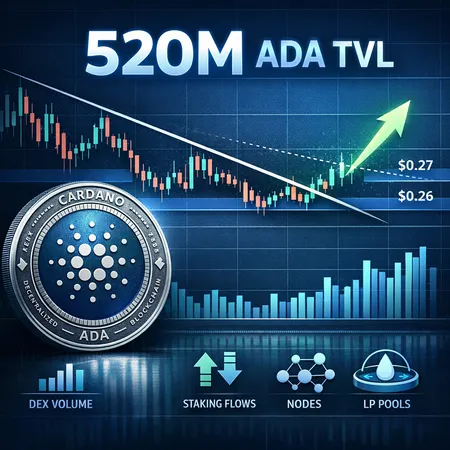
Cardano’s DeFi ecosystem recently recorded a native‑token TVL of about 520.41 million ADA, a headline that looks impressive at first glance. The raw number matters for two reasons: it signals increasing on‑chain liquidity denominated in ADA, and it highlights how composability among native tokens is being used to bootstrap DEXes, lending pools and tokenized instruments. For the core data point on ADA‑denominated liquidity, see the reporting that frames this milestone as a new floor for Cardano ecosystem liquidity.
It’s important to stress what native‑token TVL means: unlike TVL quoted in USD, this metric is measured in ADA units. That has structural implications. If ADA rises, the USD value of that TVL increases even without a single new deposit; conversely a price drop shrinks USD TVL while ADA‑denominated liquidity remains. Still, measuring TVL in ADA has upside: it emphasizes on‑chain composability — Cardano allows native tokens without ERC‑20 style wrapping, which reduces friction for swapping and composing pools on DEXes and AMMs.
For traders and on‑chain analysts this matters because composability and native token mechanics reduce interoperability overhead, but they also concentrate risk around ADA price action and liquidity concentration in a handful of pools.
Price context: consolidation, levels, and the technical bull case
ADA has been consolidating roughly around $0.26–$0.27 in recent sessions. Technical commentators have pointed to a tightening structure: a horizontal base in the low‑$0.20s and a descending resistance line that’s capped rallies. One technical write‑up frames ADA as being squeezed between roughly $0.18–$0.25 and a descending resistance that must be broken for a major leg higher; another source highlights a weekly buy‑signal and consolidation that could support an upside if confirmed.
Two simple levels to watch:
- Support: $0.18–$0.22 zone (on‑chain accumulation and prior liquidity clusters).
- Resistance: the descending trendline and the $0.30 area as the first meaningful USD resistance; above that, $0.40–$0.55 are psychological and liquidity targets if momentum expands.
Analysts arguing for a multi‑hundred percent rally hinge on a clean breakout: a weekly close above the descending resistance with expanding volume and on‑chain liquidity fueling swaps and staking flows. A breakout in thin markets looks good on charts but can fail without depth — so the quality of the breakout matters: not only price, but DEX volume, liquidity migration, and increased smart‑contract activity.
(See technical notes and the weekly buy‑signal discussed in industry coverage for more on the price context.)
Where the capital is coming from on‑chain: DEXes, staking, and the plumbing to watch
Capital that shows up in ADA‑denominated TVL mostly originates from a few on‑chain behaviors:
- DEX liquidity and swap volume: When traders and liquidity providers deposit ADA into pools (AMMs), that raises the ADA TVL figure. So track 7‑ and 30‑day DEX swap volumes and the depth (ADA per pool) of the top pools. Rising volume with rising pool depth reduces slippage and attracts more LPs.
- Staking inflows and redelegation: Cardano’s delegated staking is a structural capital sink. Large redelegations or increases in delegated stake percentage can indicate longer‑term ADA lockup, reducing float available for DeFi but increasing on‑chain commitment. Watch overall active stake and changes in stake distribution among pools.
- Protocol‑level deposits: New lending markets, derived products, and staking derivatives (if any) absorb ADA into smart contracts. Deployment of new Plutus scripts and growth in the number of active smart contracts are leading indicators that developers are building features that demand liquidity.
Practical on‑chain metrics to monitor day‑to‑day:
- DEX swap volume (7d/30d) and average slippage on top pools.
- ADA TVL concentration: percent of TVL in top 3–5 pools/contracts.
- Active addresses interacting with DeFi contracts and count of new Plutus script invocations.
- Net ADA inflows/outflows to DeFi contracts vs. staking delegations.
- Median transaction size and UTXO growth tied to DeFi activity.
Rising DEX volume and a broadening distribution of TVL across protocols suggest a more robust liquidity base capable of supporting a sustainable breakout; a spike in TVL concentrated in a single pool does not.
Structural risks: slow developer cadence, liquidity depth, and macro crosswinds
The bullish thesis is real: ADA‑denominated TVL growth shows interest. But risks are material and must be weighed.
- Developer activity and product cadence: Cardano’s focus on formal verification and Plutus means development can be slower than on some EVM chains. That slower cadence can delay the emergence of complex lending markets, options, and composability rails that attract sustained capital. If developer momentum stalls, TVL growth can be ephemeral.
- Depth and concentration: TVL denominated in ADA can mask poor depth in USD terms. If large market participants attempt to trade in or out, thin pools will widen slippage and make the breakout less tradable. Concentration of TVL in a few LPs or a single protocol increases protocol risk.
- Macro and cross‑market risk: ADA’s correlation with BTC and overall risk appetite means that macro events (rate surprises, equity shocks) can reverse technical breakouts quickly. A breakout that occurs into a risk‑off regime is vulnerable.
Mitigations: watch for diversified protocol participation, on‑chain evidence of composability (cross‑protocol interactions), and growing developer metrics like new dApp deployments.
Realistic scenario analysis — base, bull, bear
Base case (probable short to medium term): incremental TVL and price consolidation
- ADA continues to attract TVL but denominated growth is steady rather than explosive. Price trades in a range with occasional squeeze attempts that fail without expanded DEX volume. Traders can expect chop and should prefer smaller position sizes and defined stops.
Bull case (conditional breakout): decisive technical break + broad on‑chain backing
- A weekly close above the descending resistance with expanding DEX volumes, broadening TVL across multiple protocols, and rising active addresses. In this case, ADA could reprice aggressively as liquidity becomes more tradable — the technical narrative of a multi‑hundred percent move relies on a chain reaction of liquidity migration, yield farmers redeploying capital, and new product launches.
Bear case (breakout fails or macro shock): liquidity repricing and flight to safety
- A failed breakout or sudden macro risk leads to rapid ADA weakness. Because TVL is ADA‑denominated, USD TVL plunges even if ADA TVL is unchanged. Thin USD liquidity exacerbates slippage and can trigger stop cascades.
A practical checklist for traders considering ADA exposure or a breakout trade
Before increasing exposure, look for the following checklist items. Treat them as confluence — the more boxes checked, the higher the probability of a sustainable move.
- Weekly close above descending resistance with a follow‑through daily close above that line.
- Rising DEX swap volume and pool depth: 7‑/30‑day volume increasing and decreasing average slippage.
- Broadening TVL: less concentration in top pools; new deposits spread across protocols.
- On‑chain activity uptick: more unique addresses interacting with DeFi contracts and new Plutus deployments.
- Staking flow confirmation: either increased delegation (reducing float) or meaningful redelegation into DeFi derivatives (showing active capital deployment).
- Macro alignment: BTC and risk assets not breaking down; volatility regime supportive of rallies.
- Risk plan: position size defined (<2–5% portfolio for swing trades depending on risk tolerance), clear stop level (e.g., below key support like $0.18–$0.22), and profit targets (tiered exits at $0.40, $0.60, etc.).
If several items are missing, consider watching or trading smaller size with tight risk management. Bitlet.app and other execution venues can help implement staged entries and limit slippage if liquidity is sufficient.
Final thoughts — what TVL growth does and doesn’t prove
Crossing ~520M ADA in native‑token TVL is a meaningful milestone: it reflects on‑chain interest, growing composability, and the possibility that Cardano’s DeFi plumbing is maturing. However, because the metric is ADA‑denominated, it is sensitive to price moves and can be misleading if taken in isolation.
A sustainable breakout requires both clean technical price action and deeper, broader on‑chain liquidity: more active addresses, rising DEX volumes, diversified TVL across protocols, and signs that developers are shipping useful products. Traders should treat the current state as an invitation to monitor a set of confluence signals rather than a standalone buy trigger.
Sources
- Cardano native‑token TVL surpasses 520.41 million ADA: Cardano DeFi hits record 500 million ADA; TVL is one billion milestone next
- Technical squeeze case and support/resistance analysis: Cardano eyes $1,000 rally as key support holds strong
- Weekly buy signal and consolidation context: Cardano ADA price eyes breakout after weekly buy signal emerges