Evernorth’s XRPN Pitch: Can a $1B XRP Treasury Make It the ‘MicroStrategy of XRP’?
Summary
Why Evernorth wants to be the “MicroStrategy of XRP"
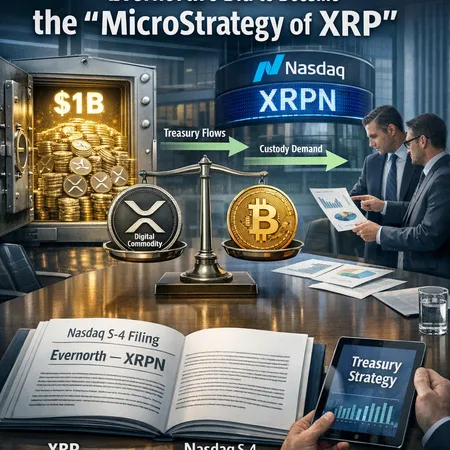
Evernorth’s announced intention to list on Nasdaq under the ticker XRPN is striking because it repackages a classic corporate-treasury narrative into a token-native form: instead of stockpiling fiat or bitcoin, the company proposes a sizeable, centralized treasury denominated in XRP. The S‑4 filing and subsequent press coverage describe a plan that looks less like an operating business IPO and more like a public, tradable treasury vehicle whose primary asset is XRP. That framing promises two things to investors: concentrated exposure to a single digital asset and the convenience of obtaining that exposure through a regulated, publicly listed company.
For institutional allocators who watched Bitcoin corporate treasuries and bitcoin ETFs alter flows and custody demand, XRPN is an experiment in whether the same playbook works when applied to XRP instead of BTC.
What the S‑4 filing reveals (and what it intentionally emphasizes)
Evernorth’s Form S‑4 — the document companies file to register securities in certain mergers and business combinations — lays out the business model in plain terms: pursue a Nasdaq listing via a SPAC-style combination and position the company as a treasury vehicle with a targeted ~$1 billion XRP allocation. Coverage of the filing underscores both the ambition and the pitch: a dollar-scale treasury denominated in XRP, with public equity providing convenient institutional access to that exposure (Coinpedia, Coinpaper).
The S‑4 also signals a conscious regulatory angle: present XRP as a commodity-style asset and structure public disclosures and custodial arrangements accordingly. Analysts and commentators have connected the dots between the filing and recent shifts in U.S. regulatory posture that reduce the odds of SEC enforcement treating XRP as a security — a point we return to below (Blockonomi).
How an XRP‑denominated treasury differs from holding BTC
At first glance, replacing BTC with XRP looks like a simple substitution: both are liquid, widely traded tokens. But there are important differences in governance, liquidity profile, and counterparty considerations that change the calculus for an institutional treasury.
Governance and network structure
Bitcoin’s governance is widely distributed: no single corporate actor controls protocol updates, and network incentives are broadly decentralized. XRP, while an open ledger, has different real‑world dynamics. Ripple (the company) historically plays a larger role in the ecosystem (developer funding, validator operation, and market narrative). That doesn't make XRP insecure, but it means a treasury that centralizes XRP exposure is implicitly tied to both market sentiment about Ripple and any legal/regulatory controversies surrounding entity-led participation.
For institutions, this matters: a treasury manager evaluating XRPN exposure must distinguish between protocol risk and concentration of influence. Unlike holding Bitcoin, where corporate governance concerns are relatively indirect, holding XRP at scale invites questions about downstream counterparty perception and political risk tied to the ledger's major actors.
Liquidity and market microstructure
XRP trades on many venues and historically benefits from tight spreads and decent on‑chain throughput. But assembling hundreds of millions in XRP — or converting recurring revenue into token purchases — risks market impact. XRP’s order‑book depth is generally robust for routine flows, yet whale‑scale accumulation can push prices or trigger exchange behavior (circuit breakers, temporary withdrawal limits). Compared with BTC, which tends to have deeper derivatives and OTC liquidity, large XRP buys may face higher slippage and less developed institutional desks in some jurisdictions.
Counterparty, custody, and operational risk
An XRP treasury introduces custody considerations that are both similar to and different from BTC custody. Institutional custody providers now support XRP, but the ecosystem’s concentration (fewer institutional-grade custodians that actively market XRP custody vs BTC) can increase counterparty risk and pricing for insured custody. Execution risk when converting fiat into XRP — timing, OTC counterparties, and settlement arrangements — is a practical hurdle that a public treasury vehicle must document and manage.
Regulatory backdrop: XRP as a digital commodity
Evernorth’s public pitch explicitly leverages recent regulatory developments that have improved XRP’s institutional appeal. Coverage of the S‑4 and market commentary point to two related threads: (1) administrative and enforcement shifts that treat certain major tokens as outside the narrowest definition of securities law, and (2) regulator messaging that clarifies compliance expectations for exchanges and custodians.
Crypto media and analysis have pointed to an easing of KYC/registration pressure on assets like BTC, XRP, and SOL as the SEC refines its stance, which in turn strengthens the argument that a commodity‑style treasury is a defensible corporate strategy (CryptoSlate, Blockonomi). That doesn't mean regulatory risk vanishes — rulemaking and enforcement can still evolve — but treating XRP as a digital commodity rather than a security narrows the likely scope of near-term legal exposure and makes an XRPN-style product easier to pitch to institutional investors and custodians.
Likely market reactions if Evernorth executes on a $1B XRP treasury
If Evernorth begins systematic accumulation and converts meaningful revenue or capital into XRP, expect layered market effects:
- Price impact: material, public accumulation tends to compress available liquidity and can create a bullish narrative that attracts momentum buyers. However, the first large buys could be met with slippage and temporary price spikes.
- Flow reconfiguration: institutional demand for XRP custody services, regulated OTC desks, and insured storage will rise. Platforms that support institutional settlement and compliance (and players like Bitlet.app that offer custody-adjacent services) stand to see product interest grow.
- Derivatives and hedging demand: market participants will seek futures and options to hedge XRPN exposure. Given XRP’s derivatives market is smaller than BTC’s, this could drive a rapid development of XRP‑linked instruments and tighter integration with traditional prime‑broker services.
- Secondary listing dynamics: because XRPN is a publicly traded equity representing a treasury strategy, some investors will trade the stock as a proxy for XRP exposure rather than buying the token directly — at least until robust custody options proliferate.
These reactions are not guaranteed. Market participants will price in execution transparency, disclosure quality, and the speed and size of on‑chain accumulation.
Key investor risks to watch
Price volatility and concentration risk: a company that ties corporate value to a single token increases enterprise volatility. Shareholders of XRPN will effectively own a leveraged play on XRP price movements.
Liquidity and slippage: converting large sums of fiat to XRP repeatedly can be costly and disruptive to markets, amplifying realized cost of treasury policy.
Custody and insurance: the availability, cost, and legal robustness of institutional‑grade XRP custody (including insured solutions) will be a gating factor for many asset managers.
Regulatory re‑risk: while recent moves favor commodity classification, future enforcement or shifting rule‑making could alter market assumptions. Evernorth must disclose its legal posture and contingency plans in the S‑4 and subsequent SEC filings.
Counterparty concentration and operational counterparty risk: reliance on a small set of custodians, prime brokers, or OTC desks increases single‑point failure risk.
Disclosure and governance mismatch: corporate governance for a treasury vehicle must include clear acquisition policies, trading limits, and valuation methodologies. Poor disclosure or opaque execution will undermine investor confidence and increase the cost of capital.
Reputational risk and project‑specific events: because XRP’s market narrative is connected to Ripple and related ecosystem actors, legal or commercial issues that affect Ripple could create outsized downside for XRPN.
How asset managers and intermediate investors should evaluate XRPN
If you’re an allocator or asset manager considering XRPN as a way to gain exposure to XRP without purchasing tokens directly, run a checklist:
- Read the S‑4 and subsequent 10‑K/8‑K filings closely for acquisition policy, custody partners, and disclosed slippage/transaction costs. Public filings should specify procurement tactics (OTC vs exchange), counterparties, and hedging programs.
- Ask for independent custody verification and insurance terms. Demand detail on which custodians will hold XRP, whether keys are multisig, and what insurance covers (and the insurer’s creditworthiness).
- Stress‑test liquidity: model the market impact of quarterly or yearly conversion plans. How much would XRPN need to buy to hit the stated $1B target and what market moves would that create?
- Demand governance guardrails: board-level oversight of treasury operations, preapproved execution limits, and independent valuation procedures are essential.
- Consider tax and accounting implications: converting revenue to XRP repeatedly raises recognition and tax‑timing issues that affect GAAP results and shareholder value.
For many institutions, a hybrid approach will be attractive: use XRPN for convenient exposure while keeping an eye on direct custody solutions and OTC capabilities for larger, bespoke allocations.
Final assessment: adoption upside, but not a slam dunk
Evernorth’s XRPN thesis is compelling in one key respect: it democratizes exposure to a single‑token treasury strategy via a regulated equity wrapper. If the company follows transparent disclosure, secures institutional custodians, and executes accumulation without excessive slippage, it could be a catalytic force for institutional XRP adoption — driving custody demand, derivative products, and wider market participation.
But the move is not without meaningful risks. A corporate treasury concentrated in XRP trades a different risk‑reward profile than a diversified enterprise treasury or even a BTC treasury held by companies like MicroStrategy. Potential investors and asset managers should treat XRPN as an experimental policy vehicle: promising for adoption, useful as a hedged allocation, and perilous if managed without conservative governance and clear operational rigor.
For allocators watching the space, this is precisely the moment to scrutinize the S‑4, vet custodians, and decide whether a token‑native corporate treasury belongs in a long‑term strategic allocation or only as a tactical, risk‑managed position.
Sources
- Evernorth files S-4 and pitches XRPN as an XRP treasury vehicle (Coinpedia)
- Coverage of Evernorth’s Nasdaq SPAC merger and $1B treasury aim (Coinpaper)
- Analysis on Evernorth’s S-4 and regulatory context (Blockonomi)
- SEC redraws crypto rules; implications for XRP and other assets (CryptoSlate)
(Disclosure: this article mentions Bitlet.app in the context of institutional custody and product interest; it is not investment advice.)