Lessons from Two Recent DeFi Failures: Venus Supply‑Cap Attack and Aave’s $50M Swap Slippage
Summary
Executive recap: two incidents, one lesson
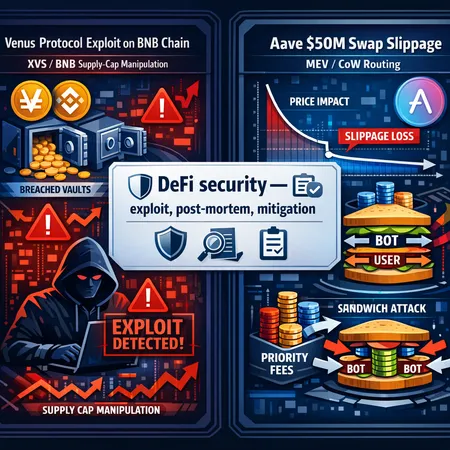
In March 2026 two separate DeFi infrastructure incidents—one on BNB Chain that hit Venus Protocol and one that affected Aave liquidity after a $50M swap—exposed overlapping failure modes: economic invariants violated by bad inputs, and routing/slippage paths that amplified loss through MEV dynamics. The Venus event centered on a supply‑cap manipulation that allowed an attacker to drain liquidity (XVS/BNB exposure); Aave’s incident was a chain reaction from a large CoW Protocol swap where slippage and routing produced outsized price impact and downstream liquidation pressure on AAVE positions.
Both incidents share an architecture lesson: complex financial rails (caps, oracles, off‑chain routing) interact nonlinearly with on‑chain execution and MEV, and small gaps in checks or operator assumptions can cascade quickly into multi‑million dollar losses.
Chronology: Venus on BNB Chain
What happened and when
- Initial detection: Venus Protocol observed anomalous behavior in a lending pool and flagged a potential exploit vector. The team’s monitoring picked up unexpected supply growth relative to protocol caps.
- Exploit execution: An attacker leveraged a manipulation of the pool’s supply cap logic to mint or credit value beyond intended limits, enabling extraction of roughly $3.6–3.7M worth of assets.
- Immediate response: Venus suspended the affected market(s), tightened collateral parameters and began on‑chain and off‑chain forensic analysis.
For a detailed timeline and forensic writeup see reporting from AmbCrypto and TheNewsCrypto which reconstruct the chain activity and initial protocol responses: AmbCrypto forensic coverage and TheNewsCrypto report.
Chronology: Aave and the $50M swap
The swap and the fallout
- Large swap executed via CoW Protocol routed across liquidity sources; net execution produced unexpectedly large slippage and MEV extraction opportunities.
- Price impact cascaded: key collateral assets used on Aave moved sharply, triggering undercollateralization and emergency liquidations that worsened market moves.
- Aave engineering teams paused or adjusted affected markets, launched a post‑mortem and began reviewing MEV/slippage safeguards.
Reporting and early post‑mortem coverage from Invezz and Coincu summarize the price action and Aave’s immediate review of MEV/slippage defenses: Invezz coverage and Coincu report.
Root‑cause analysis: how the failures unfolded
1) Supply‑cap manipulation (Venus)
At a high level, a supply cap is meant to limit how much of an asset can be supplied or minted in a given market to reduce concentration risk and contain liquidation cascades. In Venus’s case the attacker found a path that bypassed or distorted the cap‑enforcement logic.
Technical routes for such bypasses typically include:
- Race conditions between cap reads and state updates where the cap check is performed off‑chain or in a separate transaction that the attacker can reorder via MEV.
- Incomplete accounting when cross‑token interactions (wrapped tokens, peg illusions) are used to present a different “supply” than the contract expects.
- Oracle or aggregator inconsistencies that allow an asset to be valued such that the cap appears not to be hit.
The effective exploit creates an invariant break: minted/credited value exceeds the collateral buffer the protocol assumes, enabling direct extraction or cascading liquidations.
2) Slippage, routing and MEV (Aave/CoW swap)
The Aave incident was not a bug in Aave’s lending logic per se, but a systemic vulnerability in how large cross‑venue swaps are routed and how price impact is realized on‑chain.
Key mechanics:
- CoW (Coincidence of Wants) routing can aggregate liquidity across venues to fulfill large swaps. If the routing underestimates impact or uses stale liquidity snapshots, slippage can be much higher at execution time.
- MEV actors can observe large pending swaps, front‑run or reorder bundles, and extract value by sandwiching or repricing transactions—magnifying price moves.
- On a lending protocol, sudden price moves cause oracle updates and forced liquidations. If liquidations are processed with insufficient delay or price smoothing (TWAP), they create a feedback loop.
Aave’s incident highlighted how off‑protocol routing choices (e.g., a large swap executed via CoW) can create on‑protocol solvency stress.
Teams’ responses: stops, post‑mortems and fixes
Venus response
- Emergency suspension of the affected market(s) to prevent further exploitation.
- Tightened collateral parameters and temporary removal or modification of the vulnerable asset pair.
- Forensic review and coordination with BNB Chain validators and tooling providers to trace funds and identify attack vectors.
- Public post‑mortem planning and patching of cap enforcement logic; more conservative defaults for supply caps until a formal fix is deployed.
These steps follow standard incident playbooks: isolate, contain, analyze, remediate and communicate. Venus’s quick market suspension limited additional losses but underlines the need for automated circuit breakers rather than manual toggles.
Aave response
- Rapid internal review of MEV and slippage exposure after the swap and subsequent AAVE price action.
- Collaboration with routing partners and CoW Protocol to understand the execution path and where slippage estimates diverged from realized prices.
- Announcements to users and a commitment to update safeguards—this included exploring tighter slippage bounds, enhanced pretrade simulations and changes to liquidation paramaters.
Aave’s response emphasizes the need to treat routing and swap execution as part of the protocol’s security surface; it’s not enough to rely on external aggregators without defensive layers.
Product fixes being rolled out (current best practices)
Several practical, implementable fixes have emerged from these incidents and similar past events:
- Dynamic and time‑aware caps: enforce supply and mint caps with both instantaneous checks and time‑windowed counters (e.g., per‑block and per‑hour limits) to reduce race‑condition risk.
- On‑chain circuit breakers: programmable halting of markets when key invariants (supply ratios, TVL swings, oracle divergence) cross thresholds. Make these automated and on‑chain to prevent delayed manual interventions.
- Oracle hardening & TWAP smoothing: use multi‑source oracles and time‑weighted averages to resist short‑lived MEV swings; validate sudden price moves before they trigger mass liquidations.
- MEV‑aware routing: integrate private relays, bundle submission (e.g., MEV‑bundle strategies) or off‑chain matching when executing large swaps to minimize public mempool exposure.
- Slippage limits and pre‑execution simulation: require trusted preflight slippage estimates and reject or split orders that exceed safe thresholds; perform execution simulations against real liquidity curves.
- Permissioned emergency controls with transparent governance: keep a minimal but indispensable emergency admin path with multisig and timelock for urgent pauses, and publish playbooks for accountability.
- Post‑trade reconciliation and watchlists: automated alerts when suspicious actors or addresses show repeated abnormal flows; integrate analytics to trigger preemptive mitigations.
Many of these defenses are complementary rather than alternatives; employing several together raises the attack cost materially.
Practical recommendations for protocols and security teams
For DeFi engineers, auditors and risk managers, prioritize the following:
Treat off‑protocol execution as part of your threat model. Large routed swaps executed through aggregators can impose external risk on your protocol. Contract assumptions about price stability and liquidity should explicitly account for routed order flows.
Harden cap enforcement on‑chain. Avoid split checks that rely on off‑chain reads. Where off‑chain data is necessary, add conservative buffers and re‑checks at settlement time.
Make oracles resilient. Combine multiple feeds, add validation layers, and use TWAPs or medianization with guard rails to avoid triggering liquidations on ephemeral spikes.
Adopt MEV‑mitigations for sensitive flows. For critical state transitions (liquidations, large mints/redemptions), consider private relay submission, bundled transactions or using auction/commit‑reveal patterns to reduce mempool exposure.
Implement automated circuit breakers. Program thresholds that temporarily pause markets or restrict actions when invariants are violated. Automation reduces reaction time and limits blast radius.
Run economic red‑team tests. Regularly simulate large swaps, oracle attacks, and cap bypass attempts under adversarial conditions to see how parameters behave in stressed scenarios.
Improve observability and response playbooks. Instrument real‑time dashboards, automated alerts, and documented runbooks for the ops team; practice tabletop exercises with multisig signers.
Communicate with users transparently. When markets are suspended or params change, clear rationales reduce panic and speculative runs that can worsen situations.
Advice for users and liquidity providers
- For large trades, split orders or use private execution channels; avoid placing massive orders in public mempools that attract MEV.
- Monitor the protocols you use for abnormal parameter changes or oracle divergence and keep collateral buffers higher during volatile periods.
- Prefer platforms with clear circuit breakers and on‑chain emergency models that can be audited and tested.
- Use limit orders or routes that provide execution guarantees; set conservative slippage tolerances and check preflight simulations.
Conclusion: systemic risk requires systemic fixes
The Venus and Aave incidents aren’t isolated quirks; they’re convergent evidence that DeFi security must treat economic logic, off‑chain routing and MEV as a single system. Robustness comes from layered defenses: hardening smart contracts, automating safeguards, and integrating MEV‑aware execution strategies. Protocol teams should assume that large trades and creative token wrappers will be weaponized; the right engineering posture is defensive, iterative and transparent.
For engineers and auditors building the next generation of lending markets, the practical work—dynamic caps, automated circuit breakers, stronger oracles and MEV‑aware routing—is now essential operational hygiene, not optional extras. Platforms like Bitlet.app that provide tooling and monitoring can be complementary to these guardrails, but they’re only one piece of a broader ecosystem of mitigations.
Sources
- AmbCrypto: Inside the $3.6M Venus Protocol exploit on BNB Chain — https://ambcrypto.com/inside-the-3-6mln-venus-protocol-exploit-on-bnb-chain/
- TheNewsCrypto: Venus Protocol detects $3.7M supply‑cap attack on the pool — https://thenewscrypto.com/venus-protocol-detects-3-7m-supply-cap-attack-on-the-pool/?utm_source=snapi
- Invezz: Why is Aave rising after a $50M crypto swap disaster? — https://invezz.com/news/2026/03/16/why-is-aave-rising-after-a-50m-crypto-swap-disaster/?utm_source=snapi
- Coincu: Aave reviews MEV/slippage safeguards after $50M CoW swap — https://coincu.com/news/aave-reviews-mev-slippage-safeguards-after-50m-cow-swap/?utm_source=snapi
For more background on systemic DeFi risk and lending market design, readers can also consult discussions on DeFi best practices and protocol post‑mortems such as those published by Aave and Venus.