Politicized Crypto: How Political Events Fuel Memecoin Rallies and Political DeFi
Summary
Introduction
The intersection of politics and crypto has shifted from rhetorical debates to market mechanics. What used to be campaign hashtags and policy statements now shows up as tradable tokens, promoter-led rallies, and even DeFi ventures tied to political brands. That shift raises practical questions for compliance officers, token issuers, and investors: how do you evaluate political crypto when a single event — a gala, a tweet, or a rescheduled meeting — can trigger a rapid price spike?
This piece uses recent $TRUMP memecoin episodes and the WLFI announcement as grounding examples to explain the economics, legal exposures, and sensible exchange responses that can reduce systemic and reputational risk.
The rise of political memecoins: $TRUMP as a case study
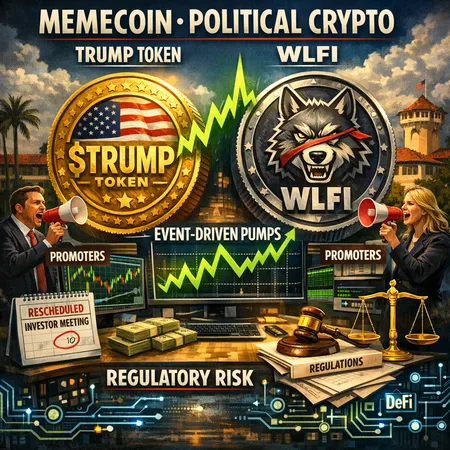
Memecoins are by design narrative-driven assets. When the narrative is political, the stakes change: attention is amplified, media coverage broadens, and promotional channels can be unusually effective. In March and April 2024, the $TRUMP memecoin recorded dramatic short-term moves after organizers and promoters tied token interest to high-profile events. Promoters advertised a Mar-a-Lago gala linked to $TRUMP and reported a near-instant 60% price jump after that advertising push, a clear example of how targeted promotion can move price in low-liquidity tokens (CryptoNews report).
A follow-up promotional tactic involved scheduling and then rescheduling investor-facing engagements connected to the token, offering token holders direct access to token-linked promoters — another lever that appears to have driven buyer demand (CryptoNews coverage). These tactics combine scarcity narratives (exclusive access), social proof (high-profile venues), and simple marketing to create intense, but fragile, demand.
For market participants this creates a distinct profile: sudden volume surges, rapid price appreciation concentrated in a small window, followed by near-instant reversals when the underlying event attention dissipates. That pattern is the epitome of event-driven pumps in the memecoin space.
Political DeFi: WLFI and the emergence of branded investment products
Political branding is not limited to memecoins. DeFi formations tied to political figures or families — such as World Liberty Financial (WLFI), associated with the Trump family — demonstrate how political actors are exploring decentralized finance channels to package investment access and products. The WLFI announcement described a new investment opportunity and positioned the project as a politically branded financial vehicle (Bitcoinist overview).
A few features distinguish political DeFi from celebrity-backed memecoins:
- Token design may include utility or governance components intended to mirror traditional investment access.
- Marketing frequently promises privileged access (events, direct contact, or exclusive financial products) that go beyond standard token utility.
- The projects may attempt to leverage brand recognition to bootstrap liquidity and social engagement.
These elements make political DeFi attractive to retail buyers seeking affiliation and to speculators chasing narrative-driven alpha. Yet they also compound legal and ethical questions — which we address below.
Market microstructure of event-driven pumps
Understanding how these pumps unfold helps compliance teams detect and respond faster. Typical mechanics of an event-driven memecoin pump include:
- Low initial liquidity: Many memecoins have small order books and few liquidity providers, so modest buy pressure moves price easily.
- Concentrated token holdings: A small number of wallets or insiders often control a large share of circulating supply, enabling coordinated or unilateral supply-side actions.
- Promoter-triggered flow: Advertising, influencer endorsements, or event promises (like a gala or exclusive meeting) create concentrated buy-side interest in a short window.
- Slippage and cascading sell pressure: When the event ends or sentiment reverses, thin asks lead to sharp drops; traders that bought at the top may panic-sell, amplifying the move.
- Frontrunning and MEV: Sophisticated actors may use miner/executor advantages and frontrunning techniques to capture early upside, further distorting fair market prices.
These dynamics make political memecoin rallies highly predictable in shape but hard to police in real time. Exchanges and market surveillance tools should therefore be tuned to signals such as abrupt volume spikes, social-media-driven traffic, and sudden changes in wallet concentration.
Legal and reputational risks
Politically-affiliated tokens create layered legal exposures beyond ordinary memecoins:
- Securities risk: If a token is marketed with expectations of profit, privileges, or centralized management, regulators may deem it a security. Promises of access or returns tied to WLFI-style offerings could trigger securities-law tests in multiple jurisdictions.
- Fraud and misrepresentation: Promoter claims (e.g., “guaranteed direct access”) must be verifiable; misleading claims can lead to enforcement actions and private litigation.
- Bribery and campaign-finance issues: Tokens that confer political influence or access can create campaign-finance compliance problems if they are used to funnel benefits to a campaign or political actor.
- AML and sanctions: Political actors and high-profile supporters increase the risk of illicit finance or sanctions exposure; platforms must treat politically exposed persons (PEPs) carefully under AML regimes.
- Reputational spillover: Exchanges listing or promoting politically charged tokens risk consumer backlash and regulatory scrutiny, particularly if projects are later linked to fraud or manipulation.
Compliance officers must treat these tokens as higher-risk products requiring elevated due diligence and legal review.
Compliance and exchange responses: what to consider
Exchanges and marketplaces need a layered approach combining policy, surveillance, and disclosure.
- Enhanced listing standards
- Require detailed whitepapers, audited smart contracts, token-holder distribution breakdowns, and lockup schedules.
- Demand legal opinions addressing securities law in major jurisdictions.
- Pre-listing promoter/influencer disclosures
- Insist that token issuers disclose promoter agreements, compensation, and the nature of any promised access tied to token holdings.
- Monitor paid promotion campaigns and require tags/labels for sponsored content.
- Market surveillance and circuit breakers
- Configure alerts for rapid-lift-and-crash patterns, unusual concentration of buy-side flow, and abnormal social-media spikes.
- Implement dynamic circuit breakers or temporary halts for coins exhibiting abnormal, event-driven volatility.
- Operational controls
- Limit listing eligibility for tokens that promise political favors or access without transparent, auditable mechanisms.
- Keep the ability to freeze or delist tokens where legal or reputational risk is acute (with clear, pre-published criteria).
- AML/KYC and PEP screening
- Apply higher scrutiny for large holders or promoters who are PEPs.
- Track on-chain flows linked to sanctioned entities.
- User education and warnings
- Publish risk disclosures specifically calling out event-driven pumps, political branding, and the potential for rapid loss of value.
Platforms like Bitlet.app that offer P2P and earn products should ensure their product teams and compliance functions are aligned on such risks before integrating politically branded tokens into yield or exchange services.
Practical steps for investors, issuers, and compliance officers
For investors
- Do rigorous due diligence: check token distribution, smart-contract audits, on-chain liquidity, and promoter compensation.
- Assume event-driven rallies are short-lived unless underlying fundamentals and genuine utility exist.
For issuers
- Be transparent: publish audited contracts, comprehensive tokenomics, and independent legal opinions.
- Avoid ambiguous promises of access or returns; tie any perks to verifiable, contractual mechanisms.
For compliance officers and exchanges
- Build a playbook for politically-linked tokens: pre-listing review, ongoing surveillance, and emergency action procedures.
- Train market surveillance teams to correlate social-media events with on-chain and off-chain activity quickly.
- Coordinate with legal to evaluate potential securities or campaign-finance issues early.
Conclusion
Political crypto is not a passing curiosity — it's an emerging market behavior that blends branding, influence, and speculative capital. The $TRUMP memecoin episodes and the WLFI announcement are timely reminders: when political events are used to manufacture token demand, the result is often intense short-term gains for some and rapid losses for many. Compliance teams, issuers, and investors who anticipate event-driven pumps, demand transparency, and apply rigorous controls will be best positioned to navigate this unpredictable corner of the crypto market.