XRPL's Paradox: Explosive On-Chain Tokenization and Why XRP's Price Still Lags
Summary
Executive snapshot
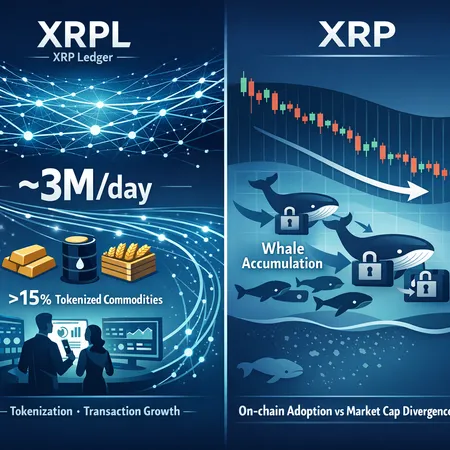
The XRP Ledger (XRPL) has quietly matured into one of the most active tokenization rails in crypto. Over the last year its daily transaction counts surged to roughly 3 million, and a growing proportion of tokenized commodities are settling on-chain. Yet the native token, XRP, has spent long stretches below previous highs, leaving many to ask: is XRPL becoming an infrastructure winner while the token lags behind?
This article walks product managers, token investors, and enterprise developers through the evidence for XRPL’s on-chain growth, the causes of price underperformance, the influence of whale flows and technical setups, and practical roadmap items that could help convert infrastructure activity into token value.
Evidence: transaction growth and tokenized commodities
Data points are hard to argue with. A recent report documents XRPL’s transaction growth to about 3 million daily transactions over the past year, driven by token issuance, automated market activity inside decentralized exchanges, and higher-frequency payment rails. The raw throughput and cheap settlement costs make XRPL attractive for high-volume tokenized workflows. See the coverage documenting this rise here: XRPL transactions rally to ~3M/day.
Parallel to transaction growth is the rapid uptake of tokenized commodities. Analysis shows XRPL now hosts over 15% of global tokenized commodity supply, an outsized share considering its market cap, which signals strong product-market fit for asset issuers exploring on-chain ownership and settlement. The implications for on-chain assetization and custody workflows are significant; read the deep-dive here: XRPL surges to second globally with >15% of tokenized commodities.
Taken together, transaction growth and tokenized asset share position XRPL as a practical infrastructure layer for enterprise-grade tokenization projects, especially where throughput, finality, and low fees matter.
The paradox: bustling ledger, subdued token price
A paradox has emerged: record network activity but a muted market value for XRP. Coverage of this disconnect highlights factors such as speculative capital rotation, regulatory uncertainty, and macro liquidity dynamics that can decouple usage metrics from token market cap. The paradox is explored here: network activity surges while token price searches for macro bottom.
Several forces create this divergence. First, tokenization and enterprise usage can be denominated in stablecoins, fiat on-ramps, or fee-minimizing structures that bypass holding large amounts of native XRP. Second, capital markets price narrative and macro risk—when traders favor blue-chip tokens or risk-on narratives, infrastructure-native tokens sometimes lag. Third, speculative supply dynamics and concentration among a small number of large wallets can mute organic price discovery.
Whale accumulation and technical outlook
On-chain signals show notable whale activity. Large inflows into exchange-hosted or custody wallets can both presage accumulation and create selling pressure depending on the destination and intent. Reporting on whale flows and macro catalysts (such as commodity-linked inflation fears) shows how larger market narratives intersect with XRPL interest: whale accumulation and macro drivers.
Technically, analysts point to consolidation ranges that often precede sizable directional moves. One technical piece argues XRP may be positioned for a significant move after consolidation around key levels, suggesting the market is coiling rather than collapsing: why XRP is set for a major 30% move. For investors this combination—whale accumulation plus technical compression—warrants attention, but it is not a guarantee. Liquidity, macro shocks, and regulatory news can quickly change the setup.
What this means for product managers
For PMs evaluating XRPL as an infrastructure choice, the ledger’s strengths are clear: low-cost settlement, high throughput, deterministic transaction finality, and growing demand from asset issuers. Rather than assuming native-token demand will materialize automatically, product teams should design experiences that create explicit utility for XRP within their products—examples include: fee-smoothing pools denominated in XRP, native settlement rails bridging tokenized commodities to fiat, or liquidity incentives that route market taker fees into XRP sinks.
Practical priorities:
- Build frictionless fiat on/off ramps that convert between fiat and on-chain tokens while exposing settlement advantages.
- Implement UX flows that make holding small XRP balances trivial, thereby increasing the token’s transactional use.
- Collaborate with custodians and exchanges to ensure tokenized commodity listings have deep XRP liquidity pairs, not only stablecoin pairs.
Platforms like Bitlet.app and others watching tokenization trends will benefit from product-level integrations that favor on-ledger settlement and liquidity routing.
Enterprise implications: why commodities issuers are onboarding
Enterprises issuing commodities on-chain get three immediate benefits: auditable provenance, fractional liquidity, and faster settlement cycles. The >15% share of tokenized commodities on XRPL indicates that commodity issuers find the ledger technically and commercially attractive—especially where issuance requires predictable fee models and fast finality.
Key enterprise considerations:
- Compliance primitives: enterprises need KYC/AML-friendly token wrappers and revocation mechanics; developers should expose these as configurable modules.
- Custody and insurance: institutional issuers require audited custody solutions and insurance layers for tokenized holdings.
- Market-making and settlement rails: to keep tokenized commodities liquid, enterprises should coordinate with market makers to create XRP-denominated liquidity or robust cross-pairing with stablecoins.
Investor playbook: risks, opportunities, and signals to watch
For token investors, XRPL’s growing usage is a bullish structural narrative—but timing and execution matter. Indicators to monitor:
- Whale wallet flows and on-chain distribution changes (are whales accumulating off-exchange or moving to exchanges?).
- Exchange order book depth in XRP pairs, especially against tokenized commodity placements.
- Developer activity and new token listings on XRPL, which signal sustained product adoption.
- Macro liquidity and sentiment—broader market risk appetite often amplifies or suppresses token price moves.
Position-sizing should reflect the divergence between infrastructure adoption (which favors long-term optionality) and short-term price volatility.
Practical use cases that convert ledger activity into token utility
Bridging on-chain usage to token value requires creating explicit reasons to hold and spend XRP. Practical use cases include:
- Native settlement corridors: commodity issuers and traders settle margins or final invoices in XRP to leverage speed and cost, creating transactional demand.
- Fee subscription models: platforms charge micro-fees in XRP for API calls, marketplace listings, or custody operations, creating recurring sinks.
- Liquidity mining and cross-settlement incentives: reward market makers with XRP-denominated rewards to deepen order books for tokenized assets.
- Automated treasury management: enterprises holding tokenized commodities can use XRP as a temporary liquidity buffer, increasing intraday holdings.
Each use case demands developer tooling (SDKs, compliance modules, treasury connectors) that make XRP integration straightforward.
Roadmap items that could bridge utility to price
To convert infrastructure success into token appreciation, stakeholders across the ecosystem should prioritize:
- Better developer tooling: robust SDKs, audited smart-contract equivalents (hooks), and composable libraries for tokenization workflows.
- Compliance and standards: reusable KYC/AML token templates and standardized metadata for commodity-backed tokens so enterprises can onboard quickly.
- Economic sinks: subscription, fee, and burn models that create predictable demand for XRP rather than purely speculative holding.
- Enterprise integrations: custodial partnerships, regulated on/off ramps, and market-maker agreements to ensure liquidity for XRPL-native pairs.
- Clear narrative and education: show balance sheets and throughput-case studies that translate ledger metrics into economic value for enterprises and investors.
If these elements are executed, the path from ledger activity to token price becomes more direct—transaction growth turns into recurring demand rather than isolated throughput.
Final takeaways
XRPL is demonstrating that real-world tokenization and high-frequency transaction rails can scale without immediate token repricing. That’s not an indictment of the ledger—it’s a common stage in infrastructure adoption where usage leads price. For product managers and enterprise developers, XRPL offers a compelling technical platform today. For token investors, whales and technical consolidation hint at potential moves, but converting ledger utility into sustained price appreciation will require concrete utility sinks, stronger liquidity design, and institutional workflows that denominate economic activity in XRP.
Watch on-chain distribution, enterprise integrations, and developer activity closely. If those line up, XRPL’s infrastructure lead could translate into meaningful token demand.
Sources
- U.Today — XRPL transactions rally to ~3M/day: https://u.today/xrp-ledger-transactions-rally-300-in-1-year-report?utm_source=snapi
- Coinpaper — XRPL surges to second globally with >15% of tokenized commodities: https://coinpaper.com/15434/xrp-ledger-surges-to-second-globally-with-15-of-tokenized-commodities-on-chain?utm_source=snapi
- Blockonomi — XRPL network activity surges while token price searches for macro bottom: https://blockonomi.com/xrp-network-activity-surges-while-token-price-searches-for-macro-bottom/
- FXEmpire — Whale accumulation and macro drivers affecting XRP: https://www.fxempire.com/forecasts/article/xrp-news-today-oil-shock-whale-inflows-in-core-focus-1585274
- Finbold — Technical case for a sizable XRP move after consolidation: https://finbold.com/heres-why-xrp-is-set-for-a-major-30-move/?utm_source=snapi
For comparative context on broader crypto market narratives, many readers also track how on-chain infrastructure themes play out in markets like Bitcoin and DeFi.