Why Bitcoin Is Holding Up as a Macro Safe-Haven: ETFs, Gold Outflows and the $72k–$100k Thesis

Summary
Executive snapshot
Bitcoin’s recent run amid the Iran conflict has reanimated a familiar debate: is BTC acting as a macro safe-haven or simply benefiting from a short-term capital rotation? The data since the shock points to both narratives being true. Institutional demand into spot Bitcoin ETFs, historic outflows from gold funds, and active stablecoin flows have combined to create a tighter spot market that amplifies price moves. At the same time, on-chain signals and derivatives metrics show both conviction (accumulation) and elevated risk (leverage and positioning).
For many allocators the immediate question is practical: does a $72k handle change the argument for increasing crypto exposure into H2 2026? Below we unpack the drivers, the on-chain and derivatives evidence, the technical roadmap from $72k to a $100k upside thesis, and risk-managed allocation plays.
Why BTC has outperformed equities and gold since the shock
A few mechanics explain why Bitcoin outpaced the S&P and traditional safe-havens after the geopolitical shock. First, headlines and uncertainty drove a classic risk-repricing: investors sought assets that can re-price quickly and access new liquidity pools. For a growing set of institutions and allocators, that pool now includes spot BTC via ETFs.
Market coverage noted Bitcoin topping $72,000 even while U.S. equities and a strengthening dollar diverged—suggesting BTC’s drivers are not merely a reflation trade tied to risk assets but a distinct cross-asset flow story (CoinDesk). Cointelegraph framed the breakout explicitly as a geopolitical stress-test, a line that fits how investors view BTC as a non-sovereign hedge when geopolitical lines are redrawn (Cointelegraph).
Second, capital rotation away from traditional stores of value—most notably gold—has been measurable. Reporting shows historic outflows from gold funds concurrent with surging demand into Bitcoin ETFs, a direct reallocation rather than a pure expansion of risk appetite (Blockonomi). The net effect: some investors are treating BTC as a liquid, tradeable store of value in place of gold.
Third, the market structure difference: spot BTC liquidity is now more ETF-centric and stablecoin-enabled. ETFs pull capital that must be delivered into the spot market, while minted stablecoins—USDT in particular—provide a fast conduit for dollar liquidity into exchanges and OTC desks. That structural plumbing can accelerate moves when demand is one-sided.
ETF inflows and the liquidity plumbing
Spot ETF inflows are the most tangible institutional on-ramp in 2025–2026. When ETFs receive dollars they either buy spot BTC directly or create arbitrage flows that draw BTC from exchanges or OTC desks into custodial venues. The consequence is a net removal of circulating spot supply from liquid exchange order books into custody, tightening available liquidity and increasing the price impact of marginal buys.
Blockonomi documented a clear correlation: as gold funds saw outflows, Bitcoin ETFs experienced surges in flows—an observable rotation of capital across asset classes (Blockonomi). That shift matters because ETF-led demand is typically persistent and programmatic: weekly creations and recurring allocations from wealth managers and multi-asset funds produce a steady bid rather than a one-off spike.
Meanwhile, stablecoins—chiefly USDT—act as immediate ammunition. When USDT is minted and transferred to centralized venues or OTC desks, execution desks can match buyers quickly, compressing slippage and turning latent demand into executed buys. The interplay of ETF demand and USDT liquidity is therefore multiplicative: ETFs create a structural bid; USDT supplies nimble execution capacity to feed that bid.
On-chain and derivatives signals: what to watch
Several metrics give intermediate investors a read on conviction and risk:
Whales and accumulation: Large on-chain transfers into cold wallets and reduced exchange balances are classic signs of accumulation. When sizeable addresses are adding to balances while exchange reserves fall, it implies longer-term custody rather than immediate selling intent.
Open interest (derivatives): Rising open interest—especially alongside rising price—suggests fresh leverage is entering the market. That can sustain rallies but also creates a vulnerability: if price reverses and liquidations cascade, volatility spikes.
MVRV and realized metrics: Market Value to Realized Value (MVRV) gauges whether on-chain holders are, in aggregate, in profit. Elevated MVRV warns of latent profit-taking. A sustained rally into high MVRV bands typically precedes consolidations or corrections.
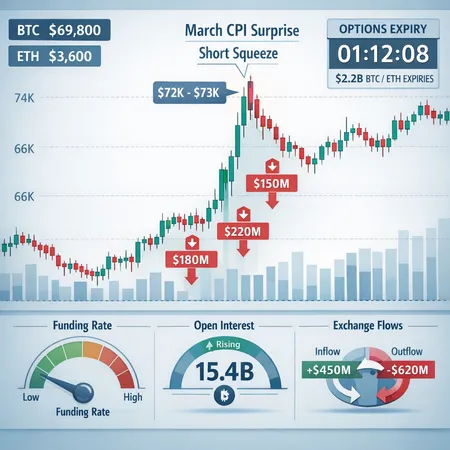
Collectively, these indicators have shown a mixed portrait in the current episode: accumulation by long-term holders and institutions on one hand; growing derivatives participation and higher open interest on the other. The result is a market that can march higher under steady demand but remains susceptible to quick reversals if a liquidity shock or negative ETF narrative emerges.
Technical framework: $72k base, $90k–$100k upside thesis
Technically, the path forward can be framed in three scenarios:
Base case (near-term consolidation): Price stabilizes around the $70k–$75k band as ETF inflows ebb and derivatives positioning normalizes. This path involves sideways-to-mild-up momentum while on-chain accumulation continues.
Upside case (sustained flows): Continued ETF inflows and steady USDT-backed spot demand push BTC through intermediate resistance toward $90k. If momentum sustains and macro headlines keep safe-haven flows active, a stretch toward $100k becomes feasible as narrative and liquidity align.
Downside case (profit-taking / liquidity shock): A sudden reversal in ETF flows, a triggered deleveraging in derivatives markets, or a broader risk-off in global markets could push BTC back toward deeper support levels. In that scenario, stop-loss layers and rebalancing protocols become critical.
Key technical levels to watch: $72k as near-term support and sentiment pivot; $85k–$90k as the first resistance cluster where profit-taking often concentrates; $100k as the psychological and headline-driven extension target.
Practical allocation and risk-management for H2 2026
For intermediate investors and allocators, the rally reshuffles the calculus but doesn’t eliminate the asset’s volatility profile. Here are pragmatic steps to consider:
Size to volatility: Instead of fixed nominal allocations, size BTC exposure to a volatility-scaled budget. For example, cap initial allocations at a level where a 50% drawdown would not imperil portfolio objectives.
Use regulated vehicles for entry: ETFs provide regulated exposure, custody convenience, and block trading options for large allocators. For those who prefer self-custody, ensure counterparties and custody solutions are institutional-grade—platforms like Bitlet.app are now part of that evolving on-ramp landscape.
Maintain liquidity buffers (USDT/cash): Keep dry powder in stablecoins or cash to rebalance on dislocations. USDT remains the dominant execution stablecoin; monitoring USDT mint/redemption cycles can provide tactical entry windows.
Layer entries and partial profit-taking: Stagger buys across macro headlines and technical pullbacks. Likewise, set predefined rules to harvest gains into traditional safe-havens—especially if MVRV moves into historically high bands.
Hedging options: Institutional allocators can use options or futures to hedge tail risk. Cost-effective hedges during quiet markets can protect the portfolio against sharp deleveraging events.
What could derail the narrative?
Several shocks would undercut the safe-haven rotation thesis: a rapid normalization of geopolitical risk, a dramatic reversal in ETF flows or regulatory action targeting ETFs or custody, or a generalized liquidity scrape in the stablecoin system. Any of these would remove the bid that has underpinned recent strength and could trigger leveraged unwind.
Takeaways for allocators
- The recent BTC rally is structural, not purely speculative: ETF demand plus stablecoin liquidity and a genuine reallocation from gold are creating a new cross-asset flow regime.
- On-chain accumulation by large addresses and falling exchange reserves support a medium-term bullish case—but elevated derivatives open interest raises short-term risk of sharp corrections.
- A disciplined allocation approach—sized to volatility, executed via regulated vehicles, and supplemented by liquidity buffers—lets allocators participate while managing asymmetric risk.
If your allocation thesis is long-term, treat current levels as an opportunity to implement staged buys and protective rules rather than an all-or-nothing decision. For tactical traders, monitor USDT flows and derivatives open interest closely: they will often give the fastest signals of shifting liquidity and sentiment.
Sources
- Cointelegraph — Bitcoin passing geopolitical stress-test and BTC price commentary: https://cointelegraph.com/news/bitcoin-passing-geopolitical-stress-test-btc-price-spikes-above-72k?utm_source=rss_feed&utm_medium=rss&utm_campaign=rss_partner_inbound
- CoinDesk — market coverage of BTC topping $72,000 amid dollar dynamics: https://www.coindesk.com/markets/2026/03/13/bitcoin-outperforms-stocks-tops-usd72-000-even-as-dollar-strengthens
- Blockonomi — documentation of ETF inflows and gold fund outflows during Iran crisis: https://blockonomi.com/bitcoin-etfs-surge-as-gold-funds-experience-historic-outflows-during-iran-crisis/
- CryptoDaily — contextual market update showing BTC strength vs S&P: https://cryptodaily.co.uk/2026/03/btc-price-stays-strong-at-71k-while-sp-500-slides-stocks-rolling-over-whats-next-march-13-update
For ongoing tracking, keep an eye on ETF creation data, exchange reserve reports, USDT mint/redemption flows, and derivatives open interest—these plumbing metrics often lead price in episodes driven by capital rotation and geopolitical shocks. And if you're managing allocations, combine the macro perspective above with your institution’s risk limits and liquidity needs before changing weightings.
(Internal resources: for context on on-chain behavior and macro interplay see Bitcoin analyses and broader DeFi narratives.)