Kraken Lists PI Ahead of Pi Day: Will Exchange Timing Still Trigger a Pump?
Summary
Why Kraken’s March 13 PI listing matters
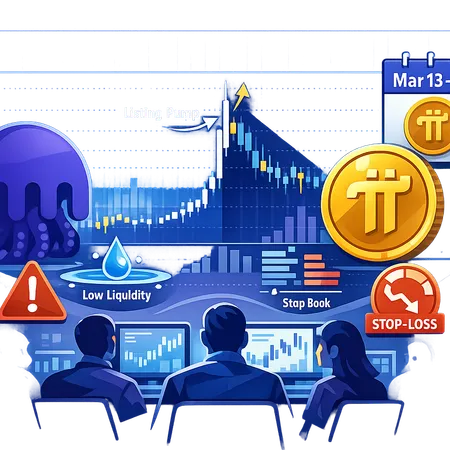
Kraken announced it would list PI trading on March 13 — explicitly timed to come just before Pi Day on March 14 — and that scheduling is not accidental. Exchanges and projects often coordinate listings around civic or community dates to concentrate attention and order-flow. That makes PI listing + Pi Day a classic case study in event-driven crypto speculation.
The listing news itself drove anticipatory sentiment in community channels and price-expectation narratives. Coverage of the event noted the expected rally and community excitement (for example, see reporting on Kraken’s listing timeline and the expected Pi coin rally) Kraken listing announcement and coverage of the rally. But attention alone doesn’t guarantee a durable price floor — it more often produces a rapid, high-volatility phase that benefits nimble traders and punishes inattentive holders.
Do exchange listings still reliably produce short-term rallies?
Short answer: sometimes. Historically, major exchange listings for tokens with pre-existing community interest often lead to short-term price spikes — but reliability has fallen as markets matured and as liquidity and counterparty mechanics evolved.
Why results vary:
- Liquidity and order-book depth: A shallow order book can amplify small inflows into large price moves. But shallow markets are also fragile; once buying pressure eases, the price can reverse quickly. That’s the core mechanism behind many “exchange listing pump” events.
- Information leakage and front-running: Bots and market makers monitor exchange announcement flows and often position ahead of visible retail orders, compressing the window of opportunity for ordinary traders.
- Exchange mechanics and listing cadence: Some exchanges stagger deposit-only windows, announce exact tradable times, or impose initial price bands — these operational choices materially change outcomes.
- Regulatory and gateway effects: Listings on regulated or large venues (Coinbase, Kraken, Binance) bring new custody flows and institutional participation, sometimes creating a more sustained ramp; for small venues, pumps can be purely retail-driven and ephemeral.
So: yes, listings can cause rallies, but they are no longer a dependable, repeatable trade unless you control for liquidity, fees, and execution timing.
The March 13–14 pattern: what to expect around Pi Day
Timing a listing one day before a community holiday concentrates speculative demand. Traders often buy pre-listing on smaller exchanges or OTC, then attempt to sell into the liquidity surge once major venues open trading. Expect this typical sequence:
- Pre-listing buildup: social buzz, higher quoted prices on smaller venues, and OTC demand.
- Listing-time spike: concentrated buy orders push price up as retail piles in at tradable time.
- Immediate reversion or multi-hour consolidation: profit-taking and market-making fills the book; price can fall back below pre-listing levels.
- Short tail: depending on fundamental interest and utility, a second wave of buyers may appear — but often only after clearer on-chain usage signals appear.
Because Kraken scheduled PI trading specifically on March 13, the market may front-load some of the Pi Day narratives, meaning volatility could peak on listing day rather than on Pi Day itself.
Mechanics of exchange-driven pump events
Understanding the plumbing helps traders and marketers alike. The main mechanical drivers are:
- Order book thinness: small buy volumes create large upward ticks when the immediate liquidity is low.
- Market vs. limit order dynamics: retail who use market orders often pay the spread and drive the immediate spike; savvy traders use limit orders placed at strategic points.
- Liquidity provision and maker incentives: some exchanges offer incentives (rebates, lower fees) to market makers around listings; their presence can dampen extreme moves or create visible depth.
- Withdrawal and deposit timing: deposit windows, KYC delays, and withdrawal holds can trap tokens on exchange, affecting supply available to the broader market.
- Algorithms and bots: institutional/quant actors can sniff announcement timestamps and submit iceberg or algorithmic orders to capture short-term momentum.
These mechanisms mean an exchange listing is not just a marketing event — it alters actual market microstructure in ways that can either magnify or mute price action.
Liquidity, listing risk, and reading the order book
Before assuming a listing equals profit, traders should assess:
- Order book depth at multiple price levels (not only the best bid/ask). If a 5% market order consumes only a few thousand dollars of liquidity, the market is fragile.
- Spread and slippage estimates: compute expected slippage for your target trade size and set limit orders accordingly.
- Deposit and withdrawal constraints: some traders cannot move coins fast enough to react; this asymmetry creates opportunity and risk.
- Daily traded volume and active addresses (for on-chain tokens): low real usage increases the chance of pump-and-dump behavior.
Listing risk also includes post-listing withdrawal freezes, delisting risk later on, and counterparty exposure if the exchange imposes strange rules or constraints. Treat an initial listing as the opening of a new market — not immediate liquidity insurance.
Risk-management tactics for retail traders
Event-driven trades attract leverage and emotion. For retail participants, practical tactics include:
- Position sizing: size trades so that a total loss is acceptable. Assume an event trade can flip 30–100% in minutes.
- Use limit orders, not market orders: this avoids worst-case slippage on thin books.
- Staggered entries and exits: split exposure across multiple price levels or time windows rather than “all-in” at the first sign of momentum.
- Pre-defined stop-loss and take-profit levels: decide these before market open and stick to them.
- Watch spreads and fees: high taker fees plus large spreads can erase short-term gains.
- Consider liquidity-providing strategies: providing limit liquidity on both sides can capture spreads, but requires discipline and monitoring.
- Don’t chase FOMO: last-minute bids often occur at the very top; better to wait for a pullback unless you have a scalping plan.
For many retail traders, the safest approach is to trade smaller sizes or to avoid the initial listing window altogether and instead monitor how the token behaves over several hours to days.
How listings fit into a token’s lifecycle and long-term adoption
A listing is a milestone in visibility and accessibility, but it’s not the same as product-market fit. Consider three phases after a listing:
- Liquidity discovery: markets find a price that reflects supply/demand; short-term volatility is the price of discovery.
- Utility testing: genuine adoption shows up in on-chain activity, integrations, merchant acceptance, or protocol usage. Without these, price action is narrative-driven.
- Maturity or fade: tokens that win real utility and ecosystem partnerships can sustain higher liquidity and narrower spreads; others revert to low-volume, high-volatility regimes.
For project teams, a major exchange listing should be part of a broader strategy: market access, developer partnerships, real use cases, and incentives that encourage meaningful on-chain flows. Otherwise, the listing is a media event with little lasting impact. Bitlet.app sees this pattern often—listings bring attention, but sustainable growth requires product and network effects.
Practical checklist: traders and project marketers
For traders (pre-listing):
- Read the listing terms and exact tradable time on the exchange announcement.
- Check cross-exchange prices and OTC demand to estimate pre-listing premium.
- Set limit orders at multiple price levels; avoid large market orders.
- Decide exit plan before entering: short scalp vs. multi-hour hold.
For project marketers (planning a listing):
- Coordinate clear messaging around deposit/trade/withdraw timelines to reduce confusion.
- Work with market makers to seed initial liquidity and reduce extreme spreads.
- Sequence listings across exchanges thoughtfully — a single top-tier listing may create more durable flows than simultaneous small listings.
- Be transparent about token economics, vesting, and on-chain metrics to reduce speculation driven purely by FOMO.
Final takeaways
- Exchange listings, including Kraken’s PI listing ahead of Pi Day, remain catalysts for volatility but not guaranteed profit generators.
- The key determinants of listing outcomes are liquidity, order-book structure, exchange mechanics, and whether fundamental demand (usage, integrations) exists beyond hype.
- Retail traders should favor disciplined risk management, use limit orders, and avoid oversized bets on initial pumps. Project teams should view listings as one step in a longer adoption journey, not a substitute for utility and ecosystem growth.
By treating listings as market-structure events rather than simple news, traders and project marketers can navigate the listing lifecycle more rationally and reduce exposure to avoidable listing risk.
For context on Kraken’s timing and the community reaction to the PI listing, see the initial reporting of Kraken’s schedule and commentary on the Pi rally Kraken listing announcement and the event coverage noting expected community excitement around Pi Day coverage of the rally.
For broader market context, remember how listing narratives interact with macro and sector trends — whether it’s NFTs, memecoins, or more utility-driven tokens like those discussed alongside Bitcoin and DeFi.