Quantum Threat to Privacy Coins: Assessing Risks for Monero (XMR) and Zcash (ZEC) and Pathways to Post‑Quantum Resilience
Summary
Why the quantum threat to privacy coins matters now
Quantum computing isn’t just an academic curiosity anymore — it’s a strategic risk vector for long-lived ciphertexts, signatures, and anonymity systems. Privacy coins such as Monero (XMR) and Zcash (ZEC) rely on asymmetric cryptography and advanced privacy primitives whose long-term security assumptions are tied to the hardness of problems that could be solved by a sufficiently large, fault-tolerant quantum computer using Shor’s algorithm.
Two recent developments have put this topic back in the headlines. Researcher Justin Bons has publicly warned that practical quantum machines could break privacy technologies used in Zcash and Monero, emphasizing the stakes for archived ledgers and future de-anonymization. Reporting of new, large-scale quantum computing facilities breaking ground lends additional urgency to the conversation — it’s a reminder that the capability curve can move faster than many expect.
For context, while many market participants watch Bitcoin price action, protocol designers and custodians must watch a different clock: the timeline for quantum capability versus the shelf life of on-chain data and user privacy.
What exactly is at risk: cryptographic primitives and privacy constructs
The quantum threat is not uniform. It targets specific cryptographic building blocks:
Asymmetric public-key signatures and key exchange (ECDSA, EdDSA-style schemes, CURVE- based keys): Shor’s algorithm would, given a large enough quantum computer, break the discrete-log and integer-factor problems that underlie most widely used signature schemes. That means private keys could be derived from observed public material.
Pairing-based constructions and certain zk-SNARK setups: Some zk-SNARKs and related primitives use pairing-friendly curves and structured setup assumptions; these rely on discrete-log hardness in their security arguments. If those underlying problems are solved, the assumptions that underpin certain zero-knowledge constructions could be invalidated.
Symmetric cryptography and hash functions: These are less exposed. Grover’s algorithm gives a quadratic speedup for brute force, effectively halving the security level (so a 256-bit hash becomes similar to 128-bit against a quantum adversary). The fix here is larger parameters rather than wholesale replacement.
In practical terms for privacy coins:
Monero’s privacy model (one-time addresses, ring signatures, and key images) is designed to obscure linkability, but many primitives used for signing and key derivation are ECC‑based. If an attacker can recover private keys from public transaction data, past transactions could be linked or spent.
Zcash’s shielded pools and proof systems use zk-SNARKs (Sapling/Orchard-era improvements notwithstanding). Some zk constructions rely on pairing-based cryptography and trusted-setup paradigms; those require careful re-evaluation under post-quantum assumptions.
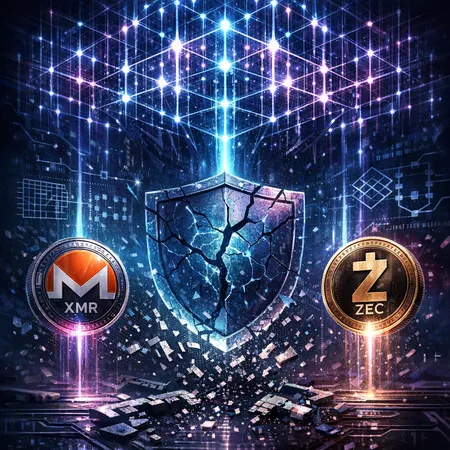
Justin Bons’ warning about Zcash and Monero makes this precise point: archival collection of transaction data plus future quantum capability equals a potential de-anonymization vector if the primitives are vulnerable (Justin Bons warning).
How imminent is the threat? Timelines, uncertainty, and recent hardware news
Estimating timelines for fault-tolerant quantum computers is famously uncertain. Publicly stated roadmaps range from optimistic (a decade or less) to pessimistic (several decades). That said, two factors change how custodians and protocol developers should think about urgency:
Harvest-now–decrypt-later: An adversary can record public blockchain data today and attempt to break keys later once quantum resources are available. That means the clock starts now for any data that must remain private long-term.
Growing investment and facilities: Coverage about emerging large-scale quantum facilities and the financial and national-security interest behind them suggests resources are being marshalled aggressively. Reporting on new giant quantum computing facilities breaking ground highlights how a 'quantum era' could accelerate (Coverage of new facility).
Researchers’ timelines vary, but the consensus for planning is: assume credible risk within one to three decades, and treat high-value, long-lived secrets as needing earlier action. For privacy coins — where the core product is long-term untraceability — that planning horizon is conservative and appropriate.
Practical mitigation pathways: technical and operational strategies
There is no single silver bullet. Mitigation is a layered program combining cryptographic upgrades, protocol governance, and custodial practice.
1) Embrace crypto-agility and hybrid signatures
Design systems to be crypto‑agile: allow signature schemes and curve parameters to be swapped without breaking consensus. During transition, use hybrid signatures that require both a classical ECC signature and a post-quantum signature (for example, lattice-based). A hybrid approach buys a bridge: an attacker must break both schemes to forge or deanonymize.
Promising post-quantum candidates include lattice-based schemes (CRYSTALS-Kyber for KEMs, CRYSTALS-Dilithium for signatures) and hash-based signatures like SPHINCS+. NIST’s standardization process has already favored a small set of primitives that are practical and reasonably well-studied.
2) Favor post-quantum proofs where possible
For zero-knowledge, research is moving toward constructions believed to be more quantum-resistant. For example, STARKs (scalable transparent arguments) avoid pairing-based assumptions and rely on hash-based assumptions that are less vulnerable to Shor-style attacks (though they still face Grover-size considerations). Where zk-SNARKs are used today, projects should evaluate post-quantum alternatives or hybrid instantiations.
3) Operational measures for custodians and exchanges
Custodial services and exchanges hold large concentrations of keys and are high-value targets. Recommended actions:
- Key rotation and migration policies: Rotate keys proactively; when possible, migrate funds to addresses protected by hybrid or PQ-capable schemes.
- Minimize long-lived exposure: Avoid reusing keys, and limit any on-chain data that ties disparate operations together.
- Multi-sig with diversity: Use multi-signature wallets that combine keys across different primitives (e.g., classical ECC key + PQ key). Compromise then requires breaking multiple independent systems.
- Auditable audits and testnets: Run migration rehearsals on testnets and publish plans so users and third parties can verify the transition approach.
4) Governance and upgrade paths for protocol developers
Protocol-level changes will often require soft or hard forks. To minimize disruption:
- Build upgrade hooks and meta-protocol mechanisms that allow new signature schemes to be adopted without contentious forks.
- Develop and publish formal migration roadmaps, including fallback options and compatibility windows.
- Engage with the broader privacy community — users, custodians, exchanges, and researchers — early and transparently.
A practical migration playbook for XMR and ZEC communities
Below is a pragmatic sequence you can adapt based on community cadence and technical constraints.
- Risk inventory and modelling: Identify which primitives are used where (signatures, key agreements, proofs) and model worst-case harvest-now scenarios.
- Select primary PQ primitives and prototypes: Choose NIST-recognized options (e.g., CRYSTALS families, SPHINCS+) and prototype hybrid transactions on a testnet.
- Implement crypto-agility primitives: Add versioning and capability flags so nodes can negotiate and accept multiple signature types.
- Launch migration testnet: Run a public testnet for a prolonged period, including audit challenges and community bounty programs.
- Custodial transition plan: Exchanges and custodians adopt PQ-capable deposit/withdrawal addresses, rotate keys, and communicate timelines to customers.
- Mainnet rollout with staged enforcement: Start with optional support, then require hybrid signatures for newly created addresses, and finally mandate PQ or hybrid protections after a long notice period.
This sequence balances safety, interoperability, and the social coordination reality of privacy-focused projects.
Trade-offs, costs, and user experience considerations
Post-quantum schemes can have larger signatures, different key sizes, and heavier verification costs. For privacy coins, larger proofs/signatures can increase transaction sizes and fees, and might interact unexpectedly with anonymity set algorithms. Developers should benchmark designs for bandwidth, storage, and UX impact.
A pragmatic stance is to apply the strongest protections to the most sensitive objects (e.g., shielded pools, spending keys, custodial hot wallets) first, while iterating on efficiency for broad adoption.
What privacy advocates and users should do now
- Treat archival risk seriously: assume that any public chain data could be harvested today and attacked in the future.
- Prefer services and wallets that publish clear PQ migration plans. Custodians should disclose their key rotation and upgrade policies.
- Support protocol funding for cryptography research and for open-source implementations of post-quantum schemes.
Bitlet.app and other service providers will need to build transition plans into custody and wallet products — even if adoption is staged over several years.
Conclusion: inevitable adaptation, manageable risk
A future where large fault-tolerant quantum computers exist would change security assumptions across the industry. That future is not necessarily tomorrow, but for privacy coins the time to act is now: archival harvesting makes procrastination risky.
The good news is that we already have viable building blocks — lattice-based signatures, hash-based schemes, STARK-style proofs, and hybrid strategies — and a clear engineering path: prioritize crypto-agility, pilot hybrid approaches, and move critical keys and services to post-quantum protection early.
The transition will take coordination, careful benchmarking, and clear stewardship from protocol teams and custodians. But with deliberate planning, privacy coins like XMR and ZEC can preserve their core promise — long-term anonymity — even in a quantum era.