Aave V4 Reinvestment Module: What It Means for DeFi Lenders and Idle Liquidity
Summary
Why the reinvestment module matters
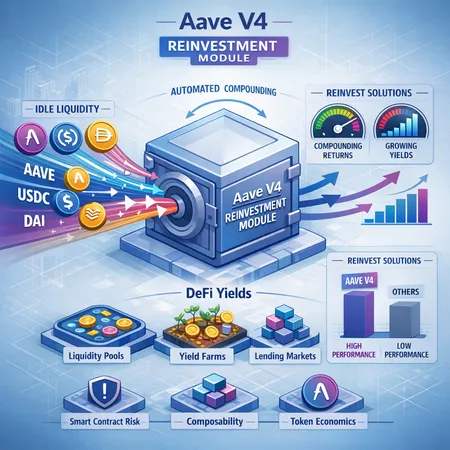
Aave V4’s reinvestment module is one of the clearest attempts by a major lending protocol to tackle idle liquidity at scale. Lenders on Aave often see a meaningful portion of supplied assets sitting unused between borrows; those idle balances create a drag on DeFi yields because the protocol can’t return revenue that isn’t being earned. By offering an automated way to redeploy that idle capital into yield strategies, the reinvestment module aims to lift effective supply rates for depositors without changing base borrower pricing mechanics.
For many DeFi strategists, Aave is still the benchmark for tradable lending markets. The module is therefore consequential — it could set a standard for how blue‑chip protocols wring more return from deposits while retaining the liquidity rails that make borrowing reliable.
How the reinvestment module works (technical overview)
At a high level the V4 reinvestment module implements three interlocking pieces: a deposit/idle tracker, a strategy abstraction layer, and a managed execution engine. Rather than leaving protocol-held buffers untouched, the module continuously measures idle liquidity and routes eligible tranches to registered strategies.
Strategy abstraction and execution
The strategy layer exposes a uniform interface so that different yield approaches — e.g., lending on other protocols, staking derivatives, or fixed-rate vaults — can be integrated without altering the core market contracts. This is usually realized as an upgradable strategy adapter pattern with well-defined entry/exit functions and accounting hooks for accrued yield.
Execution is permissioned: a set of executors (or a keeper network) can trigger reinvestment and harvest functions subject to governance-set guardrails. Those guardrails typically include caps on deployable amounts, minimum expected yields to justify gas and rebalancing, and emergency unwind paths.
Liquidity and withdrawal mechanics
A key technical requirement is maintaining near-instant withdrawal UX. Aave V4’s approach separates the on‑chain accounting for liquidity providers from the physical location of funds: lenders continue to see their supplied balances and withdraw rights as before, while the module manages a short‑term redemption buffer. When withdrawals exceed the readily available buffer, the module unwinds strategy positions through preconfigured paths. That design reduces user-visible slippage but introduces dependence on the unwindability of external strategies.
Expected impact on on-chain rates for lenders and borrowers
The immediate and intended impact is higher effective supply yields. By monetizing previously idle capital, the protocol can redistribute a portion of accrued revenue to suppliers through higher supply APYs or through protocol-side revenue sharing. In practice, the uplift depends on three variables: how much idle liquidity exists, the excess return available in target strategies, and the costs of deployment (gas, slippage, borrower‑sensitive price impact).
Importantly, this is not necessarily a free lunch for borrowers. If the protocol captures more revenue and pays it to suppliers, the net borrowing cost could rise subtly if governance elects to reallocate fees or if treasury accruals change. However, because the primary borrower price signals on Aave remain supply/demand-driven, the reinvestment module is more about compressing the lender side of the spread than directly repricing loans.
Macro context matters: rising leverage and open interest in broader markets — illustrated by recent reporting on elevated market OI — can shift where capital flows and amplify demand for lending capacity, which in turn affects how much of the redeployed yield is economically there to be captured (CoinDesk analysis on market open interest and leverage).
Does the reinvestment module change AAVE token economics?
Short answer: not directly in token supply mechanics, but materially in governance and revenue dynamics.
The V4 module does not mint or burn AAVE or alter staking algorithms by itself. Where AAVE’s tokenomics become relevant is in governance control over strategy whitelists, revenue split decisions, and potential fee-to-treasury routing. If governance decides a percentage of reinvestment profits accrues to the treasury, that could increase protocol-controlled value and indirectly support the AAVE narrative. Conversely, if yields are routed back to suppliers, token holders lose a near-term revenue stream but gain healthier market fundamentals as the protocol becomes more attractive to capital.
Net effect: token supply and emission schedules remain unchanged, but governance influence (and thus AAVE holder incentives) gains practical importance.
Comparisons with other reinvest/multi-strategy solutions
There are existing on-chain reinvestment and multi-strategy abstractions — from modular vaults to aggregator protocols — and Aave’s choice to build this capability directly into the core V4 stack is significant.
Protocol-sanctioned reinvestment (Aave V4): tight integration with market accounting, continuity of UX for lenders, governance control over strategies. Trade-off: greater centralization of decision-making and concentrated risk in the protocol layer.
External multi-strategy vaults and aggregators: more aggressive yield hunting, diversified strategy suites, often community-run. Trade-off: these live off‑chain or as separate contracts that suppliers must opt into, which fragments liquidity and UX.
Third-party reinvestment plugins (e.g., keeper-run vaults): flexible and composable, but require permissioning and obviously introduce composability risk.
The reinvestment module’s main advantage is that it keeps liquidity in‑market — depositors don’t have to leave Aave to chase returns — which reduces fragmentation and can attract more passive capital. But comparison shows the trade-offs between yield optimization, decentralization, and systemic risk.
Risk considerations: smart contract, composability, and operational risks
Every yield optimization increases exposure vectors. The primary risks to evaluate:
Smart contract risk: adding strategy adapters expands the trusted codebase attack surface. Upgradability and adapter privileges must be scrutinized; bugs in a strategy can drain pooled capital or break unwind logic.
Composability risk: strategies will likely call other protocols. This creates dependency chains where an issue in a third-party protocol cascades to Aave markets.
Liquidity unwind risk: if strategies are not liquid under stress, forced redemptions could create slippage and temporary withdrawal freezes. The reinvestment module’s buffer design mitigates but does not eliminate this.
Oracle and pricing risk: many strategies depend on accurate pricing. Oracle manipulation could cause misrouting or incorrect accounting of yields.
Centralization and governance risk: permissioned strategy whitelists and executor roles concentrate power. Governance capture or rushed approvals can increase exposure.
Operationally, execution cadence (how often the module rebalances or harvests) and the gas economics of running small deploys matter; frequent small deployments can get eaten alive by gas, negating yield gains.
Practical implications for yield-seeking investors and DeFi strategists
If you optimize portfolios for protocol yield, here’s how to think about Aave V4’s reinvestment module:
Re-evaluate liquidity allocation: some assets that were inefficient on Aave could become more attractive, especially stablecoins where idle liquidity has historically been high.
Monitor strategy whitelists and governance proposals: the quality of integrated strategies determines realized returns and risk. Active due diligence on adapter contracts is now table stakes.
Stress-test withdrawal scenarios: model worst-case unwind spreads and time-to-liquidate assumptions for strategies targeted by the module.
Consider counterparty exposure: if you already use third-party vaults, compare the additional layer that Aave’s module adds versus your existing setup.
Bitlet.app users and other yield optimizers should view the reinvestment module as infrastructure that can reduce fragmentation, but not as a blanket safety upgrade — higher on-chain yields will come with new vectors to manage.
Implementation timeline and governance pathways
Aave Labs’ approach, as with prior Vx releases, points to a phased rollout: initial permissioned strategies, followed by community audits and staged governance upgrades to expand access. That staged approach helps reduce the blast radius of implementation bugs but also means yield effects ramp over time rather than overnight.
Developments in broader markets — for example, increased leverage and open interest in BTC and other assets — will influence how attractive the reinvestment strategies are at launch and beyond (see coverage tying market leverage to capital flows CoinDesk).
Final read: balancing yield and safety
Aave V4’s reinvestment module is a pragmatic attempt to convert idle liquidity into value for lenders and to keep supply-side capital from fleeing to external yield aggregators. For strategists, it opens opportunities: improved effective yields, less need to migrate liquidity, and a cleaner UX for capturing extra returns. But the trade-offs are concrete — increased smart contract surface area, composability chains, and governance centralization.
If you’re assessing the module for portfolio use, prioritize questions about strategy audit quality, emergency unwind paths, and explicit fee/treasury routing decisions from governance. The module could shift how DeFi yields are earned on major platforms, but the upside comes hand in hand with new systemic responsibilities.