Why March 2026’s Bitcoin Rally Is Structurally Different: ETFs, Treasuries, Banks
Summary
Executive summary: March 2026 — not another pump
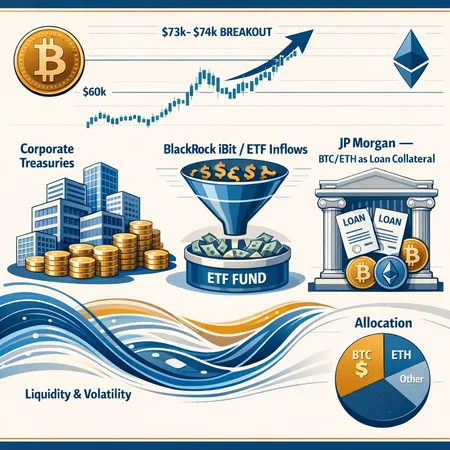
Bitcoin’s ascent through the $73–74k zone in March 2026 looked, at first glance, like another momentum-led leg. But beneath the headlines lies a structural reshaping: persistent ETF inflows, visible corporate treasury accumulation and the practical acceptance of BTC and ETH as bank loan collateral are reordering both supply dynamics and market plumbing. For allocators thinking beyond momentum trades, this matters — because the drivers that move price now are increasingly institutional, sticky and sometimes off-chain.
For many traders, Bitcoin remains the primary market bellwether, yet the mechanics behind its moves are evolving. Market reporters flagged the breakout into the mid-$70ks as macro tensions eased, a point discussed in contemporaneous coverage of the move past $74k. (See market coverage that tracked the breakout.)
ETF inflows and the BlackRock iBit effect
In 2026 the ETF ecosystem — led by large, easily-accessible products such as BlackRock’s iBit — continues to be a dominant flow driver. Several analyses tie fresh ETF inflows to tighter on-exchange supply and to episodic upward price pressure. The chain of logic is simple but powerful: significant ETF purchases are executed through OTC desks and custody channels, removing spot BTC from circulating exchange inventories and creating structural scarcity that amplifies upward moves.
Research and press coverage have linked ETF flows to price action during the surge: analysts noted that concentrated inflows coincided with both the rebound and with temporary liquidity squeezes that exacerbated short-covering. For a tactical allocator, ETF inflows matter because they are recurring, measurable and typically funded by institutional sources rather than retail impulse. See the recent reporting on how ETF inflows correlated with the rebound and the role of concentrated buying pressure.
- Why iBit and similar ETFs matter: they aggregate institutional demand into a tradable, custody-backed wrapper, increasing allocators’ ability to express exposure without touching exchanges.
- Market impact: repeated, predictable buying reduces available spot supply and creates asymmetric liquidity — bigger bids on the margin and thinner offers during rallies.
(For a deeper read on ETF flow analysis and shifting holders, see a Bernstein-focused write-up that links ETF inflows to changes in the long-term Bitcoin holder base.)
Corporate treasuries: sticky demand and changing balance sheets
Beyond funds, corporates are increasingly treating BTC as a strategic treasury allocation. Public-company treasury accumulation — whether headline-grabbing buys or steady programmatic purchases — creates a class of holders with longer time horizons and different liquidity preferences than retail traders. Analysts comparing corporate behavior to prior cycles argue this is not merely PR-driven buying: reported treasury allocation trends show companies are adopting explicit allocation frameworks, custodian relationships and staggered purchase programs.
When companies allocate to BTC as part of balance-sheet strategy, their supply is effectively removed from speculative turnover. The result: fewer coins available for short-term market-making, a higher proportion of coins held in cold storage, and a shift in on-chain flow patterns. This trend amplifies the ETF-driven scarcity effect because two large buyer categories — funds and corporates — are both withdrawing supply from the float.
Banks accepting BTC/ETH as loan collateral — why it matters
A qualitative inflection point arrived when major banks moved to accept BTC and ETH as loan collateral. The practical implications go beyond headlines. When a bank (for example, as recently reported) greenlights crypto assets as acceptable collateral, it changes how investors and treasurers can finance positions, hedge exposures and obtain liquidity without selling holdings.
Accepting crypto as collateral creates a regulated conduit for credit against BTC/ETH, which in turn can: (a) reduce forced sell pressure during drawdowns because holders can borrow rather than liquidate, (b) enable levered institutional exposure that’s callable and margin-managed under bank frameworks, and (c) expand demand for custody and prime-brokerage services. The consequence is a subtle change in market microstructure: the tail risk of fire-sale liquidation can decline, while new pathways for synthetic liquidity and leverage increase.
This development was covered in recent banking coverage showing the practical acceptance of BTC and ETH as loan collateral and what it means for institutional workflows.
Liquidity and volatility: tighter float, episodic shocks
Combine ETF inflows, corporate treasuries and bank-backed credit and you get two interacting effects on liquidity and volatility:
- Structural tightening of available float. ETFs and treasuries withdraw coins from exchange inventories, reducing passive liquidity. That tends to mutate volatility: smaller, order-book-driven moves become more frequent, while large, fundamental moves are more impactful.
- New sources of institutional liquidity. Bank loans against crypto and custody-backed financing add deeper credit channels that can smooth some selling cycles but also enable larger, bank-facilitated positions that must be unwound under stress.
The practical outcome is a market that can feel less churny in normal times (fewer retail flip trades) but more prone to sharp directional moves when liquidity is needed fast — for example, during macro shocks, ETF rebalancings or margin squeezes triggered by correlated risk-off events. Coverage linking ETF inflows to leveraged liquidations illustrates how institutional flows can coincide with sharp short-covering spikes; when the float is thin, those spikes are amplified.
Allocation implications for asset managers and treasury teams
For allocators — whether multi-asset funds, corporate treasurers or family offices — the evolving structure changes how Bitcoin fits into a portfolio:
- Position sizing: a recognition that long-term, institution-driven bid floors can justify larger strategic allocations, but only if liquidity needs and drawdown financing are explicitly addressed.
- Liquidity planning: allocate across execution vehicles (spot, ETF, OTC) and maintain contingency lines (credit facilities or repo against BTC/ETH) to avoid forced sales in stress.
- Execution strategy: use staged accumulation and algos to minimize market impact; consider ETFs for convenience but understand ETF flows’ market effects.
- Risk management: account for episodic liquidity shocks; stress-test scenarios where rebalancing or margin calls coincide with thin on-exchange depth.
Practically, some allocators will prefer the custody-and-ETF route for governance and operational simplicity, while others (notably treasuries) may opt for direct custody to align with balance-sheet objectives. Bitlet.app and similar services show how the ecosystem now offers multiple ways to combine yield, custody and execution — but each path comes with different liquidity trade-offs.
Scenarios for medium-term price discovery (6–18 months)
Below are three plausible scenarios for how price discovery could play out, given the structural changes:
Conviction-led appreciation (base case). Continued ETF inflows plus steady corporate buys and limited net selling create a tightening float. Price discovery moves higher in measured steps as liquidity incrementally rebalances. Volatility narrows except around macro events.
Liquidity shock & repricing (tail risk). A macro or regulatory shock forces synchronized deleveraging. Thin on-exchange supply plus leveraged institutional positions amplify a waterfall. Price sweeps lower quickly, then recovers as banks and custody providers provide financing to stabilize positions.
Sideways digestion with periodic spikes. The market alternates between range-bound periods as new buyers accumulate off-exchange, punctuated by sharp, short-lived moves during ETF rebalances or liquidity squeezes. Net supply gradually tightens, but price action is choppy.
Which is likeliest? Given the current evidence of persistent ETF inflows and concrete treasury allocations, the conviction-led appreciation scenario has a higher prior probability — but banks accepting BTC/ETH as collateral make all scenarios feasible because they introduce both stabilizing credit buffers and new channels for leveraged exposure.
Practical checklist for allocators
- Map liquidity needs and identify if ETF exposure or direct custody better meets governance constraints.
- Maintain credit lines or repo options against BTC/ETH to avoid forced spot sales in stress.
- Stagger purchases and use algorithmic execution to limit visible market impact from large buys.
- Stress-test portfolios for simultaneous ETF outflows, macro risk-off and margin events.
- Monitor on-chain and exchange inventory metrics as leading indicators of tightening supply.
Final take
March 2026’s push past $73–74k looks structurally different because demand is less one-off and more integrated into institutional balance-sheet and market plumbing. ETF inflows, corporate treasury allocation and bank acceptance of BTC/ETH as collateral are converging to reduce available float, change liquidity profiles and introduce new credit pathways that alter volatility dynamics. For allocators, that means reconsidering execution, liquidity buffers and risk scenarios — not abandoning caution, but adapting strategy to a market where institutional permanence increasingly matters.
Sources
- Bernstein analysis on ETF inflows and changing long-term Bitcoin holder base: https://cointelegraph.com/news/bitcoin-rebound-bernstein-long-term-holder-base?utm_source=rss_feed&utm_medium=rss&utm_campaign=rss_partner_inbound
- Report linking ETF inflows and liquidations to Bitcoin's rebound above $74k: https://dailycoin.com/bitcoin-74000-blackrock-ibit-etf-inflows/
- News that JP Morgan Chase now accepts Bitcoin and Ethereum as loan collateral: https://coinpaper.com/15455/jp-morgan-chase-greenlights-bitcoin-and-ethereum-as-loan-collateral-cnbc?utm_source=snapi
- Market coverage of Bitcoin moving past critical resistance into the mid-$70ks: https://blockonomi.com/bitcoin-btc-surges-past-74k-as-iran-tensions-ease-and-markets-rebound/