How to Claim the MetaMask MASK Airdrop: Step-by-Step Guide and Tokenomics Deep Dive
Summary
Quick context: why MASK matters
The MetaMask MASK airdrop is one of the most visible examples of a wallet team tokenizing its user base and governance. For active users, claiming MASK is a short technical workflow—done correctly it’s straightforward—but the broader story is strategic: wallet-native governance tokens shift how product teams capture value, coordinate users, and fund public goods. If you want the official claim mechanics and eligibility specifics, start with the announcement and claim details in the Mask Foundation write-ups (see the live announcement here: MetaMask MASK airdrop announcement).
Step-by-step: how to claim MASK safely
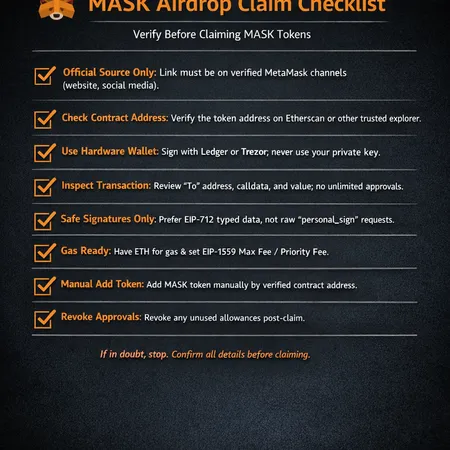
Below is a conservative, practical workflow for advanced retail users. Don’t skip verification steps—bots and phishing sites will try to capitalize on high-profile drops.
- Confirm the official URL and announcement
- Only use the domain linked from the MetaMask Foundation’s official channels and the announcement above. Bookmark the legitimate claim page rather than clicking unsolicited links. Look for HTTPS and a valid certificate, and double-check spelling (common typos: “maskfoundation”, “mask-foundation”, etc.).
- Prepare your wallet
- Use a hardware wallet (Ledger/Trezor) if you can—connect via MetaMask in hardware mode. If you use a hot wallet, ensure it's up to date and not running suspect browser extensions.
- Read the claim page details and contract address
- The claim interface should show the token contract address and a link to a verified Etherscan contract. Cross-check that contract on Etherscan and ensure the contract is verified before interacting. Never accept a random token contract passed via a pop-up.
- Estimate gas and plan the timing
- Before submitting any transactions, check current gas conditions in MetaMask or at a gas tracker. The claim page should estimate gas; compare it with MetaMask’s suggested fees. If the claim requires multiple transactions (e.g., approve + claim), you’ll pay gas twice—factor that into your cost.
- Inspect every signature request
- Never sign messages that ask for approval to move arbitrary funds beyond the specific claim contract. If the prompt requests a lifetime unlimited allowance, revoke or edit the allowance afterward.
- Submit claim and confirm
- Use the smallest reasonable gas priority that will still get mined in your timeframe. After the transaction confirms, verify token balance on Etherscan and do not accept additional prompts from the claim dApp.
- Clean up allowances
- If you granted an ERC‑20 allowance, consider using revoke.cash or an audited allowance-manager to remove excessive approvals.
Quick security checklist (phishing, verification, and gas tips)
- Verify domain: confirm the claim URL originates from the Foundation announcement and check subdomain/typo-squatting.
- Certificate and DNS: check HTTPS padlock and that the page uses a legitimate DNS registration.
- Contract verification: only interact if the token contract is verified on Etherscan and matches the contract in the official announcement.
- Avoid browser extensions during claim: disable unrelated extensions or use a fresh profile.
- Gas estimation: compare the dApp’s gas estimate with MetaMask; if gas spikes, pause and wait for lower congestion.
- Signing hygiene: refuse signatures that include arbitrary data or ask to “enable” broad permissions.
For a concise how-to and the airdrop claim window, refer to the full announcement here: MetaMask MASK airdrop announcement.
MASK tokenomics and what a capped distribution implies
Foundations typically publish supply caps or allocation tables that show the split between user airdrops, treasury, team, and ecosystem incentives. A capped supply limits the total number of tokens that can enter circulation—this has cascading effects on price dynamics and token velocity.
- Scarcity and narrative: a hard cap creates a scarcity narrative that can support higher long-term valuations, provided utility and demand follow. Scarcity without usage, however, just moves token supply from the Foundation to open market—price will reflect demand at each stage.
- Circulating vs. vested supply: initial airdrops often unlock a portion of tokens to recipients immediately, while teams and treasury allocations vest over months or years. This staged unlocking dampens immediate dilution but sets predictable future sell pressure.
- Velocity: tokens used primarily for governance without utility (fees, staking, or on‑chain primitives) can exhibit high velocity as holders turn them into spendable assets. Conversely, utility that requires holding (on‑chain fee discounts, staking rewards) can slow velocity and support price.
Because the MetaMask Foundation framed MASK as a user-and-governance-native token, watch three levers: distribution size to users, vesting schedules for treasury/team, and any on‑chain consumption mechanisms (e.g., burn, staking, or fee share). These factors together determine short-term supply shock and longer-term scarcity.
Foundation-issued airdrops vs. protocol airdrops: key differences
Airdrops from a foundation (like the MetaMask Foundation) are organizational: they’re a product and public goods funding decision. Protocol airdrops (e.g., AMMs or lending protocols) are often coupled to governance that directly affects protocol economics.
- Treasury management: foundations maintain treasuries to fund grants, audits, and operations. That creates a steady seller or strategic reserve the foundation can deploy. Compare this to a protocol treasury whose tokens may be earmarked for liquidity mining or protocol-owned liquidity.
- Incentives and longevity: foundation tokens often aim to bootstrap public goods, developer ecosystems, or product growth, whereas pure protocol tokens typically align economic incentives around usage, fees, and security adjustments.
- Transparency and asset moves: foundations can sell or swap treasury assets to fund operations. For example, the Ethereum Foundation’s sale of ETH to third parties highlights how foundations move treasury assets as part of budget management (Ethereum Foundation asset sale example). That operational flexibility can be constructive—if disclosed and governed—or create sell-side pressure if done opaquely.
The practical takeaway: understand the Foundation’s treasury policy and vesting schedule. A foundation that regularly sells to fund operations will add predictable supply into markets; one that slowly deploys grants in escrowed fashion reduces immediate market pressure.
Short-term market impacts and secondary markets to watch
Expect a classic two-phase market reaction after any large airdrop: instantaneous volatility as claimers liquidate, followed by price discovery as secondary markets settle.
- Immediate sell pressure: airdrop recipients who are not active holders will often sell into momentum. That tends to depress price in the first hours-to-days after token listing.
- Gas and frontrunning: claim events increase mempool activity; gas spikes and bot-driven sandwich attacks are common. Use conservative gas bids and hardware wallets to reduce risk.
- Secondary markets: monitor Uniswap (token/ETH and token/USDC pools), concentrated liquidity positions on Uniswap V3, and CEX listings. Liquidity profile matters—if liquidity is thin, price impact will be large on trades. If the Foundation provides bootstrap liquidity or incentives, that can stabilize markets.
- Derivatives and OTC: watch over-the-counter desks and institutional flows for larger blocks; these buyers can soak up sell pressure silently and reduce slippage.
For traders and tokenomics observers: watch on‑chain flows (token transfers from claimed addresses to CEX hot wallets), liquidity additions, and contract interactions that indicate staking or burn mechanisms. Tools that aggregate token movements and CEX inflows will give early signals.
What the MASK launch signals for wallet-token strategies across the ecosystem
Wallets launching native tokens is a structural shift. Teams are no longer purely product interfaces; they can now issue governance, capture value, and organize user participation.
- Monetization and public goods funding: wallets can direct token inflows to security, grants, and UX work without selling equity. That can be healthier for open-source development than relying solely on venture funding.
- Governance participation: tokenized wallets enable users to vote on UX priorities, privacy roadmaps, and integrations. The risk is low turnout—if voting is dominated by a few holders, governance can centralize.
- User acquisition and retention: airdrops are powerful growth levers. But repeated airdrops across many wallets could fragment attention and dilute value; winners will be wallets that combine utility with sustained engagement.
- Interoperability and composability: wallet tokens may become inputs to broader DeFi strategies—staking for protocol benefits, fee reductions across services, or cross-product loyalty. This is where DeFi interoperability will matter.
In short, expect other wallet teams to study MASK and adapt token mechanics that align incentives to their product roadmap. Some will emphasize governance; others will pursue revenue-sharing or developer grants.
Practical checklist before you claim (one last time)
- Confirm official announcement link and domain.
- Use a hardware wallet where possible.
- Verify the token contract on Etherscan and cross-check addresses.
- Compare gas estimates and be cautious of high-priority gas during mempool congestion.
- Inspect and limit ERC‑20 approvals.
- Monitor post-claim token flow (transfers to CEX often signal selling pressure).
If you’re tracking distribution and trading across drop events, services like Bitlet.app can be useful for monitoring, but always do independent verification before transacting.
Final thoughts
MASK isn’t just another airdrop — it’s an experiment in wallet-native governance and treasury management. The near-term story will be volatile: claim mechanics, bot activity, and liquidity provisioning will define price action initially. The longer-term outcome depends on whether MASK accrues genuine utility—funding public goods, reducing friction, or enabling meaningful governance—or whether it becomes another tradable token with ephemeral interest.
For active users, the technical risk is manageable if you follow the checklist above. For tokenomics watchers, the important signals are distribution size to users, vesting schedules, treasury behavior, and the emergence of real on‑chain uses.
Sources
- MetaMask MASK airdrop announcement and claim details: MetaMask MASK airdrop announcement
- Example of foundation treasury asset management: Ethereum Foundation asset sale