Memecoin Market Dynamics: Market-Cap Lift, DOGE Trendline Test, and the BONK Domain Hack
Summary
A memecoin moment: snapshot
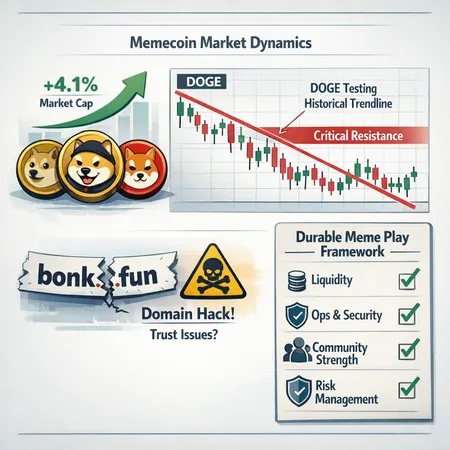
Memecoins staged a small but notable rebound: aggregate market-cap lifted roughly 4.1% in a short window, a move that caught traders’ attention even as individual names faced separate stress points. Part of that flow looks like rotational retail capital chasing higher beta assets after liquidity from larger-market catalysts — think ETF-related flows into major assets and renewed appetite for speculative narratives.
Benzinga reported on broad ETF inflows and highlighted how meme-market-cap lifted alongside them, showing how macro / institutional signals can still indirectly animate the most retail-driven corners of crypto. That creates the paradox we see today: a rising headline market-cap while many top memecoins trade on fragile technical or operational footing.
Why aggregate memecoin market-cap can rise while names wobble
An aggregate market-cap number aggregates many small bets; it can climb if fresh capital rotates into the sector even when certain large-cap memecoins are under pressure. A few mechanisms to watch:
- ETF and big-ticket liquidity flows crowding back into crypto can re-risk retail portfolios and boost appetite for high-volatility plays. Benzinga’s coverage linked ETF inflows to renewed macro interest that spilled into meme tokens.
- New launches and token listings can pull capital that registers as higher sector market-cap even while legacy tokens retrace.
- Short-term meme narratives and cross-chain airdrops create localized rallies that lift the subtotal.
So, a rising memecoin market-cap is not always an endorsement of every name — it can mask concentrated weakness underneath.
DOGE: testing a rare, long-term trendline
Dogecoin (DOGE) remains the marquee memecoin: its price action still moves sentiment across the space. Technical analysts point to a long-running trendline that DOGE is testing — a level whose breach or hold will influence both momentum traders and retail psychology.
Blockonomi’s recent technical write-up explains why this trendline is unusual: it’s a multi-year structural reference that historically attracted buying at pullbacks and selling at extensions. If DOGE breaks decisively below it, momentum could flip and crowding could accelerate liquidations; if it holds and rebounds, that becomes a credible trigger for renewed retail accumulation.
A test like this matters beyond DOGE’s order book. For many traders, Bitcoin and ETH behavior set the macro tone, but DOGE’s own technicals often dictate how aggressive retail participants become in memecoins generally.
BONK, the Bonk.fun domain-hack, and token trust
Operational security events hit memecoins especially hard because these tokens live off community trust and simple UX (website links, socials, and wallets). The Bonk.fun domain compromise — reported in detail by Ambcrypto — resulted in a wallet drainer tied to the project’s domain, creating immediate outflows and sentiment damage for BONK.
Why the fallout is outsized for memecoins:
- Many memecoins rely on a small set of centralized touchpoints (the official site, a Discord link, or a single contract address posted on a page). When those are compromised, users get drained fast.
- Retail holders often reuse browser wallets or click links without verification; attackers exploit that behavior.
- Reputation effects travel fast on social media: a single domain-hack story can invert a community’s narrative overnight.
The Bonk.fun incident is a reminder that a healthy token isn’t just about charts or memes — it’s also about operational hygiene and how the team and community manage security communications.
Framework: spotting durable meme plays vs headline-driven traps
You need a multi-dimensional checklist that blends technical, on-chain, community, and security signals. Below I outline a practical framework you can use before you scale into any memecoin position.
1) Community durability and governance signals
- Measure active engagement: daily active Discord/Telegram users, meaningful interactions on Twitter, and how quickly moderators respond to scams. A passionate, organized community often re-seeds bids after shocks.
- Evaluate token distribution: very concentrated holdings increase rug risk. Look for large holder wallets (>whale stakes) and check whether major allocations are locked or subject to cliff releases.
2) Liquidity, slippage and exchange breadth
- Check DEX liquidity pools and central limit order books. Thin liquidity means a 5% sell can become a 20% move.
- Prefer projects with multi-exchange listings (even smaller CEXes) and healthy on-chain liquidity. Tight spreads and depth are an underrated safety layer.
3) Technical setup and trend context
- Look for confluence: where price respects multi-timeframe support, where VWAP and moving averages align, or where volume confirms moves. DOGE testing a historical trendline is a textbook case where traders watch a decisive outcome.
- Be wary when price moves are solely headline-driven without on-chain volume backing.
4) Operational security hygiene
- Inspect official domains, ENS records, social account verification and DNS health. If the project uses a single domain or unprotected vanity addresses, score it lower.
- Watch admin key custody: multisig, timelocks, and transparent upgrade paths reduce rug risk. The Bonk.fun domain-hack shows how a single compromised touchpoint can cascade.
5) Tokenomics and economic durability
- Analyze emission schedules, burn mechanics, and incentive flows. Short-term yield and airdrops can pump interest but may also seed short-term sell pressure.
- Consider on-chain usage: is the token used in protocols, tipping, or staking, or is it purely speculative?
6) Social & narrative momentum vs endogenous growth
- Distinguish organic community growth (consistent engagement, organic memes) from paid or hyped amplification (bots, paid influencers). The former is stickier.
Risk management: concrete rules for retail traders and community managers
- Position sizing: cap any single memecoin exposure to a small percentage of your risk capital (e.g., 1–3%). These are high-volatility bets.
- Layer entries: use staggered buys at defined technical zones rather than all-in on FOMO.
- Predefine stop-losses or hedges: because memecoins can gap on low liquidity, consider options, inverse exposure, or simple cash reserves.
- Use non-custodial hygiene: educate your community about phishing, bookmark official addresses, and consider using hardware wallets for larger holdings.
- Communication playbook (for community managers): if an operational incident occurs, own the narrative fast — confirm channels, post forensic updates, and provide migration/mitigation steps if needed.
Actionable checklist (quick reference)
- Confirm official domain and socials; bookmark. (Security)
- Check liquidity depth across DEXes and CEXes. (Liquidity)
- Review holder concentration and lock schedules. (Tokenomics)
- Assess multi-timeframe technical support/resistance and volume. (Technical)
- Set position sizing and entry ladder; predefine stop or hedge. (Risk Management)
- Monitor reputable coverage; treat viral headlines as prompts to investigate, not trade signals. (Behavioral)
Putting it together: a short scenario
Imagine DOGE breaks below its long-term trendline on heavy volume while broader memecoin market-cap is up 4% due to a new listing in another token. That combination suggests rotational flow rather than a universal strength: some names soak the inflows while legacy assets face technical distribution. Alternatively, a domain-hack in a rising token like BONK can produce immediate outflows even as the sector headline looks positive. The right response is not to ignore sector momentum but to use strict risk rules and security checks before adding exposure.
Platforms and tools that let you predefine ladders, alerts and wallet protections — including wallet hygiene guidance that community managers can share — are useful; Bitlet.app is one example of an ecosystem where traders can pair execution with education.
Conclusion
The current memecoin landscape is a lesson in nuance: aggregated numbers like a 4.1% market-cap lift tell part of the story, but technical tests (like DOGE’s trendline) and operational events (like the Bonk.fun domain-hack) matter more for position-level risk. Use a checklist that blends community, liquidity, technicals, and security before you scale in. That way you treat memecoins as a high-beta sleeve of your portfolio — one that can deliver outsized returns but also requires strict risk management and constant operational vigilance.
Sources
- Benzinga: Bitcoin at 70,000, Ethereum, XRP, Dogecoin go sideways on ETF inflows
- Blockonomi: Dogecoin price tests critical historical trendline as X Money launch nears
- AmbCrypto: Minimal damage from hack says Bonk.fun team — so why is BONK falling?
For further reading on broader protocol and market mechanics see DeFi.