Bitcoin vs Gold in 2026: Is This the Year Digital Gold Finally Wins?
Summary
Introduction
Through the first quarter of 2026, investors are asking a deceptively simple question: is Bitcoin finally failing the 'digital gold' test? On the surface the evidence looks unambiguous — gold has rallied while BTC has drifted lower — but beneath those price lines are institutional timelines, on‑chain supply mechanics, and the emergence of tokenized gold instruments (PAXG, XAUT) that complicate any binary conclusion.
This article is written for long‑term investors and wealth managers deciding allocation between BTC and tokenized or physical gold. We'll put recent performance in context, unpack the institutional and on‑chain drivers, assess capital rotation into tokenized bullion, and conclude with concrete scenarios that would let either asset claim the safe‑haven crown over the next 12 months.
Recent divergence: gold up, Bitcoin down
The headline data is simple: gold has staged a meaningful move higher while Bitcoin has underperformed. Analysts point to a mix of macro uncertainty, rate outlooks and traditional safe‑haven flows to explain the bullion rally; contemporaneously, Bitcoin has shown weaker price action and choppier institutional demand. Coverage capturing this split argued that “Bitcoin down 21% while gold is up 79%” in certain recent windows, highlighting how investor positioning can diverge across the two assets (see reporting at AmbCrypto for a succinct take).
That divergence matters for portfolio construction: many allocators use BTC as a non‑correlated, high‑volatility inflation hedge and gold as a lower‑volatility safe store. When both rally together the allocation argument is straightforward; when they part ways, the tradeoffs in correlation, liquidity and custody suddenly look more consequential.
Institutional accumulation timelines and what they imply
Institutional flows do not flip overnight. For BTC, the last few years have been characterized by phased adoption: custody solutions matured, regulated ETFs and funds appeared in several jurisdictions, and many corporations incrementally added BTC to treasuries or corporate balance sheets. Those moves create a structural bid — but they also introduce cadence: programmatic buying, ETF creations/redemptions, and yield strategies can smooth or amplify market moves.
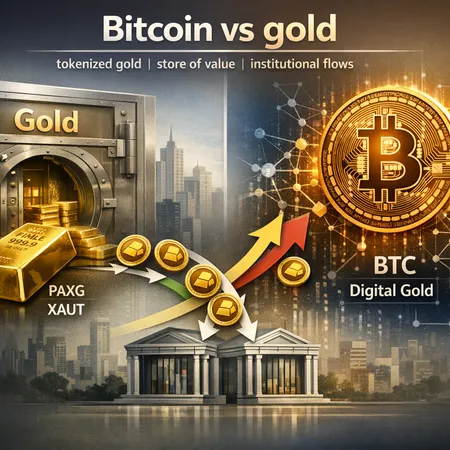
By contrast, institutional access to gold is centuries old; modern tokenized gold products like PAXG and XAUT simply make settlement and divisible ownership easier on blockchain rails. For institutions that prioritize immediacy, regulatory clarity and familiarity, buying tokenized gold can feel like a faster path to an on‑chain gold exposure than changing long‑standing treasury or investment policies to hold BTC.
Timeline matters because an institutional allocation decision is not only about return expectations but governance, accounting and custody. For many allocators, the migration from evaluating custody providers to deploying capital in scale takes quarters to years. That explains why we can observe slow, persistent BTC accumulation on some fronts while tokenized gold sees episodic demand driven by macro spikes.
On‑chain supply effects: why BTC is different
Bitcoin's supply mechanics are explicit: a capped issuance schedule, halving events, and a large portion of the stock that is long‑term dormant. On‑chain analytics show declining exchange balances and increasing coins in long‑term addresses — signals often read as supply tightening and a bullish structural factor for BTC. However, those same flows can also create price sensitivity: when coins concentrated in a small set of addresses start moving, volatility spikes and the market interprets it as potential selling pressure or re‑allocation.
Contrast that with tokenized gold: each PAXG or XAUT token purports to represent fractional ownership of a physical ounce (or fraction) held by a custodian. The supply of tokenized gold is largely demand‑driven and fungible with the broader gold market; inflows into tokenized gold reflect convenience and settlement preferences rather than a change in the global supply of bullion. That means tokenized gold flows can cause noticeable on‑chain movement (minting/redemption flows) without affecting the macro supply of physical gold.
Importantly, scarcity narratives work differently. Bitcoin's scarcity is protocol‑level and verifiable on‑chain; tokenized gold’s scarcity is ultimately a function of trust in custodians and the integrity of off‑chain bullion holdings. For investors seeking algorithmic scarcity, BTC has the stronger provenance. For those prioritizing centuries‑tested real‑asset backing, tokenized gold leans on the credibility of the vaults and auditors.
Capital rotation: on‑chain evidence of tokenized‑gold outflows
One of the clearest recent data points in this debate comes from tokenized‑gold flow analysis. On‑chain evidence and chain‑analysis reports highlighted large withdrawals from major tokenized‑gold wallets — roughly $40 million across Tether Gold (XAUT) and PAXG at one point — suggesting profit‑taking or rebalancing away from tokenized gold into other exposures. Coinpedia covered this episode, noting that large wallets cashed out amid the bullion rally and changing investor sentiment.
What does this mean? Two things. First, tokenized gold can and does attract fast, programmatic flows that feel more like crypto trading than physical bullion allocation. Second, sizeable outflows from tokenized gold do not mean physical gold is being sold into the market in a one‑to‑one sense; custodial redemptions and swaps can move on‑chain token quantities while the larger bullion market adjusts through arbitrage.
So while tokenized gold provides a canal for rapid capital rotation, the existence of outflows underscores that tokenized instruments are part crypto market and part bullion market — and therefore subject to both sets of dynamics.
What would need to happen for Bitcoin to win the 'digital gold' debate in the next 12 months?
For BTC to convincingly act like a scarce store of value to the broader institutional world within a year, several linked developments would likely be required:
- Clear, broadening institutional demand: continued ETF inflows, corporate treasury buys, and pension‑level allocations would need to move from pilots to meaningful, sustained allocations. The process is gradual, but acceleration could come from macro shocks that reframe BTC's role.
- Reduced regulatory tail risk: clarity (or constructive frameworks) in major jurisdictions that remove custody and listing ambiguity would increase capital confidence. Regulatory uncertainty raises governance and accounting hurdles that slow adoption.
- Durable reduction in exchange‑side supply: if on‑chain trends keep shifting BTC into long‑term custody and away from active exchange inventories, perceived scarcity tightens — especially if macro demand ticks up.
- Liquidity and derivatives alignment: narrower basis between spot and futures/ETF markets, along with transparent prime brokerage plumbing, would make large allocations operationally feasible.
Investors should also heed behavioral triggers discussed in longer form analysis: a re‑entry of corporate buyers or a macro event that pushes allocators to diversify away from fiat could meaningfully change demand dynamics. The Motley Fool has laid out the structural and market conditions that would need to change for Bitcoin to fully behave like a scarce store of value; those conditions overlap with the bullets above and emphasize adoption, scarcity perception, and institutional usability.
If these developments converge, BTC could close the narrative gap and attract the kind of long‑horizon capital that historically underpins a store‑of‑value asset.
What would need to happen for physical/tokenized gold to maintain or extend its lead?
Gold, and its tokenized variants PAXG/XAUT, are starting from a position of incumbency in the safe‑haven role. To consolidate that advantage over the next 12 months, the following would matter:
- Sustained macro drivers: continued geopolitical risk, persistent inflation fears, or a re‑acceleration in quantitative easing would keep capital flowing into bullion.
- Strong flows into tokenized products without large custody incidents: tokenized gold must demonstrate operational reliability at scale. Episodes of large, visible redemptions (even if they reflect profitable exits) can spook allocators unless custodial processes remain transparent.
- Integration with institutional rails: easier tokenized gold settlement inside existing custody, accounting and compliance frameworks will make it an attractive alternative to buying physical bars.
- Relative volatility advantage: if BTC remains volatile and occasionally tumbles during risk events, gold’s lower realized volatility will keep it favored for core allocation.
Tokenized gold’s tailwind is familiarity plus on‑chain convenience. For many wealth managers the ability to hold PAXG or XAUT inside tokenized portfolios without upending their compliance models is itself a decision driver.
Practical allocation takeaways for wealth managers and long‑term investors
- Consider layered exposures: a small, strategic allocation to BTC (to capture asymmetric upside if digital‑scarcity gains traction) plus a core allocation to gold or tokenized gold for ballast makes sense for many portfolios. Bitlet.app and other platforms now make blended approaches operationally simpler, but governance and custody choices remain paramount.
- Monitor triggers, not just prices: watch ETF flows, exchange balances for BTC, large custodial mint/redemption activity for PAXG/XAUT, and regulatory headlines. These are the signals that presage structural allocation shifts.
- Size for conviction and liquidity: given BTC’s higher volatility, position sizes should reflect risk budgets and time horizons. Tokenized gold can serve as a lower‑volatility on‑chain complement.
- Stress test scenarios: run portfolio simulations under macro shocks (inflation spike, dollar crisis, risk‑off liquidity event) to see which allocations perform as intended. That will reveal whether BTC or tokenized gold actually provides the desired hedging properties in practice.
Conclusion
2026’s early divergence between gold and Bitcoin sharpened a debate that has been simmering for years. Bitcoin’s protocol‑level scarcity and improving institutional infrastructure keep the 'digital gold' story alive — but tokenized gold and physical bullion benefit from incumbent trust, lower realized volatility, and immediate familiarity with institutional processes.
Over the next 12 months, victory is conditional: Bitcoin needs broader, durable institutional adoption plus regulatory clarity and continued supply tightening to convincingly act as a scarce store of value. Gold and tokenized gold need sustained macro drivers and reliable custodial operations to hold or extend their lead. For most long‑term investors and wealth managers, a thoughtful, monitored split exposure — sized to risk tolerance and operational comfort — will likely remain the prudent path.
Sources
- AmbCrypto — Bitcoin down vs Gold up discussion: https://ambcrypto.com/bitcoin-down-21-gold-up-79-so-why-are-investors-still-betting-on-btc/
- Coinpedia — Large tokenized‑gold wallet outflows: https://coinpedia.org/news/has-gold-price-topped-whale-wallets-cash-out-40m-in-tether-gold-and-paxg/
- The Motley Fool — What would need to happen for Bitcoin to flip to scarce store of value: https://www.fool.com/investing/2026/03/09/heres-what-would-need-to-happen-for-bitcoin-to-fli/
For background reading on on‑chain signals and institutional flow mechanics, see coverage of Bitcoin and related market analysis.