Bitcoin at $70k: Technical Tightrope, Morgan Stanley’s MSBT, and ETF-Driven Scenarios
Summary
Quick thesis
Bitcoin is stuck in a tight consolidation around the $70k mark. That range — roughly $69.5k–$70.6k — is compact, but it matters: a sustained breakout could accelerate institutional flows tied to ETF narratives (notably Morgan Stanley’s MSBT), while a breakdown could invite volatility from macro shocks and large whale sells. For active traders and portfolio managers this is a “prepare, don’t panic” moment: plan entries, size for potential leverage, and keep an eye on both the S‑1 progression and macro headlines.
For many market participants, Bitcoin remains the bellwether for crypto allocation decisions. Below I lay out the technical map, the MSBT-driven flow case, near-term macro and whale risks, and three scenario-based allocations with concrete trade triggers.
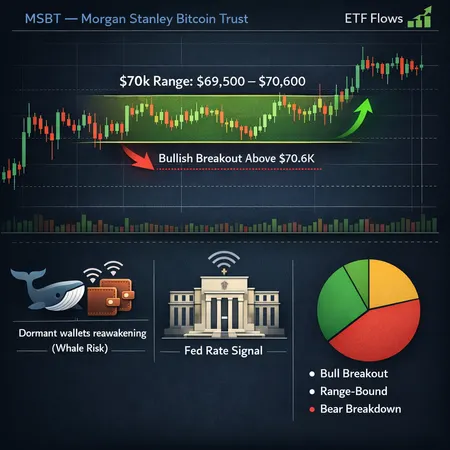
Technical picture: the $69.5k–$70.6k range
This consolidation is low volatility by recent standards — price has been oscillating in about a $1,100 band. That tightness compresses risk and sets up a classic breakout/breakdown binary:
- Support cluster: $69.5k is the immediate short-term support. Under that, bids often appear near $67k–$66k where prior accumulation and spot buy interest showed up. A failure below $66k would invite stops and could expose $62k as the next meaningful structural level.
- Resistance cluster: $70.6k is the nearby technical cap. Above that, the market has room to test $73.5k and then the psychological $75k–$80k zone where profit-taking historically intensifies.
On shorter timeframes RSI is neutral-to-slightly-oversold while VWAP and moving averages are compressing — all consistent with a squeeze. That favors momentum once direction is chosen: volume validation will be key. Look for a breakout with follow-through volume on spot/ETF inflows or futures open interest rising; the absence of volume makes breakouts likely to fail.
If price breaks above $70.6k (bull case)
A clean, daily-close breakout above $70.6k with volume acceleration would likely trigger a measured move: first targets $73.5k then $78k–$82k if momentum and ETF-tail flows kick in. In that scenario:
- Futures basis may firm (spot premium and tighter discounts), encouraging cash-buy pressure.
- Options skew could compress and call buying would push implied vols higher into expiries tied to ETF milestones.
This is the scenario where MSBT talk converts into tangible bid: announcements or institutional buy programs often cause front-running that amplifies the move.
If price breaks below $69.5k (bear case)
A breakdown below $69.5k that holds would signal sellers have control. Short-term sellers will target $66k, then $62k. Rapid liquidation in highly-levered futures positions can steepen declines: watch funding rates and liquidation metrics. Under $66k, stop liquidity could cascade toward $58k in a stressed environment.
Range traders should expect whipsaws; trend traders should only join breakdowns with confirmed follow-through and size tightly.
Institutional ETF narrative: MSBT and potential flow amplification
Morgan Stanley’s amended S‑1 for the Morgan Stanley Bitcoin Trust (MSBT) has pushed ETF conversations back to the front page of institutional strategy desks. The document lays groundwork for a large, broker‑sponsored vehicle and clarifies custody and governance intentions — the kind of filing that wakes allocators up to a spot‑ETF possibility (Cointribune coverage).
Market commentary suggests the demand upside is substantial: some estimates posit MSBT could attract very large allocations if buyers treat it as a convenient institutional on‑ramp. One analysis argues that a modest allocation from a broad institutional base could represent tens to hundreds of billions of dollars of new demand (an often‑cited figure is roughly $160B in a scenario where large managers take small percentage allocations) — a tailwind that would dwarf many prior retail-driven moves (ZyCrypto estimate).
Caveats: S‑1s are preparatory, not approvals. Timetable and final product structure (fees, authorized participants, creation/redemption mechanics) will determine how much of this theoretical demand becomes immediate buying. Nevertheless, the mere presence of a bank-backed trust increases the probability of material, sustained flows that widen the bid/support beneath BTC.
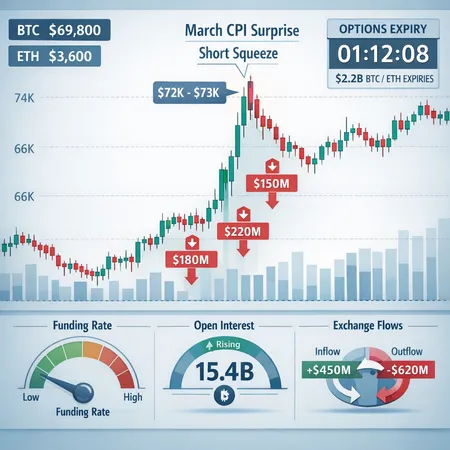
Short-term macro and on‑chain risks
Two factors can turn the MSBT upside case on its head or magnify losses: macro risk (chiefly Fed rate signals) and whale behavior.
- Fed and macro: rate guidance is the fastest path to a liquidity switch. Hawkish surprises or a resilient U.S. jobs print can tighten risk appetite and strengthen the dollar, pressuring BTC and crypto risk assets. Conversely, dovish turns or clearer disinflation could accelerate flows into risk assets and ETFs. For traders, macro prints are binary catalysts — position sizing should anticipate 24–72 hour moves around major announcements.
- Whale risk and dormant wallets: a reactivation of large, previously dormant addresses can inject supply at precisely the wrong time. Recent on‑chain scrutiny has shown renewed activity from long-idle wallets. When whales deposit to exchanges or execute big OTC blocks it can suppress price quickly, particularly in a low-volume consolidation phase. Watch exchange inflows, large transfers, and on-chain alerts.
Combine these: a hawkish Fed day plus a whale-led exchange dump can amplify the downside. Conversely, a quiet macro calendar and visible institutional spot buying (or news of APs lining up for MSBT) would favor the upside.
Scenario-based allocation and trade notes (for active traders & PMs)
Below are three practical scenarios with suggested allocations, time horizons, and execution notes. These are tactical suggestions — size relative to your crypto allocation and risk appetite.
Scenario A — ETF Breakout (Bull): probability medium
- Trigger: Daily close > $70.6k with above-average volume and rising spot ETF/OTC bids. Confirm with rising futures open interest and tightening basis.
- Tactical allocation: scale into buys totaling 30–60% of your intended BTC exposure across $70.6k–$74k. Add another tranche on a retest of breakout as support.
- RiskMgmt: use trailing stops or options protection (buying puts for a defined hedge) if you hold through headlines. Target horizon: 1–3 months to capture ETF flow windows.
Scenario B — Macro Pullback (Bear): probability medium
- Trigger: Break & hold below $69.5k, macro shock (hawkish Fed, unexpected CPI beat), or large exchange inflows from whales.
- Tactical allocation: reduce BTC exposure to defensive baseline (10–20% of pre-shock crypto target) and look for re-entry zones near $66k–$62k. Consider short-term shorts on derivatives for tactical exposure if you manage margin risk.
- RiskMgmt: tighten stops, avoid levering long; hedge with short futures or put spreads for size-efficient protection.
Scenario C — Rangebound Chop (Low Volatility): probability medium-high
- Trigger: Consolidation persists; no clear macro catalyst; ETF filings progress without immediate approval.
- Tactical allocation: keep small, active sizing — 20–40% of target BTC exposure; focus on buying dips and selling rallies within $69.5k–$70.6k with tight stops and scalping timeframes. Use options gamma plays and calendar spreads to monetize low implied volatility.
- RiskMgmt: keep exposure flexible and ready to re-weight when a break occurs.
Sizing guidance (example): if your portfolio intends a 10% long-term allocation to crypto, treat these tactical allocations as portions within that bucket — e.g., in the bull breakout scale to 6–8% of portfolio across multiple tranches; in a macro pullback trim to 1–2% until confirmed recovery.
Execution checklist (what to monitor now)
- Watch $69.5k and $70.6k for validated daily closes and volume confirmation.
- Monitor futures open interest and funding rates for speculative appetite. Rapidly rising OI on a breakout signals momentum.
- Track exchange inflows/outflows and large wallet transfers for whale signals. Sudden inflows to major exchanges often precede selling pressure.
- Follow MSBT S‑1 developments and filings for authorized participant or market‑maker announcements that suggest a launch timetable (Cointribune coverage).
- Keep macro calendar close: Fed speakers, CPI, PCE prints can flip direction quickly.
- Use options selectively: puts for cheap downside protection if implied vol is low; call buying for leveraged upside if breakout confirmation occurs.
A practical tip: use layered orders and scale exposure rather than a single all‑in tranche. Platforms like Bitlet.app and institutional desks that offer OTC executions can help manage slippage when positioning for larger allocations.
Conclusion
Bitcoin’s current consolidation at the $70k range is a tidy risk setup: it compresses volatility and concentrates directional risk around a narrow band. Morgan Stanley’s MSBT filing elevates the ETF narrative and increases the probability of sustained institutional flows — but approval, mechanics, and timing matter. Short‑term macro prints and whale activity are the wildcard catalysts that can turn quiet consolidation into sharp moves.
For active traders and portfolio managers the right posture is scenario-driven: define breakout and breakdown triggers, size positions to survive headline risk, and use options or futures to hedge where appropriate. If MSBT or similar institutional products start drawing genuine allocation, the reward asymmetry for a correctly positioned long could be significant — but so too is the cost of being over‑sized into a macro surprise.
Stay disciplined, watch the $69.5k–$70.6k door, and treat ETF flow talk as a rising tailwind that needs concrete confirmations to matter.
Sources
- Coverage of Morgan Stanley’s S‑1 and Bitcoin Trust: Cointribune
- Demand estimates and MSBT flow analysis: ZyCrypto
- Technical market update on BTC consolidation near $70k: CryptoPotato