Why Bitcoin May Be Consolidating Into a Macro-Driven Bull Phase: On-Chain, ETFs & Supply Dynamics
Summary
Executive overview — why this matters now
Bitcoin's price action over the past several months looks less like a random wobble and more like a period of consolidation driven by structural liquidity changes. On one side, large address accumulation, steady ETF inflows and a steady drop in coins held on exchanges are tightening available supply. On the other, media narratives and some analysts insist a new all-time high (ATH) remains years off. Reconciling those views requires distinguishing what is changing (supply and institutional demand) from when price reacts (timing conditioned by macro cycles and liquidity). For many traders, Bitcoin is once again behaving like a scarce, macro-sensitive asset rather than a purely speculative altcoin. Bitlet.app users who follow both on-chain and institutional flow metrics will find the signals discussed here directly relevant to position sizing and horizon selection.
Macro backdrop and mixed media narratives
The macro environment—rates, dollar liquidity and risk appetite—still sets the broad tempo for crypto. But beneath that tempo, structural shifts are altering how price responds to macro impulses. Media stories range from exuberant retail narratives to contrarian takes that drive buying or panic-selling; Robert Kiyosaki’s public bullish pronouncements are an example of the retail-facing, attention-grabbing commentary that often amplifies retail flows rather than defining fundamentals (see Kiyosaki’s recent remarks). Meanwhile, some professional analysts urge patience and caution, arguing the route to a new ATH is long and bumpy.
This divergence between narrative and on-chain reality is important: headlines move sentiment in the short term, but supply/demand mechanics and institutional flow dynamics determine how persistent price moves become once they start. The rest of this piece walks through that on-chain and institutional evidence.
Whale accumulation: what the data says and why it matters
On-chain analytics firms and services tracking large addresses have flagged elevated accumulation by whales at recent price levels. Santiment and other trackers report concentration of BTC into large wallets and slow-but-steady transfers off exchanges into long-term holding addresses. That pattern isn't proof-positive of imminent breakouts, but it does change the supply curve.
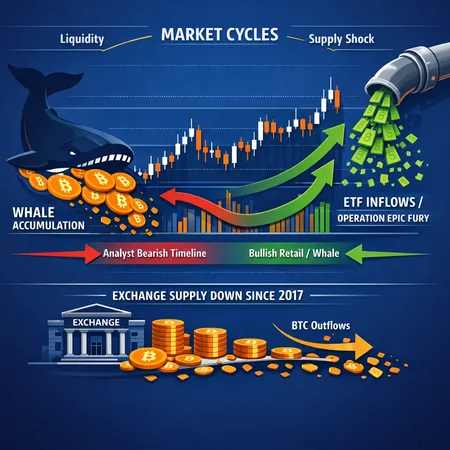
Why whale accumulation matters: large holders can remove material amounts of sell-side liquidity from the market. When sizable wallets accumulate over weeks and months, the market requires proportionally larger buy flows to move price meaningfully—every bid that would have previously been absorbed by marginal sellers may now hit a thinner pool of available BTC. Santiment’s recent report that whales accumulated at ~$71k and similar levels is a concrete example of how on-chain distribution shifts can precede periods of heightened upside volatility when macro catalysts arrive.
A critical nuance: accumulation is not timing. Whales can accumulate into consolidation for months; they can also distribute during rallies. For investors, therefore, accumulation is a structural signal (supply tightening) rather than a tactical timing signal.
ETF inflows and Operation Epic Fury: institutional demand rewriting liquidity
Institutional products have matured quickly. Weekly inflows into spot Bitcoin ETFs—widely discussed under the nickname "Operation Epic Fury" in recent coverage—are both persistent and large relative to historical liquidity. These inflows matter on two levels: first, ETFs pull BTC out of the tradable pool as custodians accumulate underlying BTC for product coverage; second, ETF flows are a more stable marginal buyer than many short-term retail flows.
CryptoTicker’s coverage of ETF inflows documents how these weekly institutional purchases are reshape liquidity dynamics. When institutions buy through ETFs, the net effect is predictable demand that compounds over time, particularly because ETFs tend to be sticky (institutions hold for mandates, treasury diversification, client demand). An ETF inflow spike can coincide with a short-term price impulse, but the longer-term effect is the permanent reduction in available, quickly executable supply.
Another consequence: ETFs change market microstructure. Liquidity that once existed in spot order books is increasingly represented by basketed, off-exchange holdings—so the market becomes more sensitive to supply/demand mismatches in the spot market.
Exchange supply falling to multi-year lows — scarcity matters
One of the clearest on-chain signals in recent quarters is the steady drop in BTC supply on centralized exchanges to levels not seen since 2017. This trend shows up in multiple data feeds and has been highlighted in recent reports. When coins are off exchanges—held in custodial cold storage, self-custody wallets, or institutional vaults—they are effectively removed from the on-demand supply that traders and market makers use.
Lower exchange supply has several implications. First, it increases the probability of sharp price moves (both up and down) because market depth thins. Second, it magnifies the potency of coordinated or sustained buy flows (like ETF purchases); a given volume of buys will move price more when exchange inventories are low. Third, reduced exchange supply signals longer-term holders choosing to lock up coins rather than trade them—supporting a scarcity narrative that complements whale accumulation and ETF demand.
Put simply: a supply contraction creates a higher elastic response to new demand. The u.today note on exchange supply dropping to 2017 levels provides a useful checkpoint for this dynamic.
Reconciling bearish timing views with bullish accumulation and flows
Not all evidence points to an imminent new ATH. Several analysts remain skeptical, arguing historical cycles suggest a multi-year path to a fresh high. Coverage summarizing this position notes that while structural changes are real, the timing of market-wide optimism and macro liquidity conditions required for an ATH may take longer. This caution is important because it reminds investors to separate structural probability from timing certainty.
How to reconcile these views: think in probabilistic layers. Structural supply tightening (whales + ETFs + low exchange inventories) raises the probability of a bullish outcome over a multi-quarter to multi-year horizon. However, macro catalysts (rate cuts, currency debasement, or geopolitical shocks) usually provide the ignition that turns probability into price. The NewsBTC analysis suggesting a new ATH could be years away is a sober counterpoint that helps set expectations: being structurally bullish does not guarantee near-term parabolic moves.
Also consider narrative-driven volatility. High-profile bullish pronouncements can draw retail—and retail can create short squeezes or quick momentum moves—yet these moves are often brittle unless supported by the structural flows described earlier.
Practical takeaways for investors and portfolio managers
Below are framework-based, horizon-specific takeaways that translate the on-chain and institutional evidence into actionable ideas. Each approach assumes investors retain strong risk management and position sizing rules.
Short-term traders (days–weeks)
- Expect thinner order-book liquidity and higher slippage during spikes because exchange inventories are low. Use limit orders or reduced size compared to historical norms. Options and structured products can be used to express directional views with defined risk. Monitor ETF daily flows and major whale movement alerts—sudden large withdrawals from exchanges or concentrated buys can trigger fast moves.
Medium-term investors (1–12 months)
- Treat ETF inflows and whale accumulation as a tailwind for mid-term appreciation probabilities. Consider dollar-cost averaging into positions rather than attempting to time an ATH. Use a mix of spot BTC and regulated ETF exposure (where available) to balance custody and liquidity needs. Track exchange supply metrics and accumulation signals as rebalancing triggers: if accumulation decelerates or exchange inflows rise, re-evaluate exposure.
Long-term allocators (multi-year)
- Structural scarcity and institutional adoption justify a core allocation to BTC for many portfolios, but horizon and volatility tolerance must be explicit. Incorporate periodic rebalances and plan for extended drawdowns; analysis suggesting years to ATH is a reminder that patience is part of long-term investing. Consider strategy vehicles (STRC-style allocations) if you need an instrumentized approach to long-duration BTC exposure while delegating active custody.
Risk controls and indicators to watch
Sound risk management converts positive structural signals into durable outcomes.
- Watch ETF flow reports weekly (Operation Epic Fury-style trends). A sustained drop in flows would reduce the demand tailwind. CryptoTicker’s inflow tracking is useful here.
- Monitor exchange supply and whale transfer dashboards; abrupt inflows back to exchanges often presage selling pressure. The u.today exchange-supply analysis is a good objective reference point for where inventories currently stand.
- Keep an eye on macro triggers: real rates, dollar strength, and systemic liquidity—these remain the primary gating variables for a large risk-on move.
- Pay attention to on-chain distribution: if accumulation shifts from long-term wallets back into shorter-duration addresses, the risk profile changes materially.
A final synthesis: more likely a macro-driven bull than a pure retail rally
Putting these threads together, the most defensible view is that Bitcoin is consolidating under stronger structural demand and thinner supply—conditions that favor a macro-driven bull phase when a suitable catalyst arrives. Whale accumulation and ETF inflows are complementary mechanisms of supply removal; exchange supply contraction amplifies their effect. That combination does not guarantee a rapid ascent to a new ATH tomorrow, but it does increase the probability of a powerful upward move over the coming quarters to years if macro liquidity conditions align.
Investors and portfolio managers should therefore treat recent on-chain and institutional signals as a shift in the market’s structural sensitivity rather than a timing signal. Position sizing, horizon alignment, and dynamic risk controls (stop rules, options hedges, staged entries) remain critical. If you use on-chain and flow data alongside macro readouts and sentiment indicators, you'll be better positioned to translate a potential macro-driven bull into portfolio outcomes—whether you trade the moves or hold through them.
Sources
- Robert Kiyosaki commentary: https://u.today/rich-dad-poor-dad-author-bitcoin-will-go-up-after-giant-crash?utm_source=snapi
- Santiment whale accumulation report: https://thecurrencyanalytics.com/altcoins/bitcoin-whales-accumulate-at-71k-santiment-reports-247339
- ETF inflows / Operation Epic Fury coverage: https://cryptoticker.io/en/bitcoin-etf-inflows-operation-epic-fury-2026/
- Exchange supply drops to 2017 levels: https://u.today/bitcoins-supply-on-exchanges-drops-to-lowest-level-since-2017?utm_source=snapi
- Analyst caution on time-to-ATH: https://www.newsbtc.com/news/bitcoin/bitcoin-historical-data-suggests-new-ath-is-years-away-analyst/