Why Tether's Big Four Audit Could Reprice Stablecoin Counterparty Risk
Summary
Executive summary
Tether's announcement that it has engaged a Big Four firm to perform an independent audit is not just a PR move — it's a potential inflection point for stablecoin transparency and the way institutions price counterparty risk. After years of questions about USDT reserves and episodic legal and operational controversies, a full Big Four audit would provide a standardized assessment that many allocators and compliance officers have long asked for. This article unpacks the historical context, why timing matters now, and what an audit could practically change for market structure and policy.
A short history: why Tether's reserves have been controversial
Tether (USDT) grew into the dominant fiat-pegged token for crypto markets quickly, but its reserve disclosures lagged that growth. For years, critics argued that Tether's public attestations — partial reports, attestations by smaller firms, and opaque collateral descriptions — left material uncertainty about liquidity and composition of reserves. Those uncertainties translated into a premium that counterparties implicitly priced into USDT exposure.
The narrative shifted a few years ago as legal pressure and forensic reporting forced more disclosure. Still, many institutions continued to treat USDT differently from bank deposits or fully audited instruments. The move now to engage a Big Four auditor responds directly to that credibility gap: it promises a familiar, standardized assurance framework that institutional risk managers recognize.
What a Big Four audit actually means — and what it does not
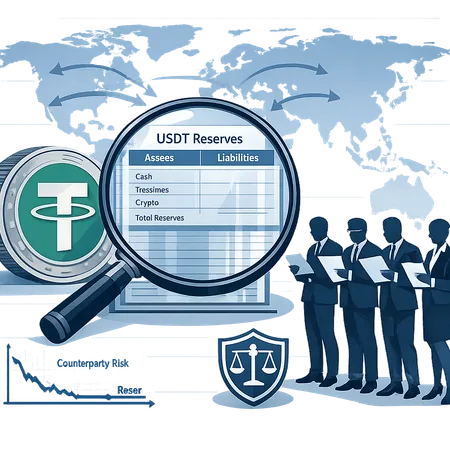
A Big Four audit is not a magic wand. In practice, such an audit would be expected to:
- Verify the composition and existence of USDT reserves, including cash, cash equivalents, and other assets.
- Assess internal controls around custody, reporting, and freeze/unfreeze processes.
- Provide an auditor's opinion under recognized assurance standards, which is significantly stronger than prior attestations from smaller firms.
However, an audit doesn't eliminate operational or legal risks (e.g., jurisdictional asset seizures, sanction-related freezes), nor does it guarantee future behavior. But it does raise the bar for market confidence because global auditor brand and methodology create comparability across issuers.
For more context on the announcement and how it was framed in crypto media, see reporting that Tether signed on a Big Four firm to complete its first independent audit here and the deeper industry analysis here.
Timing matters: regulatory scrutiny and geopolitics
Why now? Three forces converge: rising regulatory attention to stablecoins, geopolitically driven capital flows that stress custody arrangements, and reputational fatigue from past opacity. Regulators globally are accelerating work on stablecoin policy, and auditors themselves have become more cautious about the reputational and legal risks of signing off on opaque liabilities.
At the same time, geopolitics — sanctions regimes, cross-border capital controls, and exchange-level frictions — have turned stablecoins from niche plumbing into systemically relevant instruments for moving value. Recent operational events, such as wallets being frozen in compliance actions, underscore these risks and the direct link between issuer controls and downstream market safety; an example of such an incident involving Circle and Tether-related wallets tied to an Iranian exchange was reported here.
An audit now signals that Tether is positioning itself to meet tougher regulatory expectations and to stabilize its narrative amid these pressures.
How a credible audit could reprice counterparty risk for USDT
Institutional allocators and compliance officers price exposure not just on headline peg stability but on the trustworthiness of the issuer's balance sheet and controls. A Big Four audit can change three pricing channels:
- Perceived reserve reliability: A thorough audit reduces uncertainty about what underpins USDT, narrowing the risk premium required to hold it.
- Liquidity fallback clarity: Verifiable holdings and clear custodian arrangements make stress scenarios easier to model, lowering capital charges in some internal frameworks.
- Legal/operational risk assessment: Auditor reports on controls and transactions help compliance teams quantify the probability of disruptive actions (freezes, seizures), which affects counterparty limits.
Put another way, if a Big Four opinion credibly confirms that a large fraction of USDT is backed by liquid, high-quality assets, many allocators may reduce haircuts and repo margins on USDT while boosting position limits. That said, pricing changes will be incremental and conditional on the audit scope and any subsequent forensic follow-ups.
Will Tether's audit force parity changes across stablecoins like Circle?
A Big Four audit raises the comparability baseline. If USDT receives a high-quality audit, peers will face increased pressure to match both disclosure and assurance. For Circle (USDC) and other issuers, the implications differ:
- Circle has already pursued more transparent reserve reporting and banking relationships; the audit spotlight will ask if those disclosures are at parity in rigor and scope.
- Smaller or less-regulated issuers may face higher funding costs or migration of flows toward audited assets.
- Markets may introduce a two-tiered taxonomy: fully-audited stablecoins versus those with attestations — with corresponding price and liquidity differentials.
In short, parity will be market-driven. If institutions collectively demand Big Four-level assurance as a condition for low-haircut treatment, issuers that don't comply will effectively trade at a discount.
Operational and compliance implications for institutions
For compliance officers and treasury teams, an audit changes the operational checklist in measurable ways:
- Counterparty policies: Update allowable lists and haircuts to reflect audited status and read the audit scope closely to identify excluded assets or jurisdictions.
- Legal opinion needs: Audits don't substitute for legal opinions about custody and enforcement risk; maintain those where exposure is material.
- Stress testing: Re-run stress scenarios with new assumptions about reserve liquidity and access, especially in sanction or bank-run scenarios.
- Monitoring: Add auditor updates and remedial plans to regular counterparty reviews.
Remember: an auditor's opinion is a point-in-time assessment. Continuous monitoring and operational diligence remain essential.
What to watch in the final audit and follow-up signals
Institutional readers should focus on several audit signals when the report is released:
- Scope: Does the engagement cover all reserve categories and counterparties, or are there carve-outs?
- Assertions: Is the opinion a full audit opinion, an attestation, or limited-scope comfort letter?
- Control findings: Material weaknesses or management letter items that suggest governance gaps.
- Third-party confirmations: Presence of bank and custodian confirmations versus internal records.
Beyond the report, observe Tether's willingness to address findings, openness to remediate controls, and the market's reaction in liquidity and funding spreads.
Broader policy and market-structure consequences
If Big Four reporting becomes the expected norm, regulators will likely reference such standards in guidance and enforcement. That could accelerate formal regulatory frameworks where auditability and custody transparency are prerequisites for certain market privileges (e.g., being allowed as cash-equivalent collateral in regulated venues). Conversely, if audits become symbolic without meaningful scope, the market's trust dividend will be limited.
Either way, the trend favors more institutional-friendly infrastructure: clearer counterparty risk models, standardized disclosures, and a less fragmented market between high- and low-quality stablecoins. For those tracking market implications, tools like Bitlet.app that bridge on-ramps and custody for institutions will likely adapt product controls to reflect auditing status.
Practical takeaways for allocators and compliance officers
- Treat a Big Four audit as a material credit event but not a full elimination of risk.
- Review the audit scope and any management letter closely; small carve-outs can carry outsized operational risk.
- Recalibrate haircuts and limits only after modeling liquidity access under stress, not solely on headline audit outcomes.
- Encourage peer issuers to match audit standards — market pressure often moves faster than regulation.
Conclusion
Tether's engagement of a Big Four auditor is a watershed moment for the stablecoin market: it promises a level of assurance that could narrow the counterparty-risk premium for USDT, drive behavioral parity among competing issuers, and inform regulatory expectations. For institutional allocators and compliance officers, the audit should be treated as a critical data point — one that requires careful parsing of scope and follow-up actions — rather than a blanket green light.
Sources
- Tether signed on a Big Four firm to complete its first independent audit: https://bitcoinist.com/tether-engages-big-four-audit-transparency-push/
- Deep-dive framing of the audit as a long-sought milestone and reputational context: https://cryptoslate.com/after-years-of-harsh-treatment-tether-finally-convinces-big-four-firm-to-audit-usdt/
- Report on Circle and Tether wallets linked to an Iranian exchange and related compliance incident: https://www.cryptopolitan.com/zachxbt-circle-tether-wallets-iranian-wallex/
For additional perspective on market dynamics, many allocators still view Bitcoin liquidity and DeFi rails as complementary lenses when assessing stablecoin utility.