XRP’s Next Phase: Agentic Commerce, Escrow Waves, and AI-Driven Market Noise
Summary
Why this matters now
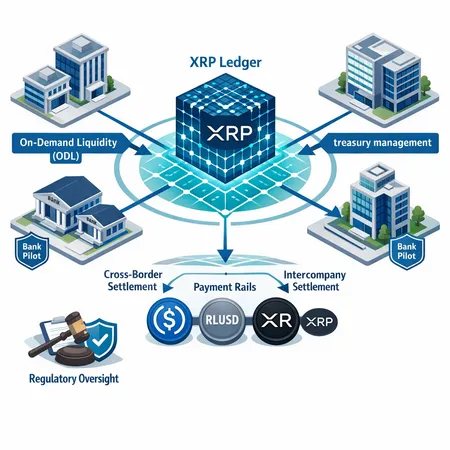
For enterprise product leads and institutional traders, the convergence of agent commerce, programmable escrow on the XRP Ledger (XRPL), and a recurring escrow release schedule is not academic — it changes settlement mechanics, counterparty risk profiles, and short-term liquidity dynamics. Add an uptick in AI-driven market commentary and the result is a more complex operating environment where predictable schedules and unpredictable narratives collide.
Agentic commerce on XRPL: what Virtuals and t54 bring
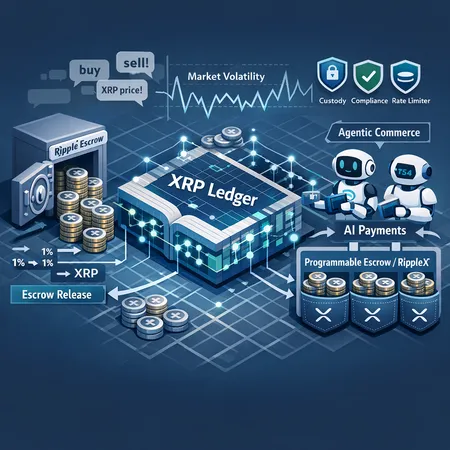
The recent announcements around the Virtuals Protocol and t54 signal a material step toward agent-enabled payments on XRPL. According to coverage of the rollout, Virtuals and t54 aim to enable agents that can hold identities, make decisions, and execute payments or escrowed transfers programmatically on the ledger (Virtuals Protocol and t54 announcement).
At a high level this means two things for settlement systems:
- Agents can initiate conditional flows — e.g., pay on delivery, retry after failed settlement, or distribute proceeds across multiple accounts — without a human in the loop.
- Escrow becomes programmable in richer ways: time-locked transfers, dispute-escrow patterns, or multi-step release logic that an agent can trigger when off-chain conditions are met.
This differs from typical DeFi automations on other chains because XRPL’s focus is native performance, fixed fees, and deterministic finality. For enterprise rails that prioritize throughput and predictable costs, programmable agents on XRPL can compress reconciliation cycles and reduce manual settlement work. At the same time, they introduce new governance and operational risks (agent keys, permissioning, and error-recovery flows).
How agent payments and programmable escrow will likely work in practice
Imagine a supply-chain integration where a buyer’s agent holds payment in escrow on XRPL. When an IoT beacon confirms delivery, a trusted oracle signals the buyer’s agent; the agent validates the proof and releases the escrowed XRP to the seller — all in under a few seconds on XRPL. With t54 and Virtuals, that agent could also reroute funds, split payouts to sub-contractors, or initiate refunds if a dispute hits a certain state.
From a tech stack perspective, expect the following components:
- Agent runtime (Virtuals/t54) with private key management and decision logic
- Escrow contracts or ledger entries that can be programmatically released
- Oracles or webhooks to feed off-chain events
- Audit trails and governance constraints surfaced through RippleX developer tools and standard libraries
Ripple’s monthly 1 billion XRP escrow releases: timing, mechanics, impact
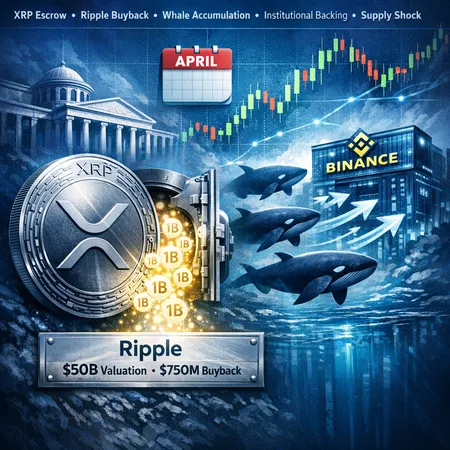
Ripple’s practice of releasing up to 1 billion XRP from escrow each month is well-documented and remains a major supply-side factor to model. Recent reporting reminds market participants that the cadence continues to matter for token supply dynamics and trader psychology (report on monthly 1 billion release).
Two important nuances:
- Release versus circulation: a monthly release from escrow does not equal an immediate one-to-one increase in circulating supply. Ripple typically places a large allocation into the market, but a material portion may be returned to escrow, held by Ripple for corporate treasury needs, or distributed to partners. Historically, on-chain trackers and reporting show net additions to free float that vary considerably month to month.
- Predictability and pricing: scheduled releases are easier to model than one-off unlocks, which reduces some uncertainty. However, the market still reacts to both the release size and the observed flow into exchanges or OTC desks. If the released supply quickly lands on exchanges, price pressure can follow; if it is systematically absorbed by partner OTC desks or used for corporate purposes, impact is muted.
For institutional traders this means stress-testing models across scenarios: full absorption into market, partial absorption, and near-zero circulation after a release. Build P&L and liquidity simulations around each case; treat released-but-not-circulated XRP as a conditional inventory that can materialize into the market if Ripple or counterparties decide to sell.
AI market noise and the amplification of short-term volatility
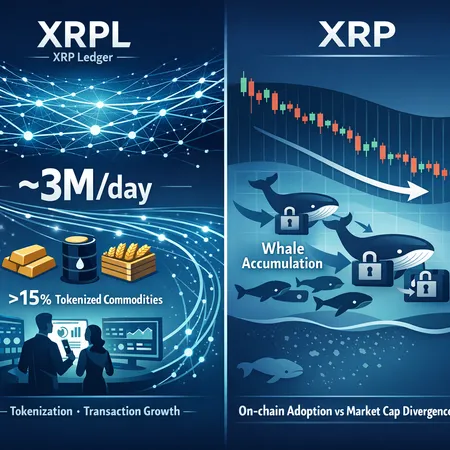
A fresh, less-quantified variable is the proliferation of AI-generated market takes about XRP and its fundamentals. Analysts have flagged how LLM-generated narratives — some shallow, some aggressively bullish or bearish — are increasing noise around XRP price interpretation (analysis on AI-generated market takes). These automated commentaries get amplified on social feeds, where speed often trumps accuracy.
Why this matters to institutions:
- Conflicting LLM takes create signal fragmentation. One model might interpret a release as bearish; another repackages on-chain evidence as bullish momentum. Rapid-fire, contradictory narratives can trigger algorithmic responses from retail bots and momentum engines.
- Liquidity mismatch. Large, but gradual, escrow releases can be misread as immediate supply dumps by noisy models; that misread can cause transient liquidity vacuums and exaggerated spreads.
- Coordination risk. Traders reacting to AI-driven headlines may move faster than reconciliation cycles, widening settlement risk for institutional counterparties.
In short, AI commentary increases the probability of short-term volatility spikes even when fundamental supply changes are modest or predictable.
Practical mitigants for institutional onboarding and risk teams
Institutions evaluating XRPL exposure — whether for settlement rails, custody, or trading — should combine operational controls, trading playbooks, and data hygiene around LLM noise.
Operational and treasury mitigants:
- Escrow-aware treasury policies: track scheduled releases, reconcile daily with on-chain flows, and model the difference between released and circulating XRP.
- Custody and agent controls: require multi-sig and delegated permissions for any agent-enabled operations. Limit agent autonomy with kill-switches and time-limited approvals.
- Counterparty agreements: stipulate restrictions on immediate secondary sales of escrowed XRP and clarify settlement windows for agentic flows.
Market and trading mitigants:
- Liquidity ladders and TWAP/VWAP execution: avoid executing large trades immediately after a release; instead, use discretized execution to minimize impact.
- Hedging and synthetic positions: pre-hedge anticipated supply shock exposures using futures or options where available.
- Dark liquidity and OTC relationships: build deeper OTC corridors to absorb large blocks without feeding exchange order books and AI-driven momentum signals.
Data and signal mitigants for AI noise:
- Curated feedstack: combine vetted on-chain metrics, trusted custodial reports, and a small set of high-quality analyst sources to reduce reliance on raw social/LLM outputs.
- Ensemble signal models: instead of trusting a single LLM or sentiment model, use ensembles with confidence thresholds and manual override gates.
- Narrative monitoring: maintain a rapid response feed that flags high-amplification narratives (viral LLM takes) and pairs them with on-chain evidence so traders can debias decisions.
Finally, operationalize recovery plans for agent errors: if a Virtuals/t54 agent misfires and releases funds improperly, there must be clear legal and technical remediation steps. Institutions should engage early with tool providers, RippleX docs, and custodians to ensure agent flows align with institutional risk tolerances.
Short checklist for product and trading leads
- Map the escrow release calendar into treasury forecasts.
- Require escrow-aware custody architecture and multi-sig for agent operations.
- Design trading schedules around release windows; favor OTC absorption for large flows.
- Deploy curated data sources and ensemble models to filter LLM noise.
- Run scenario stress tests: full dump, partial dump, and zero-circulation outcomes.
Platforms like Bitlet.app can be part of a broader toolset for institutions testing settlement and installment mechanics on XRPL, but integration should follow the same governance and audit standards as any custody or settlement provider.
Conclusion
XRPL’s new wave of programmability — driven by Virtuals and t54 — opens helpful possibilities for automation and faster settlement, particularly for enterprise rails. But programmable escrow combined with Ripple’s steady 1 billion monthly escrow cadence means institutions must treat releases as recurring supply catalysts, not one-off events. Layer on the modern problem of AI-generated market noise and you get a short-term volatility landscape that is more reactive than it was a few years ago. Solid engineering, strict agent controls, disciplined execution, and curated signal stacks are the practical guardrails that will let institutional adopters capture XRPL’s speed and cost advantages without being blindsided by supply shocks or noisy narratives.