Why Dogecoin Was Left Out of Elon Musk’s X Money Beta — Market Impact & Strategies
Summary
Quick recap: the beta announcement and the market blip
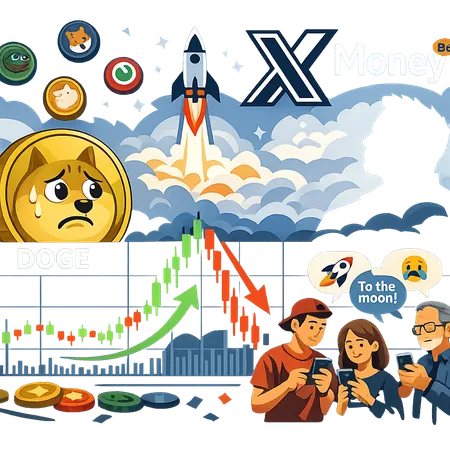
When Elon Musk confirmed early public access for X Money, markets reacted immediately. Social feeds and orderbooks lit up; Dogecoin (DOGE) spiked more than 10% on the headline before pulling back as deeper details emerged about which assets would be supported in the initial beta. Media coverage later reported Dogecoin was left out of the first public beta, a fact that flipped sentiment for a short time and left traders parsing what the announcement actually meant for the memecoin landscape (Finbold report on the spike and reporting that DOGE was not part of the initial public beta rollout is detailed in coverage like Zycrypto's piece).
This episode is a useful case study: a charismatic founder teases a payment product, social speculation drives price moves, and then product constraints and choices reassert themselves. The immediate reaction tells you as much about trader behavior as it does about fundamentals.
Immediate market reaction: spike, squeeze, retrace
The mechanics here are familiar to anyone who has watched memecoin cycles. A high-profile product announcement sparks a liquidity vacuum where retail traders rush to buy on social momentum. Low liquidity in memecoins magnifies the impact — a modest influx of buy orders can push price multiples higher within minutes. That explains the initial >10% move.
What follows is the retrace: as the market digests the fact that DOGE was reportedly excluded, early momentum sellers, bots and short-term arbitrageurs take profits, and price mean-reverts. The net effect is a classic volatility spike: short-lived, headline-driven, and often followed by a cooldown. For active traders, these events can offer quick scalp opportunities but also trap those who buy the peak on hype.
Why Dogecoin may have been excluded from the beta
There are several non-mutually exclusive reasons product teams often omit an asset during an initial roll-out. Understanding these helps separate conspiracy from engineering.
Product design and technical constraints
Product teams prioritize predictable integrations at launch. Many custodial and in-app payment solutions standardize on certain token standards and rails. Dogecoin is a UTXO-based coin with its own address scheme and node/software differences compared with common EVM tokens or chains with mature custodial libraries. Supporting DOGE might require separate node infrastructure, custom signing flows, or intermediary wrapping solutions, which increases complexity and risk for an initial public beta.
Custody and partner choices
If X Money opted to partner with a set of custodians or market makers that do not yet support DOGE, the decision could be logistical rather than ideological. Integration timelines for custody providers vary; some prioritize tokens with on-chain smart contract hooks or predictable RPC behaviors. New products often launch with a curated list of assets to reduce vector risk and supportability headaches.
Regulatory and compliance practicalities
Regulatory risk — real or perceived — also shapes launches. Custodial wallets and public-facing payment services must satisfy KYC/AML, sanction screening, and often choose to restrict assets that create higher compliance burdens. Memecoins can be lumped into higher-risk categories by compliance teams, especially if their provenance, issuance, or trading profile is unusual. That does not mean DOGE is necessarily legally untenable, but it can make teams cautious for a beta.
In short: being left out is plausibly the result of product and custodial trade-offs, not necessarily a deliberate slight. The reporting from industry outlets that Dogecoin was absent from the initial beta squares with those technical and compliance realities (Zycrypto coverage).
What this means for DOGE’s narrative as the premier memecoin
Dogecoin’s brand strength is real — it's arguably the most widely recognized memecoin and a cultural touchstone in crypto. Analysts often point to its name recognition and retail cachet when discussing adoption scenarios (Motley Fool commentary on DOGE and its place among meme coins). But product-driven narratives are powerful. When a mainstream product includes or excludes a coin, the market reads that as a signal about practical utility.
Being omitted from a high-visibility product like X Money can dull the short-term narrative that DOGE is a ready-built payments rail for Musk-built ecosystems. That said, memecoin narratives are resilient: community activity, merchant integrations, tipping use cases and social momentum can reassert DOGE’s primacy. The larger risk is that competitors included in X Money’s launch could capture a tranche of user flows, liquidity and headline attention if they offer smoother on-ramps inside the app.
For context, memecoin status is increasingly about plumbing and partnerships as much as brand. A well-branded coin without accessible custody, bridging or UX will struggle to translate fame into transaction volume.
Trade and community strategies after the X Money rollout
This section is for retail traders and community managers who want actionable plans rather than hot takes.
For retail traders: rules, not hunches
- Treat product-driven headlines as volatility events, not fundamentals. Use smaller position sizes and tighter stop rules around these announcements.
- Avoid buying into the first five-minute spike unless you are a scalper with a clear exit plan. Many of the fastest gains are also the fastest reversals.
- Watch liquidity and spread depth on exchanges and DEXes. Low liquidity increases slippage and execution risk. Consider limit orders rather than market orders.
- Monitor cross-market flows. If X Money drives deposits into custodial partners, watch orderbook imbalances on centralized venues — that’s often where the squeezes materialize.
- Use risk-management tools: set max allocation to memecoins as a percentage of capital, and rebalance after headline events to secure profits.
These are practical, discipline-oriented steps that keep you in the game long term rather than trying to catch every headline.
For community managers and token teams: focus on plumbing and messaging
- Prioritize integrations: start conversations with custody providers and payment rails early. If inclusion in mainstream products matters to your token’s roadmap, document the technical and compliance requirements and build toward them.
- Communicate clearly. When rumors or exclusion stories surface, control the narrative with calm, transparent updates about what you’re doing to enable integrations (bridges, wrapped token contracts, custodial partnerships).
- Build utility that’s independent of any single product. Meme power is great, but parallel use cases—merchant adoption, tipping, NFTs—reduce dependency on any single distribution channel.
- Coordinate AMAs and partnership announcements around product launches to capture attention when it matters.
Bitlet.app and similar platforms show how product availability and user flows can reshape which coins gain mainstream traction; teams that invest in plumbing and clarity are better positioned to convert attention into real usage.
Scenario planning: what to watch next
- Official asset lists from X Money and partner custodians. Inclusion announcements will move markets.
- Custody partnerships and bridging announcements from teams building fast, technical integrations for DOGE.
- Regulatory guidance or compliance notes from big exchanges and wallet providers — these often dictate which assets make it into mainstream wallets.
- Social metrics: a spike in developer activity, new merchant integrations or large transfer patterns on-chain often precede real utility gains.
If you’re a trader or community manager, maintain a short watchlist and threshold rules for action (e.g., “if DOGE is announced for X Money, increase marketing/holdings by X%; if not, focus on liquidity-building partnerships”).
Final takeaways
Product launches from high-profile platforms create real, but often transient, sentiment shifts in memecoin markets. The DOGE spike-and-retrace around the X Money beta announcement is textbook — social-driven buying followed by a correction as technical and compliance realities surface.
Exclusion from an initial beta usually reflects caution and integration constraints rather than a definitive verdict on a coin’s future. For traders, the right response is structured risk management; for communities, the answer is building the technical and partnership infrastructure that turns brand into utility. Keep watch on follow-up announcements, custody partner lists and on-chain indicators — those will tell you whether the early headline was a hiccup or the start of a new chapter.
Sources
- Finbold — Dogecoin price spikes 10% after Elon Musk announces X Money
- Zycrypto — Dogecoin left out as Elon Musk prepares X Money public beta
- The Motley Fool — Better cryptocurrency to buy with $500 and hold for… (context on DOGE’s prominence)
For further reading on asset narratives and market microstructure, check community writeups and on-chain dashboards that track inflows to custodial partners, and see editorial coverage around major product launches such as X Money. For memecoin teams, a tactical focus on custody, wrapping and clear compliance documentation will materially increase the odds of future inclusion.
(Internal reading: articles on Dogecoin and related payment rails in DeFi can help contextualize product-driven shifts.)