Programmable Payment Rails for Autonomous AI Agents: AgentPay SDK and USD1 Across EVM
Summary
Why programmable payment rails matter for autonomous AI agents
Autonomous AI agents—software that plans, executes, and pays for services—need reliable, low‑friction settlement rails. Without native payment primitives, teams stitch together wallets, bridges, and offchain invoices. That creates UX gaps and hides real costs. The AgentPay SDK changes that equation by offering programmable payments and an agent‑held funds model built to operate across EVM chains, using a stable accounting unit called USD1.
The result is an environment where agents can hold pre‑funded balances, invoice other agents or services, and trigger micropayments on demand. For Web3 teams, that means easier monetization of AI functionality and more composable integrations with existing DeFi building blocks. Even market watchers who still point to Bitcoin for macro signals will appreciate how USD1 simplifies microeconomics by decoupling billing from volatile native tokens.
What the AgentPay SDK and USD1 actually do
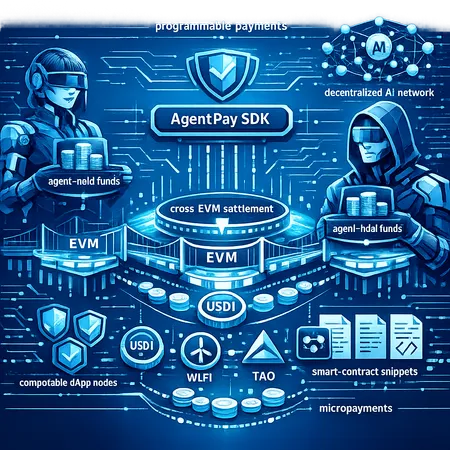
AgentPay’s core proposition is twofold: (1) a developer SDK that exposes programmable payment primitives to autonomous agents, and (2) USD1, a cross‑service stable accounting unit designed for consistent micropayment pricing. According to the AgentPay launch announcement, the SDK provides APIs for creating agent wallets, authorizing spend rules, and executing programmable transfers across EVM chains (AgentPay SDK announcement).
Key developer capabilities include:
- Agent‑held balances: agents can custody USD1 balances and disburse funds under programmatic rules (rate limits, daily caps, delegated spenders).
- Programmable escrow and release: conditional releases tied to onchain events or oracle attestations.
- Micropayment primitives: atomic micropayments, streaming payments, and batched settlements to amortize gas.
- Cross‑EVM routing: settlement flows that can traverse layer‑1s and rollups while keeping the USD1 accounting consistent.
USD1’s utility is simple but powerful: it standardizes pricing (per inference, per API call, per task) so product teams can expose predictable plans without forcing users to manage native token volatility.
Technical architecture: cross‑EVM settlement and composability
At a high level, AgentPay combines several familiar blockchain patterns into a stack optimized for agent workflows: onchain agent wallets, relayer/validator networks for cross‑chain settlement, programmable smart contracts for escrow and billing, and oracles for offchain attestations.
Core components
Agent Wallets & Smart Contracts: Each agent is represented by a wallet or smart account with programmable policies. Smart contracts enforce spend rules and provide onchain receipts for audits.
USD1 Ledger & Pegging Layer: USD1 acts as an accounting layer. Implementations can use onchain USD1 tokens, wrapped USD1 pegged across chains, or offchain accounting reconciled periodically. The SDK abstracts these options so devs can choose a custody/trust model that fits their threat model.
Relayers and Cross‑Chain Routers: For cross‑EVM settlement, relayers bundle and route transactions, batching micropayments and performing swaps or bridging actions as needed. This reduces onchain tx counts and amortizes gas costs.
Oracles & Attestations: When payments depend on offchain events (LLM inference success, data freshness), oracles attest to those events and trigger release conditions in escrow contracts.
Composability Layers: AgentPay exposes hooks so agents can interact with DeFi protocols (liquidity provisioning, automated market makers) or other dApps to convert USD1 into local liquidity or yield.
Settlement patterns and gas friction mitigation
- Batched settlements: Micro‑invoices are aggregated and settled periodically to reduce base‑fee drag.
- Meta‑transactions / gas abstraction: Relayers sponsor gas or enable payers to reimburse gas in USD1 to create a seamless UX.
- State channels / Streaming: For very high frequency microbilling (per‑token LLM billing), streaming payment channels or optimistic state channels can minimize onchain writes.
These patterns create a pipeline where an agent charges USD1 per inference or request, logs the micro‑credit on an internal ledger, and then uses relayers and batching to atomically settle the net position onchain.
Concrete use cases
1) Autonomous agent‑to‑agent payments
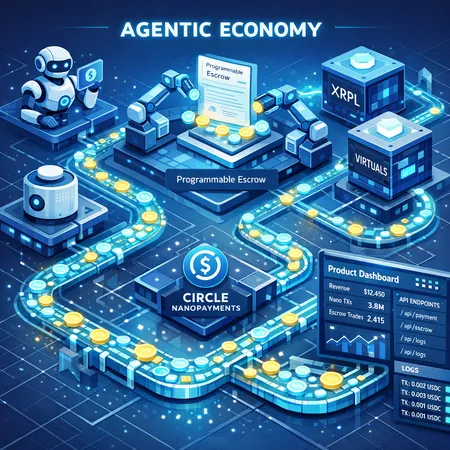
Imagine a research agent that pays a data‑gathering agent for updated datasets. Agent A deposits USD1 into an escrow and issues a conditional payment: release funds when Agent B’s datapack hash is confirmed onchain. AgentPay’s programmable primitives handle the escrow, monitoring, and conditional release without manual invoicing. This enables marketplaces of specialized agents that trade services seamlessly.
2) Onchain LLM inference billing
For teams offering LLM inference as a service, fine‑grained billing matters. Bill per token, per prompt, or per completed subtask. With USD1 and streaming/batched settlements, a product can meter every call and bill in near real time while keeping onchain cost efficient. Oracles can attest to inference outputs or quality scores so payments are tied to verifiable results.
3) Connecting to decentralized AI networks (TAO/Bittensor)
AgentPay isn’t isolated from broader decentralized AI stacks. Decentralized networks like Bittensor (TAO) provide compute and training markets; agents can pay miners/providers directly using programmable rails. Recent market events—such as TAO’s price movement after endorsements—highlight how onchain AI networks create real economic flows that payment rails must support (Bittensor TAO rally). Payments can be routed through USD1 to avoid volatility while still participating in those markets.
Economic and security considerations
Programmable payment rails introduce both opportunity and risk. Below are the primary considerations and suggested mitigations.
Gas friction and UX
Challenge: High per‑tx gas on L1 chains makes per‑request micropayments uneconomic.
Mitigations:
- Employ batching and periodic settlement windows to amortize gas.
- Use layer‑2s and rollups for high‑frequency billing.
- Support meta‑transactions so users aren’t required to hold native gas tokens.
Front‑running and MEV
Challenge: Agents emitting conditional payments or auctions can be targeted by frontrunners or searchers.
Mitigations:
- Use commit‑reveal schemes and time‑locked releases where applicable.
- Route sensitive operations through private mempools or relayer networks.
- Employ threshold signatures and multi‑party computation for high‑value flows.
Oracle manipulation and attestation risk
Challenge: Payments tied to offchain attestation (e.g., inference quality) can be misreported.
Mitigations:
- Use decentralized oracle networks and multi‑source attestations.
- Require cryptographic proofs or verifiable compute receipts when possible.
- Add redundancy: multiple oracles and dispute windows to reduce single‑point manipulation.
Liquidity and token transfer risks
Challenge: Converting USD1 to local chain liquidity may involve bridge and market risks. Large inbound/outbound flows on exchanges can create slippage or liquidation cascades—an example risk surfaced in recent WLFI Binance inflows coverage, where heavy exchange movements can trigger price dislocations or liquidity strain (WLFI Binance inflows). Teams should expect that token transfer events can cascade into settlement delays or unexpected costs.
Mitigations:
- Maintain buffer liquidity and automated rebalancers.
- Route through AMMs with sufficient depth and use TWAP execution for large conversions.
- Monitor exchange flows and set alarms for abnormal onchain transfer concentrations.
Practical mitigations, design patterns and best practices
- Hybrid onchain/offchain accounting: Keep per‑request meters offchain with cryptographic anchoring onchain for audits. Settle net positions onchain periodically.
- Graceful degradation: If oracles are offline, fall back to cached attestation or pause conditional releases until confirmation.
- Fee‑sponsored UX: Let payees reimburse relayers for gas via USD1 or allow temporary sponsored gas to avoid onboarding friction.
- Rate limiting and caps: Program spend limits into agent wallets to prevent runaway costs from compromised agents.
- Audits & continuous fuzz testing: Smart contract auditing plus ongoing simulation of settlement flows under stress conditions.
Adoption steps for dev teams and product leads
- Define monetization primitives: Decide pricing model (per‑call, per‑token, subscription plus overage) and map how USD1 will be used in each plan.
- Prototype with testnets: Integrate the AgentPay SDK in a sandbox, simulate streaming billing, and test cross‑chain settlement patterns.
- Design for gas and liquidity: Choose target chains/rollups and set up relayers with batching logic and liquidity buffers.
- Hardcode safety policies: Add daily caps, kill switches, and multi‑sig governance for large disbursements.
- Integrate oracles: Select decentralized or multi‑oracle providers for any offchain attestation dependencies.
- Security and compliance: Run audits, KYC/AML reviews where necessary, and design privacy protections for user data.
- Iterate on UX: Introduce meta‑tx flows so end users or agents don’t need native gas—test with user cohorts.
KPIs to track success
- Payment success rate: % of attempted microtransactions that eventually settle.
- Cost per inference / unit: Onchain gas plus relayer fees amortized per billable unit.
- Time‑to‑settlement: Average latency from invoice to final onchain settlement.
- Revenue per agent / ARPA: Monetization per active agent over time.
- Liquidity buffer utilization: How often buffers are tapped and rebalanced.
- Fraud / dispute rate: Frequency of contested payments or oracle discrepancies.
Track these alongside product metrics (conversion, retention) to validate that programmable rails are improving monetization without degrading UX.
Conclusion: a pragmatic path forward
AgentPay’s SDK and the USD1 unit lower the barrier to building reliable micropayment systems for autonomous AI agents. The architecture combines agent wallets, relayers, oracles, and cross‑chain routing to deliver programmable payments that are both composable and auditable. But teams must design for gas efficiency, oracle robustness, and liquidity risk—using batching, meta‑transactions, decentralized attestations, and buffers.
For product leads and engineering teams, a staged approach—prototype, integrate, harden, and iterate—works best. Bitlet.app and similar platforms can help teams operationalize onchain monetization without rebuilding settlement primitives from scratch. With careful design and careful KPIs, programmable rails like AgentPay + USD1 can enable a new class of paid AI agent marketplaces and services.
Sources
- AgentPay SDK announcement: https://blockonomi.com/agentpay-sdk-brings-programmable-payment-rails-to-autonomous-ai-agents-through-usd1/
- Bittensor / TAO market context: https://blockonomi.com/bittensor-tao-rallies-15-after-nvidia-ceo-endorses-decentralized-ai-training-model/
- WLFI inflows and token transfer risk: https://invezz.com/news/2026/03/20/wlfi-near-0-09-support-will-binance-inflows-trigger-a-sell-off/?utm_source=snapi